The prediction market outsources its disputed resolutions to an anonymous vote of crypto token holders. Some of those voters have financial incentives that could affect their votes.
Two weeks into the Iran War, President Donald Trump was asked by reporters if he’d spoken to Chinese president Xi Jinping about the conflict. “I have,” Trump said.
Ample evidence, it would seem, for a prediction market asking “Will Trump talk to Xi Jinping in March?” Some $12 million worth of event contracts turned on the question.
For Polymarket, though, the president’s confirmation wasn’t enough. “There is not a consensus of credible reporting that Trump has spoken to Xi in March,” Polymarket declared at the end of the month.
Ultimately, the bets on a Trump-Xi conversation resolved in favor of traders who predicted it wouldn’t happen.
The yes-or-no questions posed by Polymarket don’t always have clear answers, despite the company’s CEO Shayne Coplan once saying that prediction markets are “the most accurate thing we have as mankind right now.”
In the case of Trump-Xi, conflicting signals about a conversation made the resolution difficult. Chinese state media—which frequently reports calls between the two leaders—never confirmed a March discussion.
Polymarket has a process in place for disputed resolutions; in many cases, the prediction market has nothing to do with the result. Instead, an anonymous vote takes place outside of the firm’s platform. To participate, voters buy a cryptocurrency called UMA, which is currently valued at 51 cents a token. They debate how the market should resolve in a dedicated server on Discord, the social-media platform.
Other recent predictions, like whether Israel “invaded” Lebanon last September, have also faced debates over their outcome, requiring UMA-based votes.
Resolutions made by UMA, short for Universal Market Access, have risen in frequency as Polymarket handles more predictions. There were 354 UMA votes tied to Polymarket in March, more than triple the number a year earlier.
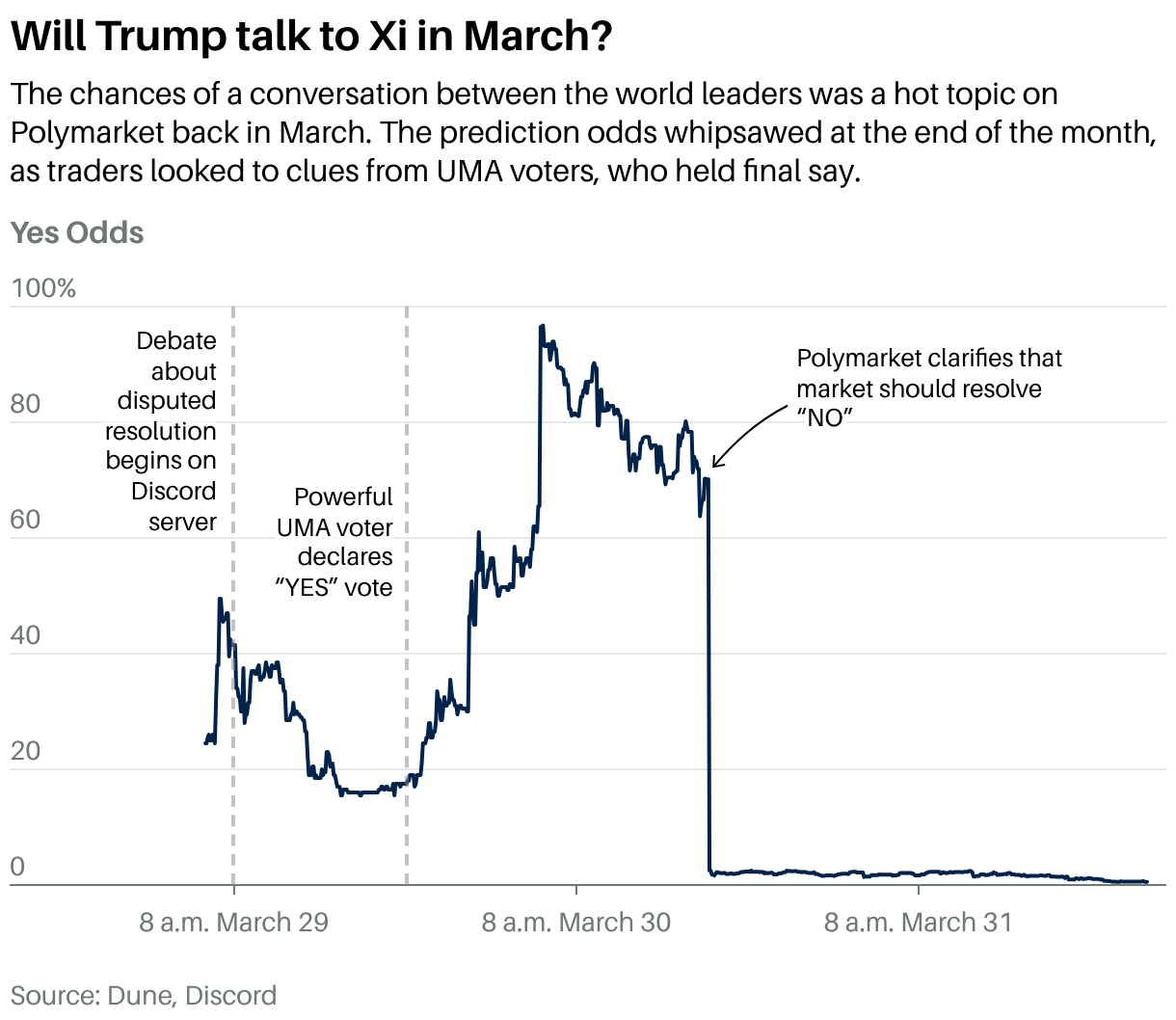
On the evening of March 29, the Polymarket odds of a Trump-Xi conversation began to climb, topping out at a 96.5% chance that, yes, the two leaders had spoken. There was no fresh news of a conversation that moved the market. Instead, the market seemed to move because a UMA voter controlling roughly 10% of the vote announced a “Yes” vote on Discord.
In some cases, Barron’s found that UMA voters have financial incentives that could drive their votes.
Polymarket has a data sharing partnership with Dow Jones, the publisher of Barron’s. Barron’s used only publicly available data for this analysis.
Polymarket’s website says that “UMA token holders are an impartial arbiter” of market outcomes. On the Trump-Xi market, however, two UMA voters also had positions on Polymarket that would pay out if that market resolved to “No.” Both voted for the market to resolve to “No.”
Barron’s separately reviewed a random sample of 50 Polymarket predictions resolved by UMA vote over a recent four-month period; 36 of them included UMA voters that had active bets on the markets they were voting to resolve. In every case, their UMA vote aligned with their prediction-market bet, according to an analysis of public blockchain data. Barron’s used an AI coding tool to query those blockchain data sets.
“UMA’s dispute resolution process is secured through economic incentives,” Polymarket said in a statement to Barron’s. “Voters must stake UMA tokens to participate, and incorrect votes are penalized through slashing, creating strong financial disincentives to vote against a verifiable outcome regardless of any external position a participant may hold.”
UMA founder Hart Lambur said in an email that the potential conflicts weren’t large enough to matter: “These votes didn’t shift the overall vote outcome at all and were meaningless to the final resolution.”
“Over the past 12 months, just 0.21% of Polymarket markets triggered a UMA vote,” the Polymarket statement said. “UMA is designed to create transparent, marketwide accountability around resolutions rather than relying on a single centralized decision maker.”
A UMA vote happens only if a proposed market resolution is disputed twice by UMA holders. At that point, voting opens on UMA’s website, with debate taking place on Discord.
Sometimes Polymarket appears to put its thumb on the scale.
When Polymarket made its public clarification about the Trump-Xi conversation, dozens of UMA voters switched their vote and the market’s odds flipped, eventually resolving “No,” in accordance with Polymarket’s clarification.
In one instance, Polymarket refunded traders when it disagreed with the outcome of the UMA vote.
“We firmly believe that UMA got this resolution wrong,” Polymarket said in an X post at the time. “As Polymarket starts to reach critical mass, our price based forecasts are becoming an indispensable source of information to many. As such, it is crucial that markets resolve to the truth by the best means possible.”
A Polymarket spokesperson says that its newer U.S.-specific platform doesn’t use the UMA resolution process.
On the international platform, which generates the vast majority of Polymarket’s trading, anyone with a UMA token can participate in the process. Voting runs for 48 to 96 hours, according to UMA’s website. Trading on Polymarket continues as this process unfolds, often leading to swings in odds as the debate publicly plays out on Discord.
Voters have an incentive to pick a resolution most aligned with the crowd; voters on the losing side see their UMA stake reduced and distributed to the voters on the winning side.
Similar to shareholder votes, UMA holders are entitled to one vote for every token they hold.
The cryptocurrency trades around $0.51 per token, down 98% from its all-time high of $33.77 in February, 2021, with a market capitalization of roughly $46 million, according to CoinMarketCap.
Polymarket rival Kalshi doesn’t use third-parties for resolution; it maintains final say on all of its markets.
“Since our product is a legal contract, we take great care to pre-emptively avoid dispute resolutions by crafting carefully worded contracts that contain provisions for all possible event scenarios,” a Kalshi spokesperson told Barron’s.
A veteran prediction trader known as Domer says neither firm has nailed down the resolution process.
“There needs to be a lot more transparency about all of this,” says Domer, who has been trading on prediction markets since 2007. “They are building a whole new class of financial instruments, and making it up as they go along can be a way to handle millions of dollars in volume but it’s an incredibly stupid way to handle billions of dollars in volume.”
Write to Nick Devor at nicholas.devor@barrons.com