A carousel of leaders has taken its toll, driving up borrowing costs and dragging down investment.

The public is about to square off with the bond market in Britain, and the country’s politicians are struggling to play both sides.
You can cherry-pick plenty of numbers to sum up the crises in the United Kingdom. Here’s one: The country could soon have its sixth prime minister in seven years. Prime Minister Keir Starmer is on the brink of being turfed out, less than two years after the Labour Party’s landslide general election win.
Even former Prime Minister Tony Blair thinks Starmer is toast, judging by a 5,700-word essay this week in which the Labour grandee argued that the government has failed to prioritize growth.
Brits rooting for change should be careful what they wish for ahead of a crucial local election that will decide Starmer’s future. The carousel of leaders has taken its toll, driving up borrowing costs and dragging down investment. The country’s political class is struggling to keep both the electorate and the market happy.
Starmer’s finance minister, Rachel Reeves, has played nice with investors by sticking to fiscal rules that require the U.K. to balance spending with tax revenue and reduce the debt-to-gross-domestic-product ratio. But that has alienated voters.
The most obvious own-goal came in April 2025 when Labour hiked the National Insurance payroll tax to help balance the books. The higher levy made it more expensive for employers to fund entry-level jobs, a real problem with more than 16% of Brits ages 16 to 24 now unemployed.
Labour suffered a bruising defeat in May’s local and mayoral elections, and users of online prediction exchange Polymarket are pricing in a 73% chance that Starmer will be gone by the end of 2026. (Polymarket has a data-sharing partnership with Dow Jones, the publisher of Barron’s.)
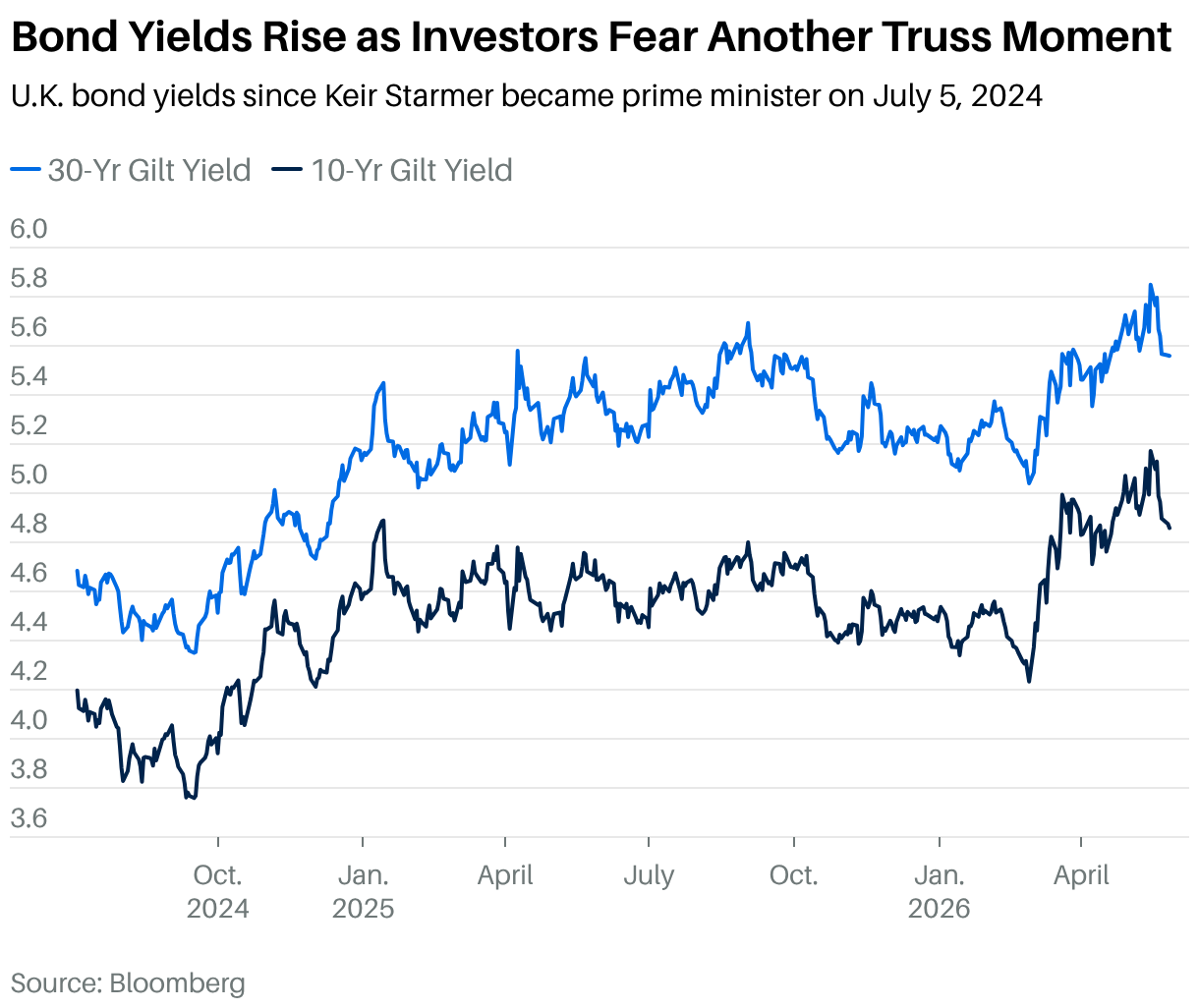
That’s spooking the bond market. The yield on the U.K. 10-year gilt, or government bond, topped 5% in May for its highest level since 2008, and the 30-year yield neared a 21st century record of just under 5.9%.
The City is worried that Starmer will be replaced by a candidate who wants to rip up Reeves’ rules. The front-runner is Manchester Mayor Andy Burnham, who is standing in a June 18 local election for the seat in Parliament he needs to directly challenge Starmer.
Burnham has said the government shouldn’t be “in hock” to the bond market and pledged to borrow to nationalize public utilities. The electorate may support that, but investors won’t. “This trade-off between fiscal consolidation and maintaining popularity is the biggest conundrum,” Oxford Economics’ Edward Allenby tells Barron’s. “What the bond market wants isn’t going to be popular with voters.”
In a nightmare scenario, Burnham’s ascension could trigger another Liz Truss moment, when bond yields surged and the pound cratered after the Conservative prime minister’s disastrous September 2022 mini-budget.
There are ways to revive growth without sparking a market meltdown. The U.K.’s next prime minister must boost investment, which has plummeted over the past decade due to the Brexit vote to leave the European Union, the Covid pandemic, and the constant churn in 10 Downing Street.
London’s flagship FTSE 100 index is up just 65% since June 2016, compared with a 252% gain for the S&P 500 index.
It isn’t just Burnham who will struggle to encourage investment. Another potential candidate, former health minister Wes Streeting, supports hiking the capital-gains tax. That would make Brits more reluctant to dip into their pockets to buy stocks, even though there’s plenty of dry powder—the household savings ratio stood at 9.9% in the fourth quarter of 2025.
“There are things that could be unleashed with the right set of policies,” says ADM Investor Services International’s Chief Economist Marc Ostwald. “But I’m not convinced that any of the Labour candidates is going to address the key issues.”
This leadership crisis is happening about a decade after the Brexit referendum. Today, the U.K. faces even tougher questions—and the politicians battling to succeed Starmer don’t appear to have the answers.
Write to George Glover at george.glover@dowjones.com