The company plans to split in two later this month. Both entities are worth owning.
Investors are creatures of habit. They look to find situations that have worked in the past, buy in, and hope history repeats itself. One such situation is staring them in the face right now. Honeywell International circa 2026 can be like General Electric circa 2024.
The GE breakup made investors hundreds of billions of dollars. Things might not go quite that well for Honeywell, but the spinoff is from the same playbook. Honeywell will create two companies, one dedicated to aerospace and the other to automation. (A third, Solstice Advanced Materials, was already spun off in October). Both companies deserve better valuations than Honeywell currently gets. It’s easy to see Honeywell shares trading for a split-adjusted $290 within a year, up 40% from Wednesday’s close of $205.88.
“This is one of the more important industrial separations, not because it is dramatic, but because it makes sense,” says The Edge research founder Jim Osman. “GE was a cleanup. Honeywell is a clarity trade. This is not a distressed breakup. It is a valuation breakup.”
LIVE Q&A
Our next live Q&A is coming up! Watch our reporters discuss recent stock picks, provide their input on the current market environment—and take your questions.
The aerospace company, Honeywell Aerospace, will trade under the stock symbol HONA. The remaining business will be Honeywell Technologies, and it will keep the HON stock ticker. The split takes effect June 29. The aerospace business held an investor event on June 3 in Arizona. The automation technology business will hold its analyst event in New York June 11.
Investors can wait until the split is done on June 30 to buy their favorite portion. It also makes sense to buy now and end up with two stocks. That’s two potential ways to win.
No one saw GE Vernova outperforming GE Aerospace over the past two-plus years. GE Aerospace is up 84% since the April 2024 spin, 42 percentage points better than the S&P 500. GE Vernova stock, however, is up more than 550%, boosted by strong business execution and rising demand for power driven by the artificial-intelligence data center building boom.
GE’s aerospace franchise was called the crown jewel of the old GE, which is how Stephanie Link, Hightower’s chief investment strategist, describes Honeywell’s aerospace franchise today.
Honeywell’s aerospace business makes aircraft electronics (avionics), thermal management and motion-control hardware, and power systems. More than 47,000 Honeywell auxiliary power units are in service.
The business generated 2025 sales of $17.4 billion, up 12% on a comparable basis year over year, with operating profit margins of almost 25%. All those numbers are solid. The average operating profit margin for an aerospace and defense company in the Russell 1000 is closer to 17%.
Operating profit is expected to exceed $6.5 billion by 2030, growing about 8% a year, on average. That growth might prove conservative. GE Aerospace is expected to grow operating profit closer to 11% a year.
If Honeywell’s profit growth can approach GE’s, its valuation multiple should expand. GE Aerospace trades for about 40 times earnings expected over the coming 12 months. Honeywell stock trades for about 19 times.
Attractive, but that’s if business execution improves. Jefferies analyst Sheila Kahyaoglu says Honeywell’s performance has lagged behind supplier expectations recently, based on conversations with Honeywell customers.
The company is addressing its supply-chain issues, recently hiring a chief supply-chain officer, Katherine Worthen, points out Capital Alpha Partners analyst Byron Callan. She comes from the auto industry. The “intent is to work closer with suppliers to identify chokepoints, smooth schedule issues,” adds Callan. “Whether this becomes a competitive advantage and not just a way to reduce working capital remains to be seen.”
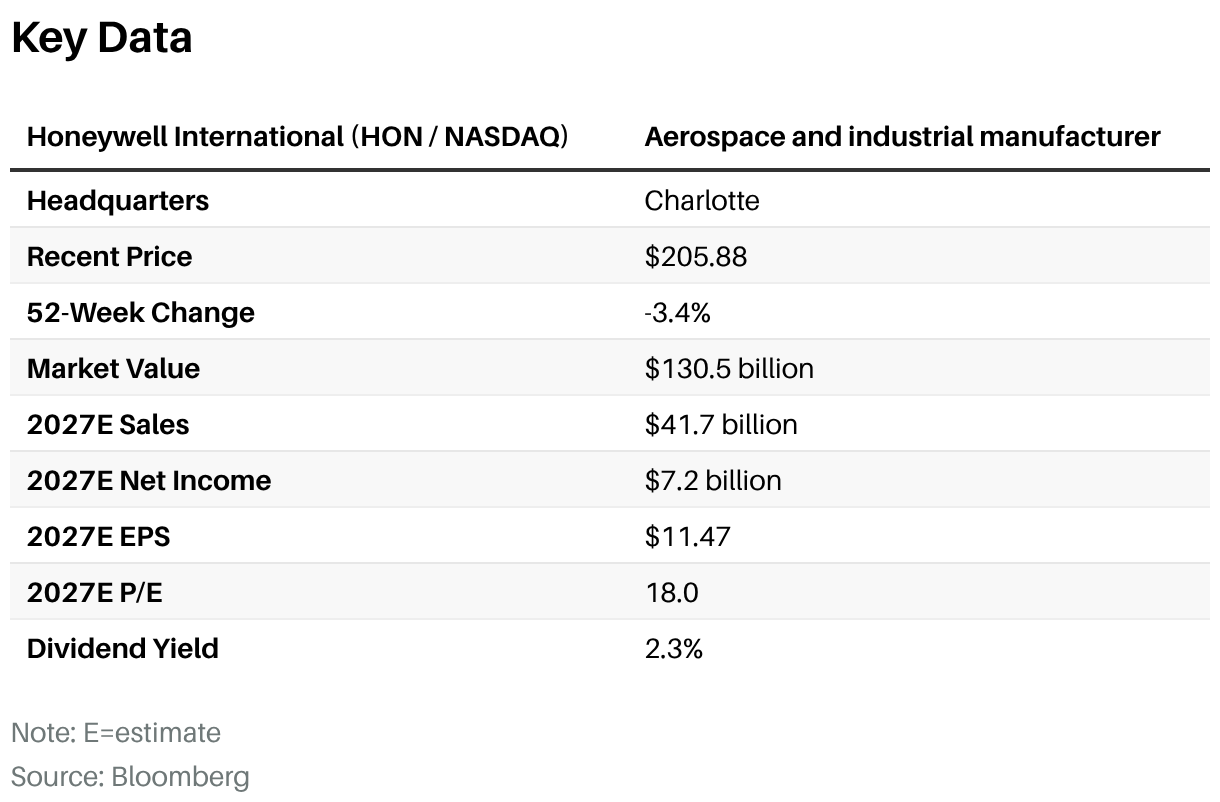
There is work to be done, but even if Honeywell Aerospace were to trade at the low end of its peer group, the business would be worth $120 billion, supporting a share price of about $310 after adjusting for debt. Honeywell shareholders will get one share of the aerospace business for each two Honeywell shares held. On the pre-split share count, the aerospace business would be worth about $155.
Honeywell Technologies will keep the building, process, and industrial automation businesses. Honeywell software and hardware help control some 10 million buildings worldwide; its process automation business provides critical materials to the energy sector; and its industrial products keep manufacturing facilities safe and productive.
If Honeywell Technologies were fully independent in 2026, it would have expected sales of $19.9 billion to $20.2 billion and earnings per share of $3.95 to $4.15, according to the company.
The industrial economy is just starting to grow again, after a brutal three-plus-year post-Covid recession. Goldman Sachs analyst Joe Ritchie believes Honeywell’s automation business could be worth about $85 billion, or about $125 a share, adjusting for debt.
That would also value the automation business at close to 30 times estimated 2026 earnings, placing it in the middle of Honeywell’s peer group, which includes companies such as Rockwell Automation, Trane Technologies, and Siemens.
Like the potential aerospace multiple, it is also higher than Honeywell stock currently trades. Just like aerospace, Honeywell Technologies will have to earn investors’ trust. That looks possible. “Expectations are relatively low heading into the Honeywell Technologies’ Investor Day,” says BNP Paribas analyst Andrew Buscaglia. He expects the company to target low-double-digit earnings-per-share growth over the next several years, similar to, say, Rockwell Automation, and higher than what is baked into Honeywell stock at these levels.
All together, the valuations imply a Honeywell stock price of $290, adding in roughly $10 a share for the company’s stake in quantum computing start-up Quantinuum.
To be sure, Honeywell’s new management teams need to execute. To a large extent, the fate of the stock is in their hands, which isn’t a bad thing, considering the macroeconomic headwinds and geopolitical tensions facing all stocks. And if management stumbles out of the gate, shares trade at a discount to the S&P 500, which offers investors a floor.
THE TECHNICAL VIEW
The industrial name trades 14% below its 52-week high after briefly clearing a double-bottom pivot at $236.55 on May 29, only to reverse course. Now riding a five-session losing streak, the stock closed below its 200-day simple moving average on June 5, signaling near-term pressure. A move toward the round $200 level, about 6% lower from here, appears likely. That would retest the prior breakout zone from an inverse head-and-shoulders pattern during the first week of 2026. Look for the stock to trade toward $250 by year end, a 17% gain from current prices. Remain bullish above $193. —Doug Busch
THE QUANTITATIVE VIEW
HON presents a mixed profile with strong profitability, quality persistence, and large-cap stability offset by weaker momentum, revisions, and growth characteristics. The company benefits from solid operating quality and lower volatility, though recent Barron’s ranking deterioration suggests investor sentiment and earnings expectations remain under pressure. Hold/selective accumulation for long-term industrial exposure; watch for more attractive on valuation improvement or evidence of accelerating earnings revisions. The stock is aligned with the current macro environment. Watch for earnings revisions, demand trends across industrial markets, margin sustainability, and whether price momentum stabilizes following recent underperformance.
—Vestmo (explanation of methodology here)