Infrastructure can be both a growth and value play, while outpacing inflation.
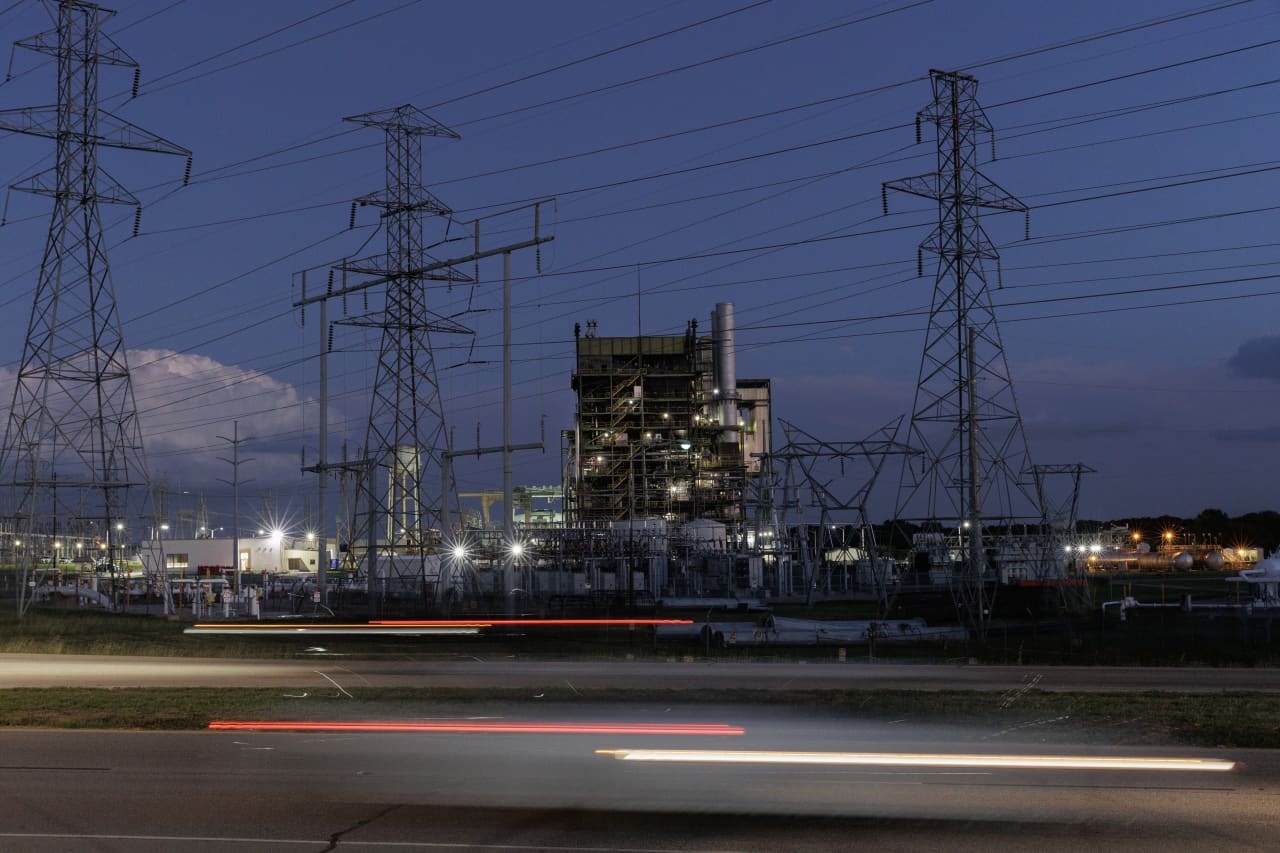
Infrastructure investing is a hot topic, with data-center buildouts dominating the discussion. But focusing solely on data centers overlooks the broader opportunities in the theme.
The huge capital expenditures in artificial intelligence that are powering the data-center boom are flowing through to the adjacent infrastructure sectors of energy or utilities. Funds focusing on those projects are well worth a look. And some promising funds are investing farther afield—in transportation, water, and more.
U.S. infrastructure investing kicked off under President Joe Biden’s administration, with the $1.2 trillion Infrastructure Investment and Jobs Act. Some of that spending was rescinded by the Trump administration, but private capital is pouring in, says Jay Jacobs, U.S. head of equity exchange-traded funds at BlackRock.
“At the federal level, it’s difficult to continue to produce trillion-dollar bills to support infrastructure, so a lot of it is coming through private investment,” he says.
That’s backed up by a 2025 report from McKinsey, which says a cumulative $106 trillion in investments is needed to meet global infrastructure requirements through 2040, both in upgrading traditional core assets, but also for emerging demand for charging stations, fiberoptic networks, and more.
Jacobs says infrastructure is a unique asset class, having both demand growth and defensive properties. It tends to pay above-average yields, since much of the cash flow is multiyear and inflation-linked.
For Matt Farrell, deputy chief investment officer of WE Family Offices, infrastructure is a long-term holding with some inflation protection. Diversification matters because there is political, regulatory, and geographic risk. “You can mitigate that overarching risk by being in fundamentally different asset classes that are exposed to different dynamics,” he says.
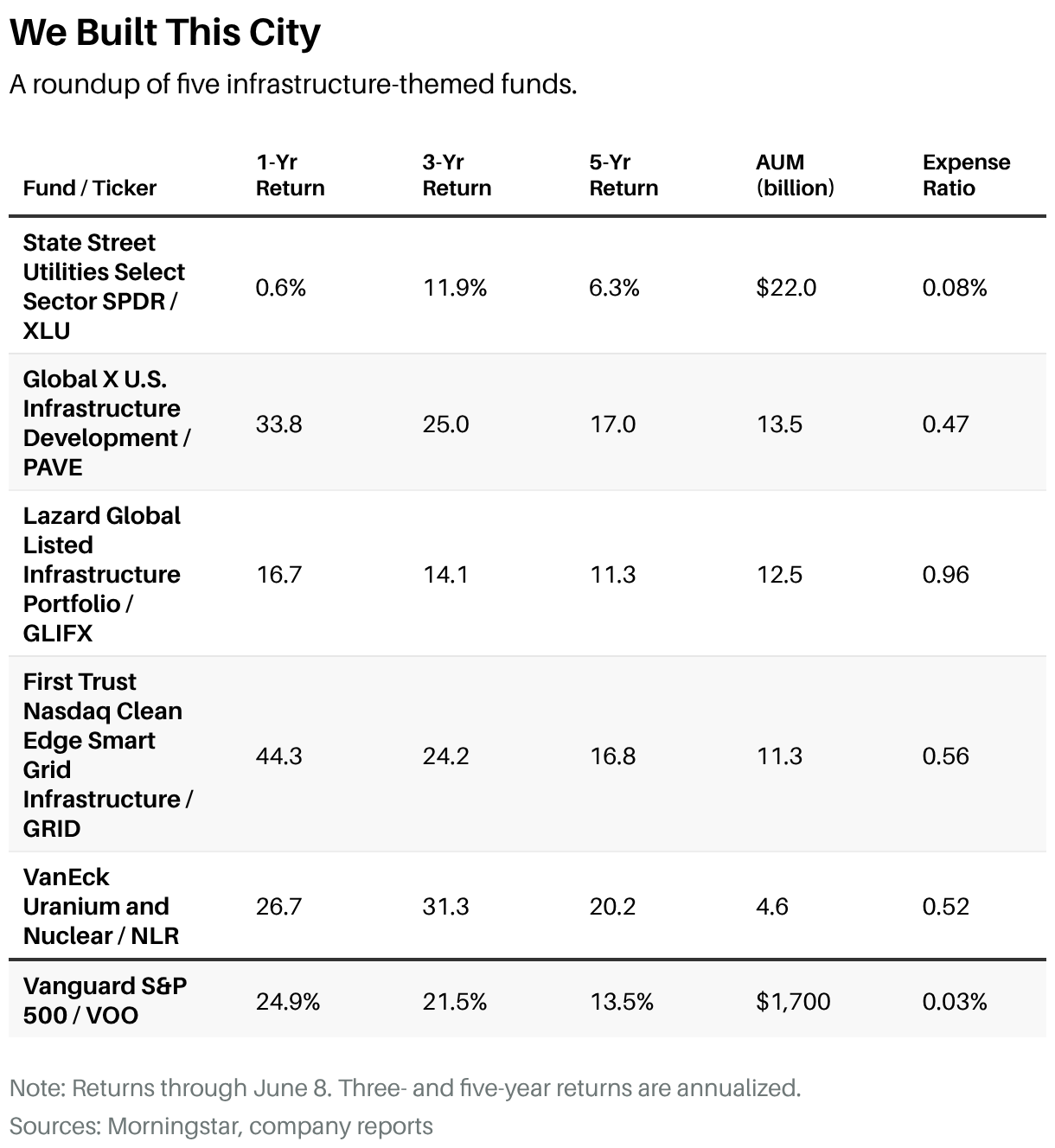
Farrell invests in both public and private infrastructure. Among his public-market holdings is the $12.5 billion Lazard Global Listed Infrastructure mutual fund, a high-conviction fund with 34 names and a value tilt, owning utilities, cellphone towers, and railroads.
Farrell eschews owning data centers, preferring AI-adjacent exposure through power generation, reasoning that markets underappreciate data centers’ high risk for technology obsolescence. Building costs are massive and the structures are bespoke, and after their 10-year leases end, clients can choose not to re-up.
Financial advisors who prefer to own power generation say demand for electricity will grow even if AI spending slows. New investors can start with broad exposure with the $22 billion State Street Utilities Select Sector SPDR or go more niche with an ETF such as the $4.6 billion VanEck Uranium and Nuclear as that industry continues its renaissance.
Derek Miser, chief managing member at Miser Wealth Partners, is normally a stockpicker, but uses specialized ETFs like the VanEck one. “It’s a subcategory where we’re not quite sure who the winners are going to be, [so] I’d rather trust the [management] teams that are closer to that,” he says.
Investors interested in the “rebuild America infrastructure” theme with reduced exposure to AI can look at the $13.5 billion Global X U.S. Infrastructure Development and $4.1 billion iShares U.S. Infrastructure, says Dan Payne, chief investment officer at SlateStone Wealth. These ETFs mostly own the companies providing the materials, products and know-how to build, along with the asset owners and operators.
The global infrastructure buildout is an opportunity to create more resilient and sustainable structures that can adapt to climate change, point out several advisors.
Alex Papadopoulos, president of Egea SRI, says renewable energy has become profitable and globally mainstream in the past three years. In addition to owning two well-known clean-energy ETFs, the $3 billion iShares Global Clean Energy and $2.3 billion Invesco Solar, he also owns the $11.3 billion First Trust Nasdaq Clean Edge Smart Grid Infrastructure ETF and the $1.9 billion Global X Lithium and Battery Tech ETF.
Peter Krull, director of sustainable investing at Earth Equity Advisors, also likes the First Trust ETF, which is focused on the electric grid and grid infrastructure both in the U.S. and globally. The ETF aligns with growth opportunities around building grid resilience, he says, citing a recent J.P. Morgan research report highlighted how hardware and software can be knitted together to constructing an electrical network that will meet future demands and reduce vulnerabilities.
Both Papadopoulos and Krull say falling costs and improvements in battery technology and storage are making it cheaper and easier to power the electric grid with renewable energy. More utility-scale batteries mean the grid can run on stored juice when the sun or wind aren’t available.
Climate resilience is a reason why Krull owns the $513 million Vert Global Sustainable Real Estate ETF. The fund holds real estate investment trusts with a lower carbon footprint and are less susceptible to climate risks such as sea-level rise, floods, and storms.
Like some AI-tech companies, some green infrastructure ETFs are up sharply on a one-year basis, but Krull thinks infrastructure is a better value for new money. “If I had a $1,000 and had a choice between putting it into tech and putting it into infrastructure, the vast majority of it is going into infrastructure,” he says.
Water infrastructure is an underappreciated asset, and AI is using much of it. Garvin Jarbusch, chief investment officer at Green Alpha Advisors, says companies that don’t recognize water cost have a structural blind spot. Just as the rise of AI uncovered power infrastructure issues, climate change and water scarcity could change the economics around water risk.
There are two ways to look at water risk he says, de-risking or seeking companies focused on water efficiency. Renewable energy uses little water compared with fossil fuels, he says, noting the U.S. Geological Survey flags thermoelectric power as the biggest water hog. Agriculture is a close second.
Several companies are focused on water efficiency, including in agriculture. The $2 billion Invesco Water Resources ETF’s underlying index is designed to own companies that create products to conserve water, owning names such as irrigation systems companies Valmont Industries and Xylem, and metering companies Itron and Badger Meter.
Write to editors@barrons.com