
Michael Saylor’s Strategy Inc. resumed buying Bitcoin a week after a rare token sale by the digital asset treasury company roiled the crypto market.
The company bought 1,550 Bitcoin for an aggregate price of about $101.3 million, according to a filing Monday. The purchase follows one of the most turbulent weeks for Bitcoin this year, a selloff that briefly drove the largest cryptocurrency below $60,000 and erased roughly half its value from last year’s peak. The decline was fueled by heavy outflows from Bitcoin exchange-traded funds and growing concerns about the durability of the digital-asset treasury model pioneered by Saylor that has become one of the market’s largest sources of demand.
Strategy found itself at the center of those concerns. Last week, the company disclosed it had sold 32 Bitcoin, its first sale since 2022. The amount was negligible relative to holdings worth more than $53 billion, but the symbolism was significant. For years, Saylor built Strategy around a simple premise: raise capital to buy Bitcoin and do not sell it. The disclosure challenged that narrative and helped deepen a rout that sent the crypto world shuddering.
“The recent sale did raise some alarm,” said Brian Dobson, a managing director at Clear Street, which is among the group of firms that sells securities for Strategy to fund the buying. “But today’s purchase should assuage those concerns. I would see this as a positive signal and a public illustration of confidence from one of Bitcoin’s top investors.”
32?
— Michael Saylor (@saylor) June 7, 2026
Strategy funded the purchases in the seven days ended June 7 thought the sale of common stock. The company also increased its reserve by $100 million to $1 billion.
Bitcoin rose as much as 3.8% to $64,198, while shares of Strategy rose as much as 7%. The stock is down around 65% in the past year.
The latest purchase suggests Strategy remains committed to the business model that has transformed it into the world’s largest corporate holder of Bitcoin. More importantly, it signals the company is still pursuing growth in Bitcoin holdings on a per-share basis, a metric Saylor has increasingly emphasized as the firm’s preferred measure of performance.
“Shareholders expect dilution so long as it is accompanied by a net increase in Bitcoin per share.” Dobson said. “The company’s common stock remains an important vehicle for acquiring Bitcoin.”
Yet the purchase does little to resolve a broader stress that has emerged around Strategy’s increasingly complex financing model. What began as a straightforward wager on Bitcoin has evolved into a capital structure that includes common stock, convertible securities and preferred shares paying double-digit cash dividends. That structure worked smoothly when Bitcoin was rising and investors were eager to finance ever-larger purchases. The model becomes harder to sustain when the cryptocurrency falls, the stock price declines and preferred securities trade below their intended value at the same time.
Investors have become particularly focused on STRC, the preferred share vehicle that has become a key source of funding for Strategy’s Bitcoin acquisitions. The security recently traded below its $100 par value, raising questions about how efficiently the company can continue issuing new shares to fund additional purchases. Critics have also pointed to the growing cash obligations tied to Strategy’s preferred securities, arguing that a prolonged downturn could eventually force difficult choices between supporting investors, preserving liquidity and continuing to buy Bitcoin.
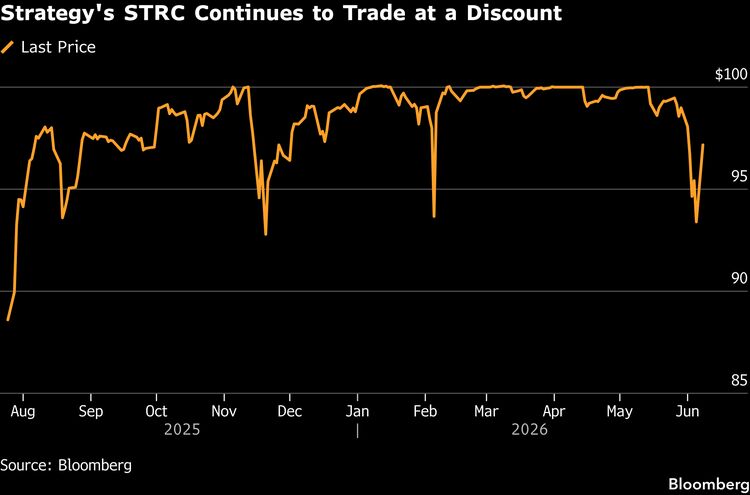
Shareholders also approved a proposal to pay the STRC dividend twice a month, a move sought by Strategy to keep the price stable at par. The preferred shares were trading at around 97 cents.
For now, Strategy’s latest purchase may help stabilize sentiment after last week’s shock dislocate of a sale. But the larger question confronting investors is no longer whether Saylor wants to buy more Bitcoin. It is whether the financing machine that enabled those purchases can continue operating if the crypto bear market endures.