Treasuries rose as falling oil prices overshadowed middling demand at the first of three longer-term US debt auctions this week.
The advance on Tuesday trimmed yields by three to four basis points across maturities. The dip largely tracked the decline in US benchmark West Texas Intermediate crude oil futures, which fell as much as 5.9% and closed down 3.4%.
“Treasuries are benefiting from short-covering with lower oil prices and some expectations of a mild core inflation print” on Wednesday, said Monty Gandhi, an interest-rate strategist at SMBC Group.
The advance was sustained despite signs of escalating conflict in the Middle East as President Donald Trump blamed Iran for shooting down an American military helicopter off Oman and said the US had to respond to the attack.
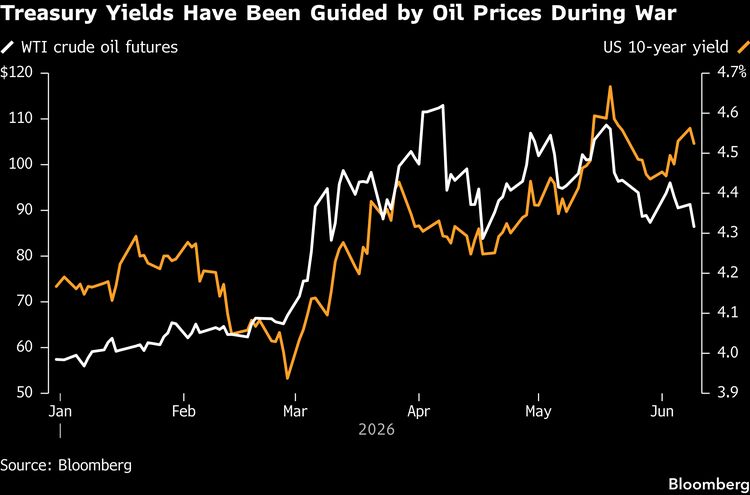
Oil’s retreat from multi-year highs reached in April has eased some concern that US inflation will remain elevated over the longer term, potentially inducing the Federal Reserve to raise interest rates. A key gauge of price pressures scheduled to be released Wednesday is expected to show further acceleration from the highest levels since 2023.
The consumer price index in April rose 3.8% from a year earlier, 2.8% excluding food and energy, the so-called core rate. Rates of 4.2% and 2.9% are seen for May, the median estimates in a Bloomberg survey of economists.
While oil prices since late February have mainly been guided by developments in the US war on Iran, which has curtailed Middle East supply, Tuesday’s drop was sparked by data showing that the surge in prices eroded Chinese demand in May.
Auction Demand
The $58 billion auction of new three-year notes was awarded at 4.192%, slightly above their yield in pre-auction trading at the 1 p.m. bidding deadline, a sign that demand fell short of expectations. It was the highest-yielding three-year note auction since February 2025.
The result suggests that Treasury yields may need to rise further to compensate investors for the risk of Fed interest-rate hikes over the coming year. Yields have risen this month amid signs of US economic resilience, particularly in the labor market, where data released Friday showed that May job creation topped all economist estimates.
Traders responded by fully pricing in a quarter-point Fed rate increase by year-end, and more than half of an additional increase by mid-2027.
This week’s auction cycle also includes reopenings over the next two days of the 10-year note and 30-year bond sold last month as new issues. The $39 billion 10-year has an indicated yield of about 4.53% vs 4.47% in last month’s sale, while the $22 billion 30-year trades around 5.01% after drawing 5.046% last month.
The improvement in the 30-year reflects expectations that Fed rate increases will keep inflation from accelerating.