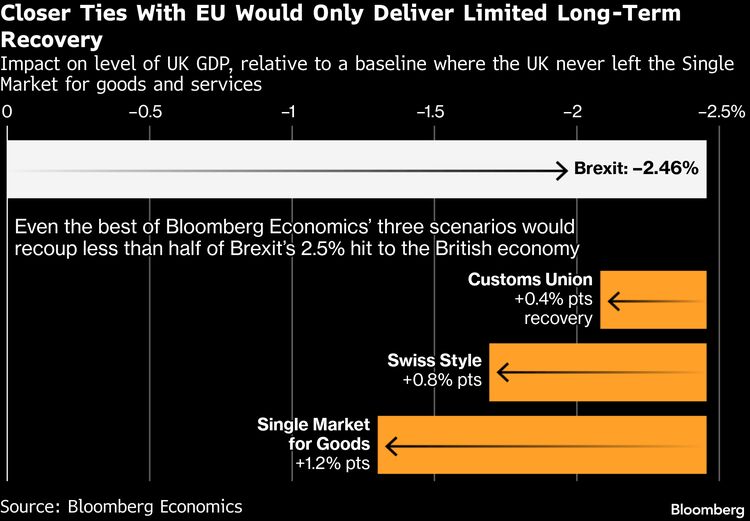
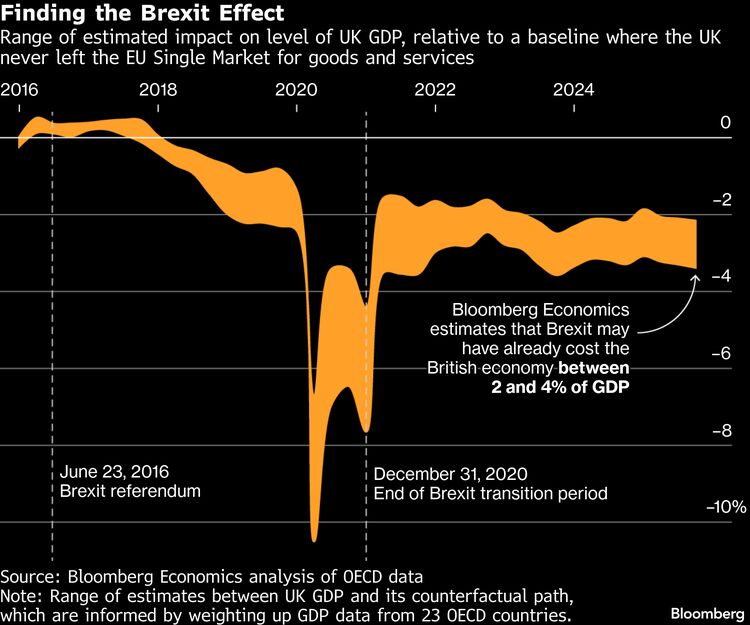
Leaving the European Union has cost the UK 2% to 4% of forgone economic output but almost half can be recovered by improving trade with the bloc, according to analysis by Bloomberg Economics for the 10-year anniversary of the Brexit referendum.
Its estimate of the damage is slightly lower than the Bank of England’s 3.5% of GDP and the 4% used by the Office for Budget Responsibility. Even so, the consequence of Brexit has been “significant and negative,” the report’s authors write.
“The economy is smaller compared to a world where it remained part of the bloc.” In terms of tax, Brexit has cost the Treasury roughly £30 billion ($40 billion) a year, using Bloomberg Economics’ 2.5% of GDP central estimate of the long-term harm.
The decade-old debate has been revived by a change in the politics of Brexit, with a majority of the public now in favor of rejoining the EU, according to the latest polling. Prime Minister Keir Starmer is seeking closer ties and several senior Labour Party figures have made a case for rejoining eventually.
Bloomberg Economics used a variety of models to calculate its central estimate of the cost to date. It found the damage was far smaller than the 6% to 8% of GDP hit set out in a recent and widely read National Bureau of Economic Research paper .
Using a “doppelganger” model like the NBER to build an alternative growth path assuming the UK had remained in the EU, Bloomberg Economics said the damage would be 9.6%.
However, it said the estimate is misleading because the NBER doppelganger includes Ireland, where growth has averaged 7% a year since the 2016 referendum thanks to its low-tax strategy, and is heavily weighted to the US, which unlike the UK “wasn’t hit by an energy shock in 2022, has benefited from significant fiscal stimulus and is seeing the benefits of AI investment.”
Stripping out Ireland reduces the hit to about 6% and adjusting the US growth trajectory to reflect pre-2016 levels of outperformance lowers the impact further to 3.4%. Alternatively, using the World Trade Organization’s Global Trade Model , capturing the impact of higher trade barriers, points to a 2.5% long-term hit, Bloomberg Economics said.
The authors also modelled three options for a change in the relationship to improve future terms of trade with the EU.
1) Customs Union: +0.4 percentage point
Several members of the Labour government have called for the UK to rejoin the customs union, despite it being a manifesto red line. Doing so would remove some border frictions for goods but require the UK adopt EU tariffs and scrap existing trade deals with the likes of India, the US and the Gulf states. The deal would not include services.
Pros:
End rules of origin checks for UK exporters, reducing administrative costs. Does not require UK to adopt EU principle of free movement of labor.
Cons:
Relatively small net gain of 0.4 percentage point. Loss of sovereignty over trade deals and tariffs. Border checks and paperwork still required as the UK remains outside the single market.
2) Swiss-style deal: +0.8 percentage point
A “cherry-picker’s” charter, as some would describe it, as the UK would sign a series of bilateral trade deals with the EU in return for single market access in those specific areas. This could go beyond goods trade to include mutual recognition of professional standards to allow services like architecture to work more easily within the bloc.
Pros: Deep access to the single market in the chosen areas. Reduces tariff and non-tariff barriers, removing all border frictions and administrative costs in those areas.
Cons: UK would have to adopt EU rules for the selected deals, with little freedom to diverge. Reduced legal sovereignty as UK would be subject to some European Court of Justice rulings. Building the deals could take many years, as it has for Switzerland. It is possible the EU would grant limited single market access without asking for full free movement of labor but the Swiss have accepted free movement.
3) Single Market for Goods: +1.2 percentage points
A bespoke deal for the UK that would give it access to the single market for goods alone. According to reports, British and EU officials have discussed the proposal.
Pros: Biggest economic boost of all plausible options. Deep access to the single market in chosen areas. Reduces tariff and non-tariff barriers, removing all border frictions and administrative costs. Quicker and easier to complete than Swiss-style sector-by-sector negotiations.
Cons: Talks with the EU foundered on the strict requirement for free movement of labor. Loss of sovereignty over goods regulation and trade deals.