Banks with exposure to heavily-indebted broadband providers are selling their loans to distressed debt funds at a discount, a sign of their increasing weariness with the cash-strapped sector.
In recent weeks, London-based FitzWalter Capital bought around half the bank debt of Germany’s DNS:Net, with lenders heading for the exit after owner 3i Infrastructure ruled out injecting further funds. The private equity group wrote down its stake to zero when the firm’s plan for rolling out cable for fiber-optic broadband faltered.
There have been a number of similar deals involving so-called altnets, smaller firms that aim to challenge incumbents like Deutsche Telekom AG and BT Group Plc.
FitzWalter also took over UK firm G.Network through an administration after buying positions in the group’s debt and equity. One bank to Deutsche Glasfaser, a major German altnet, sold roughly €350 million ($404 million) of loans to Victor Khosla’s Strategic Value Partners in the midst of a €7 billion debt restructuring.
The entrance of distressed debt funds into what is typically bank-dominated infrastructure financing highlights the lengths some lenders are prepared to go to slash exposure to the troubled industry.
Debt trades are typically limited by tough restrictions and banks’ unwillingness to crystallize losses. However, with many lenders involved in several fiber companies that have fallen short on ambitious rollout plans, some are taking the decision to get out.
There could be more painful steps ahead. Altnets borrowed big to fund the expensive work of digging up roads and laying down cables, leaving poor performers with huge loans to shoulder. About 65% of European fiber companies need to refinance in the next two years, according to a survey by AlixPartners.
They were at one point awash with cash, attracting around €85 billion in debt financing alone from 2021 to 2024, figures from industry body FTTH Council Europe show.
Private equity sponsors including EQT AB and Goldman Sachs Asset Management, and banks from NatWest Group to Societe Generale SA, saw a surefire bet given government backing for improved connectivity and trends in homeworking after the pandemic.
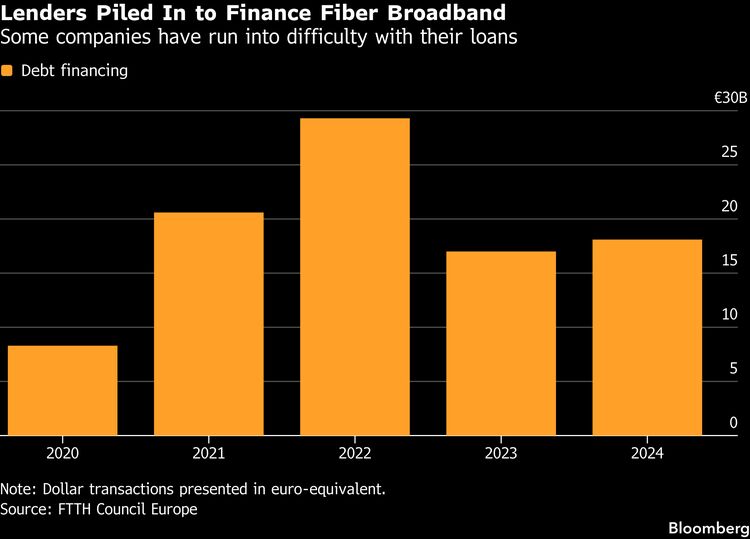
But money has become more scarce as higher inflation and financing costs undermine debt-fueled business plans. Some have emerged from the ructions fairly unscathed, given different regulatory regimes and building requirements, but the intensely competitive markets in Germany and the UK have led to problems that have inflicted heavy losses on investors.
“There’s an injection of reality that has now landed quite heavily into the market,” said Stuart Cockburn , a partner at AlixPartners in London.
Land Grabs
The altnet idea seemed simple: Finance the fastest and biggest expansion possible to grab customers and capitalize on the break-up of former monopolies.
But while newer players built vast amounts of cable, customer signups hadn’t kept pace with spending, and some had very little cashflow to show for it.
“There was a focus on land grabbing — building as much fiber as you could so that you would be there sooner than your competitor,” said Jeroen Kleinjan , global lead for telecom at ING Groep. “There wasn’t sufficient focus on actually connecting subscribers to the network.”
At the same time, Covid-era lockdowns underlined to incumbents the importance of fiber, and they began accelerating construction of their own networks. In Germany, investors are still grappling with uncertainty over how and when legacy networks that predated fiber will be phased out.
Combined, these factors quickly created refinancing difficulties, even for wholesale providers that build the infrastructure for retail-focused Internet providers.
Costly Restructurings
Restructurings have proved expensive for both lenders and sponsors alike. Deutsche Glasfaser, which agreed a debt overhaul in April, saw sponsors provide €845 million in preferred equity to support the company, but only in exchange for lenders agreeing to subordinate €1.7 billion of debt — pushing their claims further back in the queue for repayment. Banks also had to provide €400 million in new financing. Deutsche Glasfaser declined to comment.
In some cases, lenders have been forced to take over a company themselves as a last resort. A consortium of creditors including the UK’s state-backed National Wealth Fund, ABN Amro and NatWest earlier this year took control of Gigaclear , a fiber provider for rural areas in England.
The slew of negative news means many lenders have grown reluctant to lend to the sector. DNS:Net blamed its inability to refinance at the end of last year on the ongoing restructuring of a major German altnet — likely Deutsche Glasfaser.
“It’s like a gate that is closing,” said Susanne Küppers , chief financial officer of German fiber operator GVG Glasfaser, which took longer than expected to complete what should have been a routine refinancing. “Banks become unwilling to invest further in the same sector.”
Even once a company wins over lenders, some may still need funding down the line.
UK-based CityFibre may need to raise about £1 billion to fund growth plans after renegotiating its debt last year as part of a recapitalization. The country’s largest altnet already got £2.3 billion from lenders such as Lloyds Banking Group Plc and SocGen as well as shareholders.
CityFibre is among those hoping to grow through acquisitions. Buying other companies and growing “a wider footprint is a no brainer for us,” said Assia Belkahia, a partner at Antin Infrastructure Partners, a major shareholder in the firm.
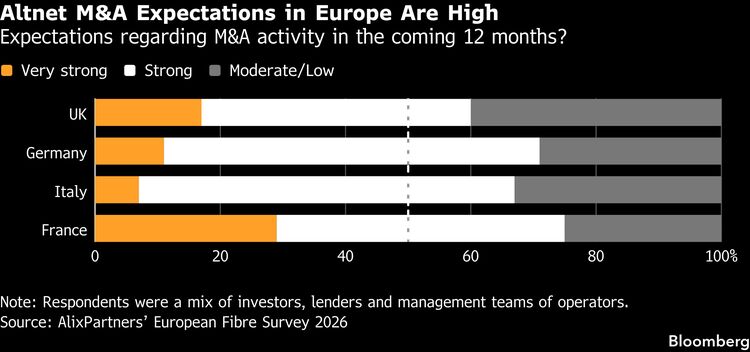
In the UK, Nexfibre — backed by Telefonica SA and Liberty Global — agreed this year to acquire Netomnia in a £2 billion deal. Shareholders are injecting £1 billion of funding to support the transaction.
Deals can be slow given the potential for disagreement over valuations, and there’s no guarantee of success.
Germany’s Unsere Grüne Glasfaser, a Telefonica-Allianz SE joint venture, acquired rival Infrafibre for just €1 in 2024, betting it could boost its business by acquiring a peer on the cheap.
But the integration of two fiber networks plus Infrafibre’s retail business isn’t without challenges. The company is engaging with lenders on a refinancing which will test financiers’ belief in the company’s ability to see through a costly consolidation. The process is currently ongoing “without any immediate pressure” from debt covenants or funding arrangements, a company spokesperson said.