
Indonesia’s bond market selloff deepened after the central bank delivered an off-cycle interest-rate hike to protect the currency. The rupiah jumped the most in nine months.
The nation’s 10-year yield surged 23 basis points to 7.51%, the highest since November 2022, while the five-year yield earlier climbed to a level last seen in May 2020. Investors have been selling the nation’s bonds on concerns over President Prabowo Subianto’s interventionist economic agenda and spending plans.
The rupiah strengthened as much as 0.8% from near a record low after the rate increase. Stocks also bounced back from recent losses in morning trading with the benchmark index posting its biggest intraday gain in more than a year.
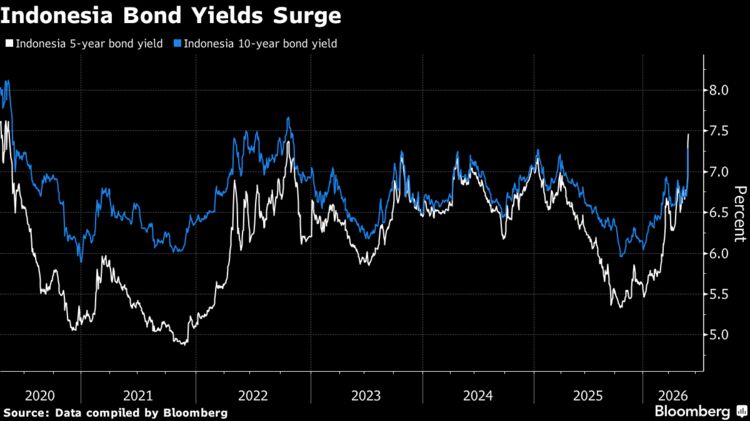
The bond market though remains trapped in a downtrend as overseas investors lose confidence in the country’s economic oversight.
“A rate hike is signaling to investors that Indonesia is moving to curb the selloff in the currency, but it won’t be enough to address concerns over economic management,” said Eugenia Victorino, head of Asia strategy at Skandinaviska Enskilda Banken in Singapore.
“There are deeper issues that must be convincingly resolved before we see a meaningful market rebound,” she said.
Funds Wary
The surge in Indonesian bond yields to multi-year highs is failing to attract global fund managers who remain bearish. Ninety One, Robeco Group and Aberdeen are staying on the sidelines, underscoring the nation’s fading allure as a key emerging-market investment destination.
“Indonesia is not a place that we are looking to allocate capital as of yet from the long side,” said Thys Louw, a portfolio manager on Ninety One’s emerging market fixed-income team in London. “The trend is one of more interventionist policy, it’s more growth and possibly fiscal loosening policies over time.”
The central bank said on Saturday it’s working with the government to boost returns on state debt as policymakers step up efforts to lure inflows. Bank Indonesia, which had been buying bonds in the secondary market as part of its currency intervention, was absent on Monday, according to traders.
| Read more on Indonesia’s selloff: |
|---|
|
The market selloff picked up momentum last week as lawmakers expanded supervision of the central bank, a corruption probe was launched, and new rules governing commodity exports were unveiled.
“There needs to be a bit more of a selloff before we look at Indonesia bonds in a more constructive way,” said Philip McNicholas, Asia sovereign strategist at Robeco in Singapore.