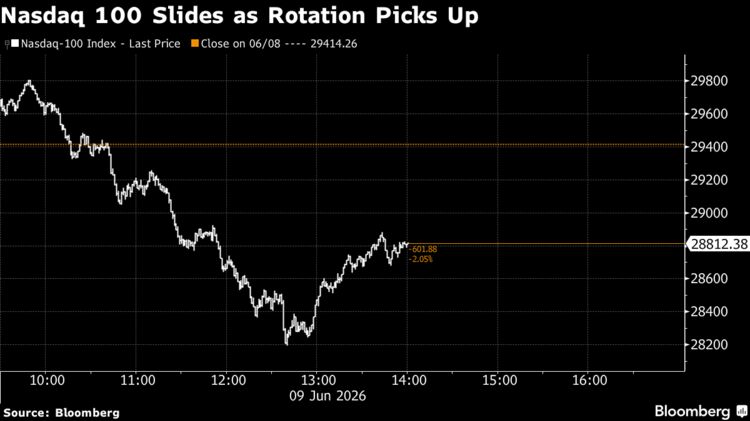
US stocks touched session lows Tuesday afternoon before paring their losses as a rotation out of the technology stocks that had propelled the market higher for most of the year gained traction.
The S&P 500 Index fell 0.5% as of 2:34 p.m. in New York, after falling as much as 2.3%. The technology-heavy Nasdaq 100 Index lost 2% after being down more than 4%. The Philadelphia Semiconductor Index, home to chip bellwethers such as Nvidia and Advanced Micro Devices Inc., retreated 3.2% following a 5.6% rally on Monday. Micron Technology Inc. lost 4.5% , while Broadcom Inc. dropped 2.0% .
Selling gathered steam mid-day after President Donald Trump said the US must respond after he blamed Iran for shooting down an American military helicopter. Major US indexes swung lower as companies selling computer chips and memory tied to the AI boom dropped. The selling in AI stocks outweighed the support from falling oil prices, and most stocks in the S&P 500 actually rose. Nearly 350 shares in the S&P 500 advanced while roughly 160 fell.
Tuesday’s rotation out of tech names, this year’s biggest gainers, came as nine of the S&P 500’s 11 sectors traded higher, led by defensive industries. Tech and energy were the lone decliners. The real estate sector rose 2.4%, while health care rose 1.3% and utilities added nearly 1%. Those are areas where companies tend to have comparatively low valuations and offer robust dividends. The S&P 500 Dividend Aristocrats Index — consisting of companies that have increased payouts for at least 25 straight years — climbed 1.5%.
“Exuberance has been building for months, pushing stocks to one record after the next, so anything perceived to be negative for equities — from higher inflation to even the potential for rate hikes — will knock the market off its footing after a historic run,” said John Cunnison, chief investment officer at Baker Boyer Bank. His firm is underweight tech shares and overweight value.
“Fears of another hot inflation print this week on the back of escalating Middle East tensions has revived fears that the threat of rate hikes may eat into Corporate America’s profit margins, and thus, stock prices,” he said.
Information technology stocks were among Tuesday’s biggest laggards, with a basket of the so-called Magnificent Seven companies dropping 3.1%, led by losses in Nvidia. A technology-driven selloff Friday was a “wake-up call” for investors, Wells Fargo & Co. strategists said in a note to clients. Analyst Ohsung Kwon said the “sugar rush” behind the recent stock surge is likely over, leaving him “unenthused” with equities.
Concern about sticky inflation and the pressure on the Federal Reserve to contain it briefly pushed the Cboe Volatility Index, or VIX, above 20, a level that signals concern among traders. With Elon Musk’s SpaceX expected to go public later this week, the prospect of another trillion-dollar-plus company hitting the market may be forcing investors to reposition their portfolios at the cost of their tech stocks, analysts say.
“Investors are taking profits in some of the leading AI names after an incredible run,” said Tim Chubb, chief investment officer at Girard, a Univest Wealth Division. He said his firm has trimmed exposure to megacap tech shares while adding exposure to financials and payment companies. “As SpaceX goes, so does the market.”
Options traders whipsawed by the market’s recent gyrations remain anxious that more volatility may arrive in the coming days, starting with Wednesday’s report on consumer prices.
Robust jobs data has put extra focus on the inflation figures as traders speculate the Fed’s next move will be to hike interest rates. The S&P 500 is expected to swing 0.9% in either direction on Wednesday, based on the cost of at-the-money puts and calls, according to Citigroup Inc. That compares to an average realized move of just 0.5% over the past 12 months.
Wednesday’s CPI report is forecast to show the core reading — which excludes food and energy costs — to have risen by 0.3% in May from a month earlier, down from 0.4% in April.