Memory chipmaker shares led a rebound in South Korean stocks, demonstrating investors aren’t quite ready to throw in the towel on the artificial intelligence boom.
The Kospi jumped 8.2% after a three-day drop that brought the benchmark index down 15% from a record high. Samsung Electronics Co. bounced 9%, while SK Hynix Inc. climbed 16%.
The rebound shows dip-buyers are wading back in after the AI trade lost momentum on fears of overheating and higher interest rates. A dramatic AI-fueled rally that had at one point lifted the Kospi up more than 100% year-to-date unraveled rapidly on Monday, triggering circuit breakers that briefly suspended trading. The downturn was exacerbated by leveraged ETFs, which magnify moves in underlying securities.
“Samsung and SK Hynix are part of the most closely-watched sector globally and they still have the most compelling valuations. That has not changed,” said An Hyungjin, chief executive officer at Billionfold Asset Management in Seoul. Many were waiting to dip buy the chipmaker shares during a pullback, he added.
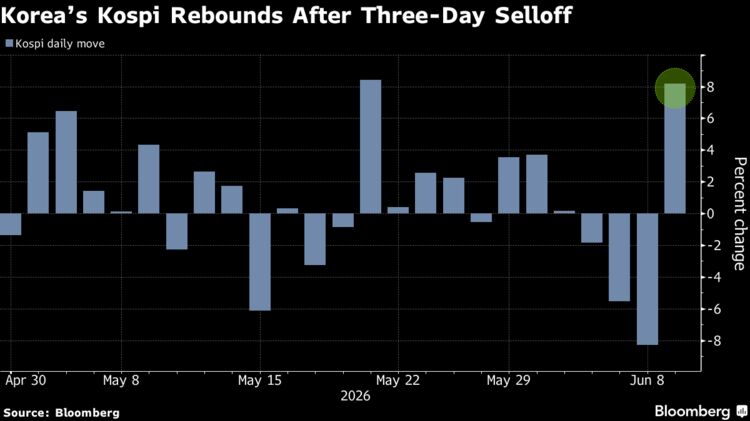
The Korean market’s volatility has surged along with a rapid rise in share prices. Exchange orders that briefly halt program buying or selling have become frequent, with such trading curbs activated on both the Kospi and Kosdaq on Monday and again on Tuesday.
A record buildup of margin debt, or borrowing to buy stocks, likely contributed to the latest market swoon. The ratio of forced liquidation for shares purchased on short-term loans jumped to above 8% on Friday and Monday, from around 1% at the end of May, according to the data from the Korea Financial Investment Association.
On Tuesday, implied volatility for Korean equities jumped 15 points to surpass 90 for the first time.
Leveraged ETFs have also been blamed for exacerbating intra-day gyrations due to the daily rebalancing requirement to maintain the targeted return ratio.
Read more: Leveraged ETF Goes Haywire in Korea With Wrong-Way 40% Moves
“Volatility has become huge, but that is due to the change in the market structure, not due to a directional shift in the cycle,” said Lee Jongwook, an analyst at Samsung Securities Co. Lee advised investors to maintain or add to positions after the selloff.
Tuesday’s rally was led by local institutional investors while foreign investors extended their selling streak in Kospi shares. Domestic retail investors were also net sellers. The benchmark is up about 92% for 2026.