A selloff on Friday whipsawed investors used to seeing momentum stocks go nowhere but up. They shouldn’t be quick to disregard it as a one-off.
Such is the warning from trading desks at Barclays Plc and Goldman Sachs Group Inc., who say crowded positioning, narrow market breadth and the prospect of higher-for-longer interest rates make the stock market more vulnerable to abrupt pullbacks.
“All of that creates an environment where factor unwinds can become materially more violent than index-level volatility implies,” Goldman traders including Lee Coppersmith wrote in a note to clients.
Friday gave investors a taste of how quickly the tide may turn for the stock market’s biggest winners should sentiment flip. The iShares MSCI USA Momentum Factor ETF lost 6% that day in its sharpest decline since a ‘Liberation Day’ selloff in April 2025. The Nasdaq 100 Index fell 4.8% as traders rushed to dump megacap technology stocks and snap up defensive names.
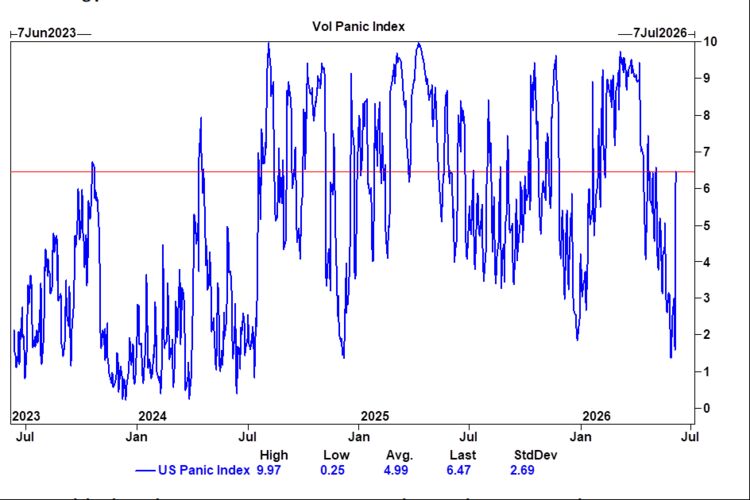
The momentum trade, which involves buying winners in the market and selling the losers, is more crowded on the long end than ever, data compiled by Goldman show. At the same time, the short end remains underowned, the data show, amplifying the risk of a sharp reversal should uncertainty take hold regarding the artificial intelligence trade, the Federal Reserve’s interest rate path or rekindling inflation.
Systematic investors may add to the pressure. Commodity trading advisers and volatility-control strategies have ramped up stock exposure to the highest level since February, leaving them vulnerable to forced selling if price swings persist.
Volatility-controlled funds may need to cut US stock allocation by roughly 14 percentage points following Friday’s rout, according to Barclays’ head of global equities tactical strategies Alexander Altmann. That would be the biggest one-day de-risking since Feb. 6.
Some of the derisking likely happened on Friday, but much of the selling typically takes place with a short-term lag, which may weigh on markets in the early part of the week.
“That can materially impact near-term price action when moves become extreme,” Altmann said.
To be sure, the dip-buying crowd stepped in on Monday, with the S&P 500 rising 0.3% and the Nasdaq 100 advancing 1.6%. Futures on both indexes were pointing to further gains early Tuesday.
That concern was somewhat echoed by JPMorgan Chase & Co.’s trading desk on Monday, which cut its near-term view on stocks from bullish to “tactically cautious.” Traders warned · that stocks are likely to remain choppy in the near-term, given that investors may continue to sell some of the tech stocks that surged during the recent rally.
While Andrew Tyler, the bank’s head of global market intelligence, said “we do feel comfortable buying the dip,” he added that it makes sense “to leg into a position over the course of this week and next” because of some factors that are exposing the market to the risk of an imminent pullback.
Tyler cited bond market volatility, position unwinding, a potential pullback from the AI trade and elevated equity issuance among them.
Investors are preparing for a wave of new equity supply unlike anything seen in recent history. A flood of shares from companies seeking capital to fund artificial-intelligence ambitions is raising questions across Wall Street about whether demand will be sufficient to absorb the issuance and what the implications will be for broader equity valuations.
The prospect of that supply arriving as positioning becomes increasingly stretched has prompted concern among some strategists that liquidity may be diverted away from existing stocks, particularly if interest rates remain elevated and economic growth moderates.
Read more: Stocks Face Rising Risk With Mega AI Deals Ready to Flood Market
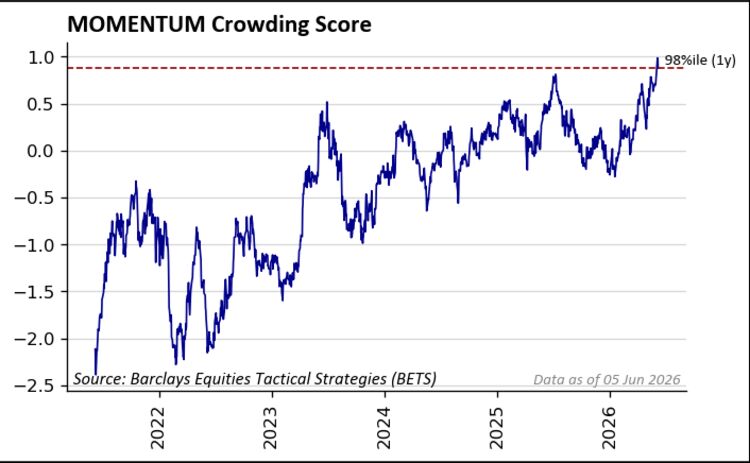
The “unusually asymmetric setup” leaves the momentum trade “vulnerable to sharper unwinds if positioning starts to reverse,” Barclays’ Altmann said.