
A charismatic salesman, Nvidia Corp.’s Chief Executive Officer Jensen Huang is visiting his suppliers in Taiwan and South Korea, hanging out at local eateries and drawing large crowds. He has also given some dangerously rosy investment advice.
Speaking at Asia’s biggest AI tech show last week, Huang’s comments on Taiwan possessing the world’s best supply chain ecosystem sent the local equities market to record high. He begged South Korea’s SK Hynix Inc. to “ please make more ” memory chips, adding fuel to a stock that has risen as much as 200% this year. On Monday, remarking on a tech stock selloff that gathered steam in the US last Friday, he said that “you should be very happy because now you can buy at a discount.”
Known for his bold statements and playful banter, Huang’s latest remarks nonetheless came across as careless and out-of-touch with market dynamics, where we have begun to witness frenzied retail buying, increased leverage, and investors reimagining makers of everything, from cars to PCs, as AI trades. To avoid a repeat of the dot-com bubble bust, what we need from the tech titan is not outsized optimism, but concrete guidance.
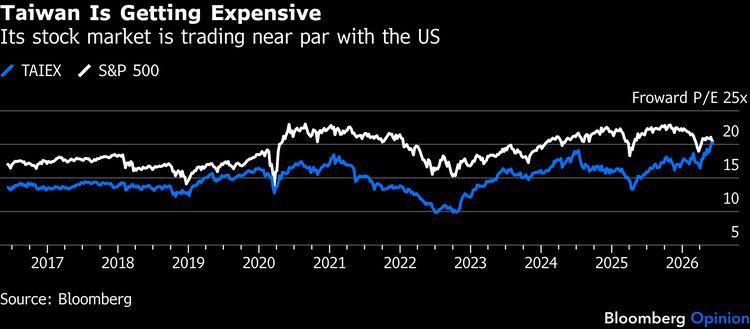
While both South Korea and Taiwan have benefited from a surge in semiconductor exports, their stock markets have started to look frothy. Taiwan’s benchmark index is now trading near par with the S&P 500 on a forward-earnings basis, even though it pales in comparison when you look at sector diversification or earnings visibility. Semiconductor and hard tech companies, which tend to be more cyclical, account for 78% of the Taiwan index.
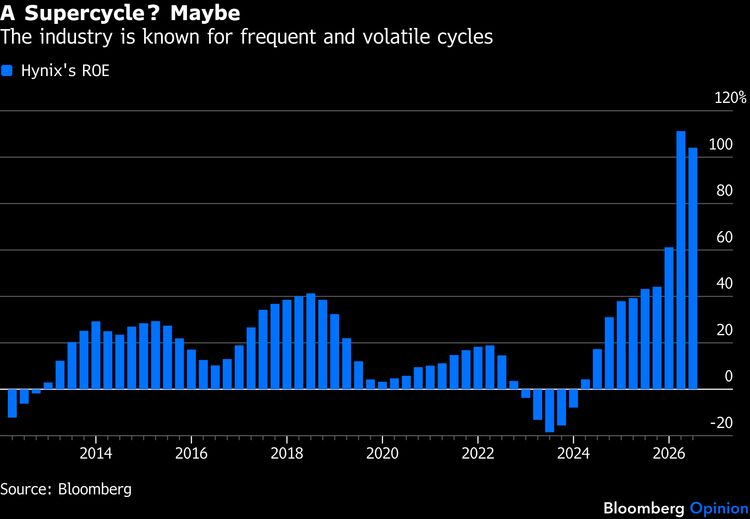
As for South Korea, where Samsung Electronics Co. and Hynix contribute to over half of the benchmark Kospi, the verdict is still out on whether the two companies can escape the volatile boom-and-bust commodity cycles that have long plagued the industry. Will they be able to sign enough long-term agreements with their customers to lock in future earnings? What do these contracts look like? Nvidia’s move to strike a multiyear partnership with Hynix, and Huang’s assurances that the world needs a lot of chips just won’t cut it. We need more details.
Until late May, when the first-quarter results were wrapped up, investors were able to lean into financial reports to fathom where we were in the AI chip rally. And one may argue the run-ups were largely justified because US hyperscalers raised their annual capital spending meaningfully and that chipmakers’ earnings largely surprised on the upside. But until the upcoming earnings season kicks off in late July, we no longer have that anchor to rely on. We’re essentially living in an information vacuum, and don’t know if the stock rally matches with increases in chip orders and corporate profits.
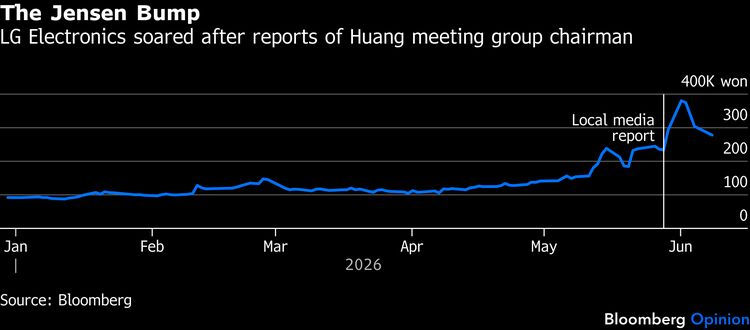
This is why comments made by tech rockstars are so important right now. As it is, Huang is seen as someone who identifies and dictates AI trends; indeed, media reports of his meeting with LG Group’s chairman sent the conglomerate’s subsidiaries to record highs. In between earnings, global investors are parsing his words even more carefully to keep up with a fast-evolving industry. Huang’s every word is market-moving.
That outsize influence must also come with some responsibilities. Deep in the midst of the AI infrastructure buildup, Huang is probably right that this technology will revolutionize the world, and that the current chip up-cycle is much larger in scale than previous ones. But has he studied valuations to make sure that retail investors have not gone wild with imagination? Until he does, the tech executive should probably stay away from giving stock tips.
More From Bloomberg Opinion:
- Jensen Huang Opens Mouth . Out Comes $50 Billion: Mark Gongloff
- Altitude Sickness Brings Stocks Down — Hard: John Authers
- A Trillion-Dollar Question for Memory Chipmakers: Shuli Ren
Want more Bloomberg Opinion? OPIN <GO> . Or you can subscribe to our daily newsletter .