Governments are borrowing from syndicated bond markets at a record clip as public spending surges.
Sovereign issuers have sold $504 billion of the debt — which is offered to investors via banks — so far this year, according to data compiled by Bloomberg.
That’s more than in the first half of 2020, when nations were paying to support their economies during Covid-19 lockdowns.
Budget deficits have been climbing since the global financial crisis. They spiked during the pandemic, when interest rates were slashed to record lows, and are widening again as governments boost defense spending and try to protect households from price shocks driven by the Iran war. Aging populations and rising interest rates are adding to the pressure.
“The main driver of the supply is basically increased public spending, and thus bigger funding needs,” said Jens Peter Sorensen, chief analyst at Danske Bank AS, pointing to greater outlays on the military, infrastructure and transition to cleaner energy.

Germany and other nations are setting aside hundreds of billions of euros for weapons and ammunition, and the European Union has relaxed its rules to allow extra spending on defense and energy initiatives that curb consumption of fossil fuels.
The sums raised from syndications are dwarfed by debt sold at regular government auctions, not least because the US Treasury only uses the latter to issue bonds. But hiring banks to sell offerings to investors is popular elsewhere, particularly in Europe. It can be a less risky option when markets are volatile, and give debt managers greater control over the timing of the sale.
Italy Leads Again
For eight of the last 10 years, Italy has been the biggest borrower in the market for sovereign syndications. It is leading again in 2026, having already raised nearly €70 billion ($81 billion) in the first six months, according to data compiled by Bloomberg.
Read More: Schroders Shuns Treasuries and Bunds in Favor of Italian Debt
Germany, which rewrote its fiscal rules to splurge on defense and infrastructure, has raised €14 billion from three syndications so far this year, while the UK, Belgium and Serbia sold their biggest-ever deals. Australia and Mexico are among this year’s top 10 issuers.
Demand remains strong, particularly for shorter maturities, and governments are seizing the chance to work through a busy refinancing schedule and fund higher spending despite an uncertain path for interest rates, said Johnathan Owen, a portfolio manager at TwentyFour Asset Management.
“They’re using this window while markets are healthy and willing,” he added.
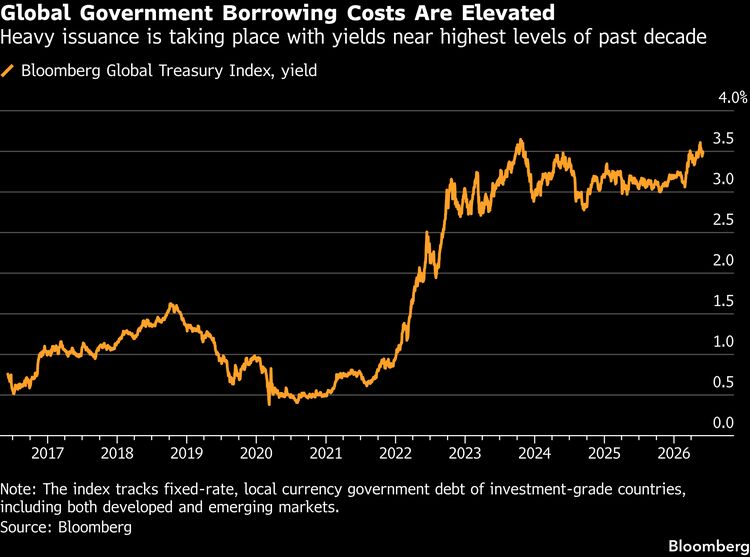
As the inflationary shock of war in the Persian Gulf has driven up yields, the outlook for the global economy has deteriorated, scrambling predictions for rates. The European Central Bank is set to deliver its first hike since 2023 this week and the US Federal Reserve is expected to tighten monetary policy later this year , although what happens thereafter is less clear.
US Treasury auctions suffered from elevated rate market volatility in March, immediately after the start of the conflict. There have been few signs since that investors are losing their appetite for debt, but they are asking for more in return. A 30-year US bond auction in May was the first since 2007 to draw a yield higher than 5%. Meanwhile, the UK’s £15 billion ($20.2 billion) offering in April drew record orders from buyers attracted by the highest yield on 10-year debt since 2008.
Pandemic Refinancing
Fueling the increase in issuance are higher than normal redemptions, as Covid era bonds begin to mature. Analysis by Natixis SA shows that refinancing deals by euro-area sovereigns have jumped by 26% in 2026, outpacing the 11% year-on-year increase in total syndicated issuance.
“This gap suggests the record first-half is primarily redemption-driven rather than opportunistic front-running ahead of potential rate hikes,” said Theophile Legrand, a rates strategist at Natixis, in comments made at the start of this month. Still, there are signs that some European borrowers may be looking to lock in costs before they rise, based on recent trends.
In May, “redemptions actually declined year-on year, yet syndicated volumes jumped from €32 billion to €45 billion, suggesting at least some degree of opportunistic front-loading,” Legrand added.
The pace of issuance for the rest of the year may depend on what central banks do next. Syndications from Belgium, Spain, Austria and Portugal in May were “earlier than anticipated,” ING strategists including Benjamin Schroeder wrote in a June 3 note.
Others are getting in ahead of the summer slowdown. Greece is tapping the market for €3 billion, garnering more than €36 billion of orders for a reopening of existing notes due in 2036. Meanwhile, Sweden is raising €2 billion of three-year debt. Both deals should price on Wednesday.
“There’s still plenty of euro zone sovereign debt to come to market in the second half of the year,” said Harvey Bradley, head of global rates at Insight Investment.