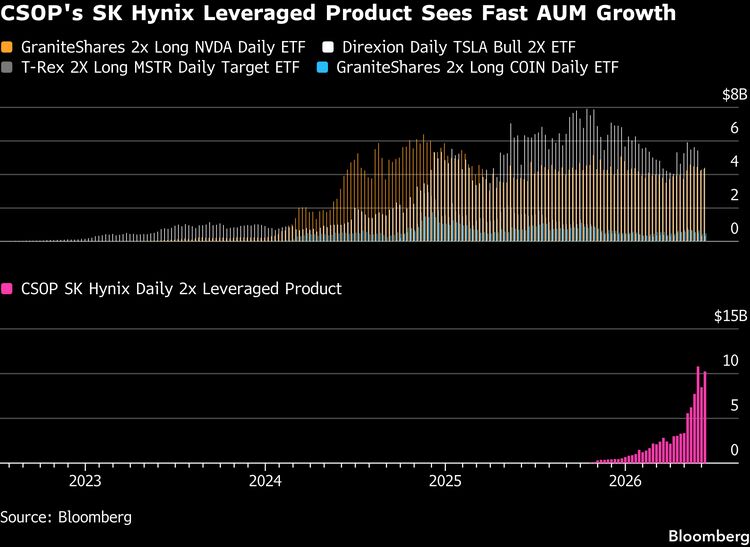
The manager of the largest leveraged exchange-traded fund tracking SK Hynix Inc. pushed back against claims that the $10 billion product is adding to volatility in the South Korean chipmaker’s shares.
Wang Yi, chief investment officer of CSOP Asset Management Ltd., said the Hong Kong-listed ETF’s trading has shown little correlation with swings in SK Hynix’s stock. He said CSOP’s analysis found only a limited impact from the fund’s daily rebalancing, even during some of the stock’s most volatile sessions this year.
His comments come as leveraged single-stock ETFs tied to major Korean chipmakers face growing scrutiny. South Korea launched a wave of leveraged ETFs tied to SK Hynix and Samsung Electronics Co. last month, following the rapid growth of CSOP’s product. The funds can amplify gains for investors, but they have also raised concerns that their end-of-day rebalancing trades may be worsening swings in individual stocks and the broader Korean equity market.
CSOP’s SK Hynix leveraged ETF rapidly became the world’s largest product of its kind after its October debut. As assets surged to about $10 billion in late May, some traders at Wall Street banks began pointing to the fund’s rebalancing flows as a possible driver of outsized moves in SK Hynix shares and Korean stocks overall.
Wang said his fund’s trades had little impact even during the oil shock in March when the underlying stock was moving by more than 10%. “During our rebalancing period, it moved less than 0.3% even with other potential contributing factors,” he added.
“There is no evidence to suggest that we are pushing the market significantly out of range, dumping trading volume into the market, or moving the share price much higher or much lower,” Wang said.
READ: SK Hynix Leveraged ETP Surge to $10 Billion AUM to Spur Launches
The Kospi index, up more than 160% in the past year — has continued to gyrate in tandem with the turbulence affecting artificial intelligence-tied stocks, triggering frequent exchange orders to halt program buying, or selling. The swings are amplified as Samsung and SK Hynix together account for more than half of the index. On Tuesday, the Kospi 200 volatility gauge surged past 90 for the first time.
Leveraged ETFs tracking Korea drew little attention until late last year, when interest started to surge alongside the Kospi’s world-beating rally. The Korean regulator approved 16 leveraged ETFs tied to SK Hynix and Samsung last month, and their combined assets surged from $3 billion at launch on May 27 to $5.5 billion within a week, according to Bloomberg Intelligence data.
SK Hynix shares endured another volatile session on Wednesday, dropping 7.5%. The stock has swung by more than 7% in either direction for a fourth straight trading day.
Volatility Accelerator
These products require a daily rebalancing to maintain leverage ratios, forcing the funds to buy into rallies and sell into declines, according to a note from Goldman Sachs Group Inc.’s sales desk last month, which called such trades a volatility “accelerator.”
“These products are likely already amplifying market volatility,” said Jung In Yun, chief executive officer at Fibonacci Asset Management Global. “Leveraged ETFs linked to Korea’s most coveted stocks are altering retail investor psychology, particularly among younger investors.”
This week, the KIM ACE SK Hynix Single Stock Leverage ETF deviated sharply from the underlying stock’s move for two sessions. The product, designed to deliver twice the chipmaker’s daily return, plunged 27% even as the chipmaker jumped 16%. The divergence followed Monday’s dislocation, when the ETF soared 50% despite the stock falling nearly 8%.
READ: Leveraged ETF Goes Haywire in Korea With Wrong-Way 40% Moves
But the problems at the Korean fund had little effect on CSOP’s product, even though it is “much, much bigger,” Wang said. At $10 billion, the fund is significantly larger than the roughly $6.7 billion average daily turnover in SK Hynix stock this year.
CSOP’s ETF products operate on an over-the-counter swaps-based structure that rely on the biggest Wall Street banks to help source liquidity, Wang said. The Korean funds use a cash equity- and futures-based structure and do rebalancing in-house.
Fueled by the success of its recent leverage and inverse products, the ETF issuer is also exploring more products tied to major Hong Kong-listed stock, Wang said.