Iraq is accelerating oil loadings at its main port and boosting shipments out of the Persian Gulf in the latest sign that the region’s top OPEC producers are getting more barrels through the vital Strait of Hormuz.
Observed shipments of Iraqi oil exiting Hormuz or loading at the country’s southern port of Basrah total about 7 million barrels so far this month, according to tanker-tracking data compiled by Bloomberg. That already matches the total volume of crude loaded and shipped in April and May, and follows a slew of departures of stranded tankers laden with Iraqi oil at the end of last month.
The effective closure of the strait after the US and Israel launched their war on Iran at the end of February choked off large volumes of oil exports from the region, with only Saudi Arabia and the United Arab Emirates able to use bypass pipelines to get significant shipments out. Now there are mounting signs more volumes are exiting, including ships that had loaded months ago, with some turning off their signals to sail undetected.
Read: Aramco, Adnoc Sneak Oil Through Hormuz as Iran Menaces Strait
Iraq and other Gulf producers are offering crude for sale both from ports inside the Gulf, as well as via ship-to-ship transfer around Oman’s Sohar or the UAE’s eastern ports, indicating the increased flows. Iraq is offering discounts to entice buyers to enter the Gulf to pick up cargoes.
The country’s observed shipments are on track to exceed the previous two months as more vessels flow out of Hormuz loaded with its oil.
The tanker Kiara M has completed its second voyage since May from the Basrah oil terminal in Iraq’s south and out of the Gulf to deliver cargoes of about 2 million barrels each. Both times the vessel sailed to an area off Sohar in Oman, which has become a common spot where tankers transfer oil to other ships for transport to the final destination, the tracking data showed.
Another tanker, the Kin A, completed loading 2 million barrels of crude at Basrah terminal today. The same vessel, previously named Helga, loaded crude at Basrah at the end of April and transported it to Ain Suknha on the Red Sea in Egypt. From there oil can be pumped by pipeline to the Mediterranean for storage or export. The vessel is currently signaling the UAE port of Khor Fakkan, located outside Hormuz and also a site popular for conducting ship-to-ship transfers.
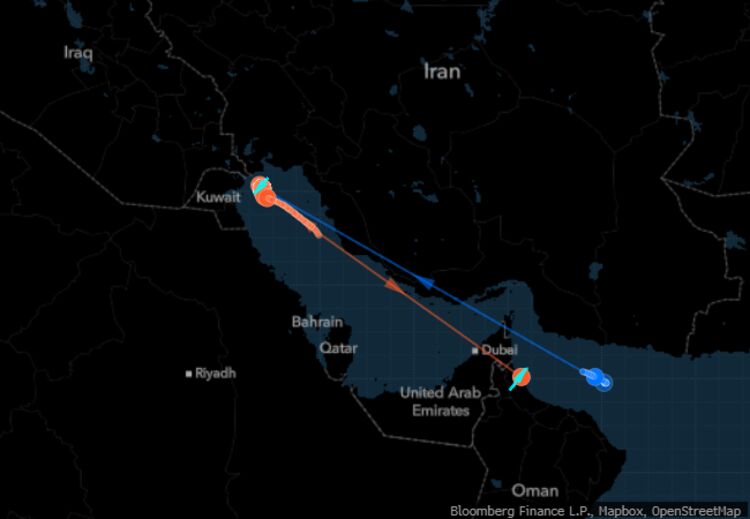
Two other tankers, the Advantage Victory and the Minerva Evropi, gave clear satellite signals outside of the Gulf earlier this month. The Advantage Victory loaded 1 million barrels of Basrah Medium crude on February 27, the day before the war started, and another 1 million barrels of Basrah Heavy crude on March 2 and is now sailing toward the Cape of Good Hope at the southern tip of Africa on the way to Rotterdam in the Netherlands.
The Minerva Evropi loaded 1 million barrels in March and is now in the Red Sea and signaling Fos-sur-Mer in France. Both tankers remained stuck in the Gulf for about three months.
After the war started, 22 tankers carrying about 29 million barrels Iraqi oil remained blocked in the Gulf and unable to travel onwards to the buyers. Two of those exited the Gulf in April and another four sailed in late May. Four had not updated their satellite signals, making it unclear they were still in the Gulf.
Tanker tracking data showed two tankers loaded Iraqi crude each month in April and May for totals of about 4 million and 3 million barrels, respectively. All four of the tankers observed loading in April and May exited the Gulf via Hormuz.
The figures for tankers transiting Hormuz account for vessels that can be seen using satellite signals transmitted from the ships. Other vessels are sailing out of the Gulf without transmitting their location, a practice known as going dark that has been used by the Saudis, the UAE and Qatar to send cargoes of crude, refined fuels and natural gas to market, Bloomberg has reported.