Alastair Campbell and Jacob Rees-Moog share little common ground on Britain’s decision to leave the European Union a decade ago — except both agree a second vote to join is unlikely in the near future.
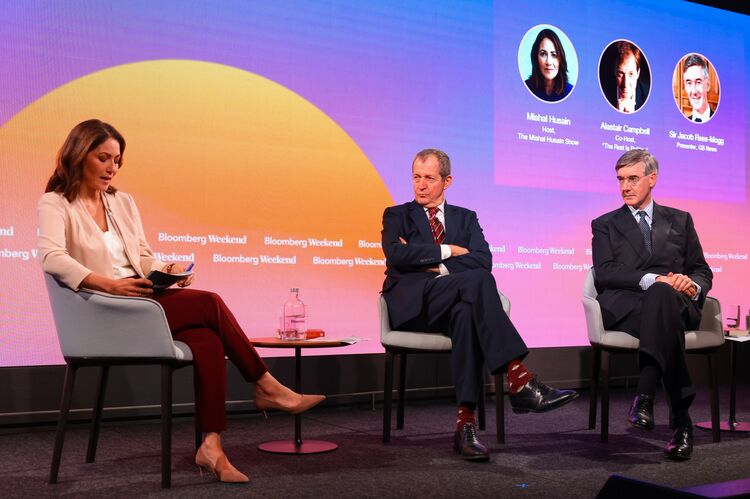
The two veteran Westminster operators-turned-talk show presenters sparred over the referendum’s legacy at Bloomberg’s European headquarters in London on Wednesday. The feisty, often amusing exchange, moderated by Mishal Husain, highlighted the deep divides over what Campbell described as a “terrible act of self harm” by British voters in June 2016.
Still, the ex-communications chief for the former Europhile prime minister, Tony Blair, said he didn’t believe that the European Union would reopen negotiations with the government while there was a real chance of one-time Brexit-campaigner Nigel Farage getting into government in the coming years.
“Nobody in this room thinks that we are going to have a referendum in the near future,” said Campbell, 69, who now hosts The Rest Is Politics podcast with former Conservative minister Rory Stewart. “OK, I would like to be one. I don’t actually think we’re going to have one for some time.”
He was responding to an Ipsos poll published by Bloomberg on Monday that showed 52% would favor rejoining the EU, compared with 33% that believed the country should stay out of the bloc. Rees-Moog, the Conservative former “Brexit opportunities” minister under Boris Johnson, said he thought that margin would narrow if the costs of rejoining were fully discussed.
“I agree with Alistair — it’s unlikely that we will have the new referendum,” said Rees-Mogg, 57, who currently hosts a show on GB News. “I think this would all change during the course of the debate.”
The exchange got off to fiery start when Campbell accused Brexit campaigners of lying about the benefits and Rees-Mogg hit back, producing what he said was a list of the former spin-doctor’s falsehoods. But the pair also clashed over issues closer to the intended subject matter, such as whether Brexit was beneficial or detrimental to the economy and whether the UK should seek a closer relationship with the continent.
An analysis by Bloomberg Economics published on Tuesday found that Brexit may have already cost the British economy between 2% and 4% of gross domestic product. While that’s less than some previous calculations, Bloomberg Economics’ central estimate for 2.5% of GDP lost over the long-run is still equal to about £30 billion ($40 billion) in forgone annual tax revenue, enough to cover the Ministry of Defense’s entire capital budget.
Campbell described the analysis as “conservative” while Rees-Mogg argued it was too severe, saying “using our economic freedoms has actually helped us.”
The Bloomberg analysis found that none of the options short of a complete reversal of Brexit would restore more than half of the output lost by Britain breaking away from its largest trading partner. Some, including Campbell’s old boss, Blair, have also warned against running back into negotiations with Brussels while key policy questions remain unresolved at home,
Campbell said that rather than “rejoin” Europe he’d prefer the UK to “join” a “totally different organization, in which is possible, for example, to have different levels of membership.” He described an expanded Europe that included Norway, Turkey and Ukraine, with a greater emphasis on defense.
Rees-Mogg, meanwhile, repeated his support for an electoral pact between Reform and the Tories, saying he supported Farage’s threat to tear up deals signed with Europe since Brexit. “‘Leave’ meant ‘leave’ — we are out. We should not be making new agreements,” Rees-Mogg said.
The pair’s views briefly converged in support of the Pope Leo XIV’s encyclical on artificial intelligence, with Rees-Mogg saying he agreed with the idea that mankind needs to keep control of AI. Pressed by Campbell whether he also accepted Leo’s concerns about inequality, Rees-Mogg, a Catholic, countered that the pontiff’s views on that matter weren’t infallible.
He said he could also argue that “actually the European Union was the apostate state and is eternally damned — that would be spicy.” “Yes,” Campbell agreed.