Beneath the veneer of China’s reputation as one of the most enthusiastic adopters of AI is an already fragile labor market, persistent youth unemployment, and a deep anxiety about the future of white-collar work.
That tension is now surfacing in courtrooms and policy signals as Beijing wakes up to a fear it can’t afford to ignore: That the artificial intelligence boom could turn into a bust for ordinary livelihoods. The government isn’t trying to slow AI down; it’s attempting to avert a political problem. Washington should be watching closely.
The Chinese government has reportedly started to warn employers, particularly tech companies, not to cut jobs as they adopt AI. And a series of high-profile court rulings in Hangzhou and Beijing that have sided with laid-off tech workers is gaining international attention, setting a precedent that implementing the technology is no excuse to fire humans. It’s a start, and a welcome contrast to the US, where AI has increasingly become a convenient cover for shedding jobs that may have as much to do with unrelated cost cutting.
But case-by-case litigation is too inadequate an instrument for a potential labor shock at this scale. It may catch or prevent some obvious AI-related cuts. Yet it leaves the burden on displaced workers to navigate a slow, uncertain and often intimidating legal process.
There isn’t a perfect solution. Rules that make it harder to cut existing jobs can also leave companies more cautious about creating new ones. That’s a risky trade-off at a time when AI is seemingly coming for entry-level roles first, and in a country where millions of university graduates are already competing for fewer white-collar openings. A policy meant to ease the employment crisis could end up hardening the divide between insiders with protected positions and outsiders trying to break in.
While none of this is a long-term fix, blunting the transition matters. Creating a bridge during the messy and uncertain middle phase of the path of AI diffusion could define its trajectory. In China, the threat isn’t confined to white-collar work. The already precarious gig economy is being upended by service robots taking over last-mile delivery and robotaxis threatening DiDi Global Inc. ride-hail drivers. These jobs may be insecure and poorly paid, but they have functioned as an absorber of economic stress. If automation weakens that valve, the political stakes for Beijing will only rise. Resulting social instability could be a major threat to the government’s legitimacy, let alone AI ambitions.
The urban youth unemployment rate for those 16 to 24, excluding students, is over 16%. Even a sheep-herding job went viral on Weibo, attracting more than 1,000 applicants in just two days — though that’s perhaps better than the state-owned enterprise that bragged about receiving 1.2 million resumes last year.
Earlier this year, the Ministry of Human Resources and Social Security said it would roll out measures to address AI’s impact on employment. The official document has yet to be released, but the ministry teased targeted employment support for key industries and expanded assistance for university graduates and young jobseekers. Matt Sheehan, a senior fellow at the Carnegie Endowment for International Peace, has written that China’s AI policy insiders only recently awakened to the scale of the jobs risk. Beijing doesn’t want to become a welfare state, but has little interest in slowing development. The result is a balancing act focused on stalling the worst of the labor market impact and buying time.
You can’t manage what you can’t measure. It’s essential that policymakers on both sides of the Pacific require disclosures for AI-related job cuts. Company leaders have a responsibility here, too. Even if the technology isn’t leading to job-level cuts, sharing data on how it’s reshaping work at the task level is crucial for navigating the transition. I’ve written about the limitations of “retraining” policy. It sounds helpful, but can be incredibly hollow; encouraging people to develop “human skills” like emotional intelligence or critical thinking. But understanding what tasks within workplaces machines still can’t do can offer some direction.
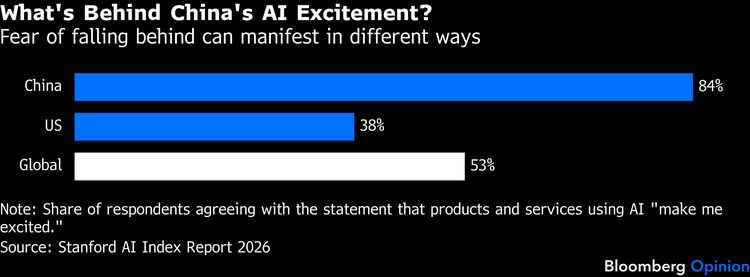
Chinese citizens’ embrace of AI in the face of high youth unemployment may look contradictory to US eyes. Yet underlying it is a fear of being left behind — a palpable anxiety in both countries . As Zilan Qian, a research associate at the Oxford China Policy Lab, writes : “Americans watching China’s AI frenzy might not be looking at a rival but into a mirror.” The idea that Washington can’t regulate Big Tech without handing a win to Beijing is getting tired.
A DeepSeek senior researcher gave a rare warning last year that a mark of success for this AI revolution “is that it replaces the vast majority of human jobs.” The nation that “wins” the race might not be the one that automates the most jobs, but that figures out what comes afterward. China’s plan is flawed, but Washington’s is non-existent.
More From Bloomberg Opinion:
- The AI Bill Is Bigger Than Ever — and Coming Due: Parmy Olson
- Huang Is Talking Up His Suppliers. It’s Worrying : Shuli Ren
- What If AI Retraining Is Just a Comforting Lie ?: Catherine Thorbecke
Want more Bloomberg Opinion? OPIN <GO> . Or you can subscribe to our daily newsletter .