
This weekend, voters in Switzerland will be presented with a deceptively simple solution to the frustrations over rising immigration that have roiled societies from the US to Europe: If they vote yes in a referendum, the country will proceed to cap its population at 10 million people. It’s the wrong answer — and not just for the Swiss.
The proposal, promoted by the nationalist Swiss People’s Party , is motivated by familiar grievances — rising housing costs, strained infrastructure and a sense that migration has escaped democratic control. Switzerland’s population, which stood at 9.1 million last year, has swelled by around 10% over the past decade, far greater than the European average of less than 2%. Since free movement with the European Union began in 2002, more than 80% of Swiss population growth has come through immigration, much of it European.
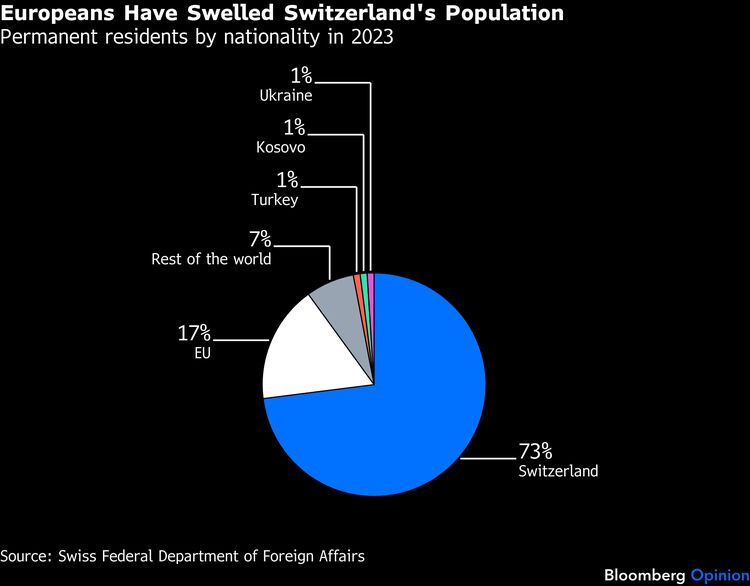
If the referendum passes, authorities would have to tighten migration controls and seek additional leeway in Switzerland’s EU obligations as soon as the population exceeds 9.5 million residents. Once it hits 10 million, the government would be required to use “all available measures” to drive it below the threshold. If that can’t be accomplished within two years, the Swiss would terminate free movement with the EU.
The consequences could be economically devastating for a country dependent on Europe for about half of its exports and 70% of its imports. Switzerland’s core accords with the EU are tied together by a “ guillotine clause ”: Terminate one, and the broader package can unravel. Swiss voters angry about rents or crowded trains may discover — as Britons did after Brexit — that protesting is easier than replacing an economic model.
The timing is especially awkward as Switzerland has signed, but has yet to pass, a new set of EU accords covering such areas as electricity, food safety and health. The agreements include enhanced provisions to limit free movement in certain circumstances and will also likely be put to a vote.
Moreover, the federal government warns that more people are already retiring than entering Switzerland’s labor market, leaving employers increasingly dependent on foreign workers. Hospitals, care homes, construction and its world-leading pharmaceutical firms all rely heavily on imported labor. A successful referendum would discourage both investment and hiring.
The country has tested this terrain before, when citizens backed immigration quotas in a 2014 Swiss People’s Party initiative. The government later had to soften implementation to preserve EU ties — a compromise that left voters unsatisfied and would be harder to engineer this time around.
A smarter strategy would focus on fixing the supply-side failures that underpin so many of the current frustrations. Take housing. Easing restrictive planning rules, speeding up permitting, clearing infrastructure bottlenecks and overcoming local resistance to denser building would all do more to relieve shortages than capping the population would. Federal planning and support for building around rail corridors and urban hubs will be important in a system where many zoning powers sit locally.
Switzerland already tightly restricts non-EU migration through quotas, skills requirements and labor-market tests. Rather than reaching for a constitutional cap, policymakers could distinguish asylum more clearly from labor migration through faster processing and firmer handling of failed claims. The country could also reduce its dependence on imported labor through retraining and policies that keep older workers employed longer, to increase domestic workforce participation .
As in the US and elsewhere, Switzerland’s immigrants are key contributors to its success story. The engineering, pharma, financial and research clusters that underpin Swiss prosperity depend on attracting the best and brightest from around the world. Whatever challenges the country faces, shutting down that pipeline isn’t the answer.
More From Bloomberg Opinion:
- Britain Is Being Dragged Into a Very Ugly Place: Rosa Prince
- Ratify Turnberry , Then Get Serious About US-EU Trade: Editorial
- UBS Has a Problem — It’s Too Profitable : Paul J. Davies
Want more Bloomberg Opinion? OPIN <GO>. Web readers, click here . Or you can subscribe to our daily newsletter .