It’s easier to turn power into money than to turn money into power. And the power restaurant has always been more about power than about restaurant: It’s a place where money buys you visibility and clout, and where the quality of the food is of secondary, if not tertiary, importance. The alchemy involved in creating such a venue, however, has always been mysterious. Many try; few succeed.
In culinary history, no place has nailed the semiotics of being a power restaurant as well as the Four Seasons. Architect Philip Johnson’s 1959 Gesamtkunstwerk inside Mies van der Rohe’s Seagram Building on Park Avenue, the exemplar of International Style modernism, exerted an irresistible gravitational pull on Manhattan’s corporate elite. Jackie Onassis called it “the cathedral,” for good reason.
Now a pretender to the throne, Cote 550 , has opened a few blocks away on Madison, in the icon of postmodernism that is Johnson’s 1984 AT&T Building. The steakhouse shares with its near neighbor an average check size high enough to leave most T&E guidelines in the dust, but it boasts no soaring ceiling or bronzed fenestration; instead it’s squeezed into a basement. For its power, Cote 550 relies, literally, on smoke and mirrors — the vaporized fat from dry-aged wagyu wafting across the room and the angled glass that reflects a brightly illuminated hanging garden encircling the black-walled space.
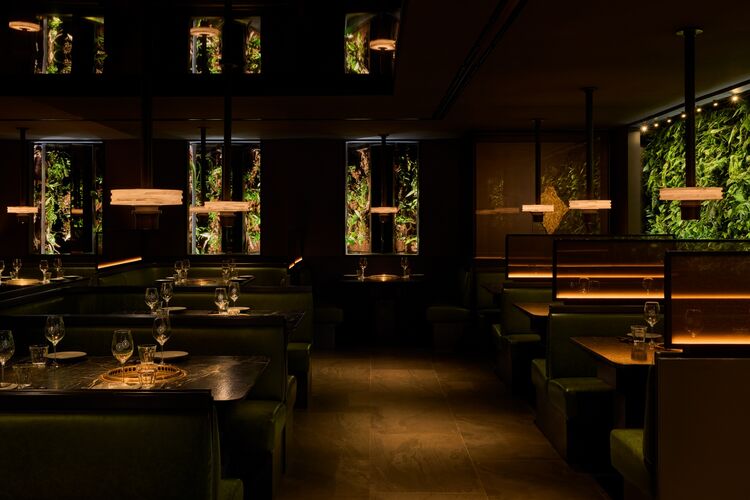
Owner Simon Kim told Grub Street he wants Cote 550 to have a “level of grandiose” unsurpassed in the city. To that end, designer David Rockwell has pulled out all the stops, even including a small central pool that’s a direct quotation of Johnson’s pool room in the Four Seasons. If it works — and early indications are that it’s working very well — the result will be that Holy Grail of restaurateurs, a place where the demand curve slopes upward and raising the price of the food only increases the clamor to get in.
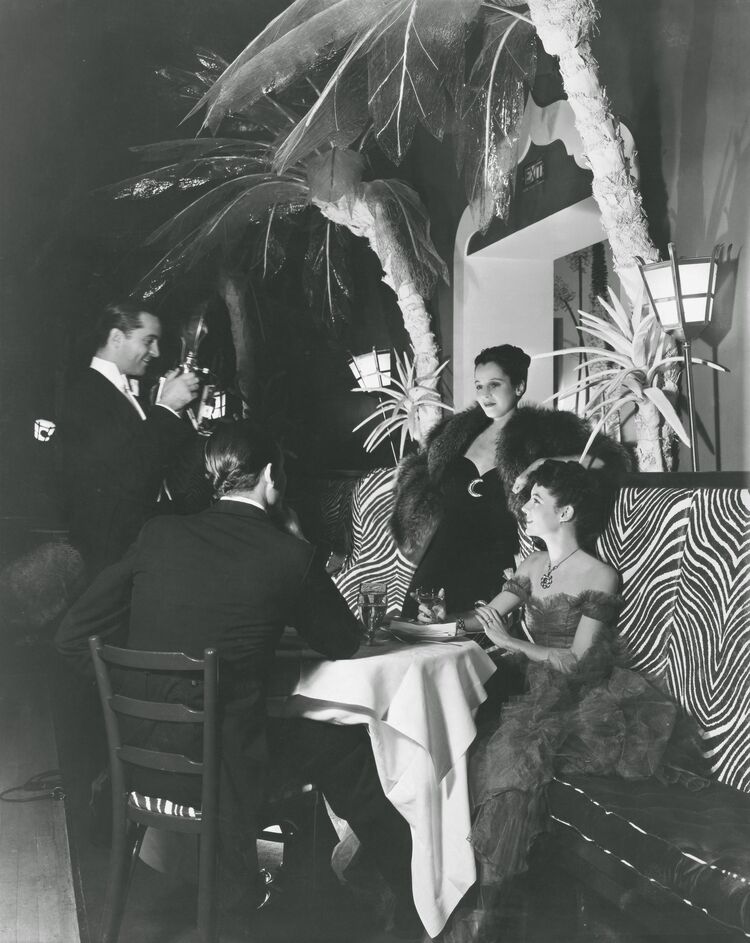
New York has a long history of such places, tracing back at least to El Morocco, which formally opened on East 54th Street in 1933 after the end of Prohibition. Possibly the world’s first clubstaurant , it rapidly became what New York Times editor Arthur Gelb described as “one of the most caste-conscious, costly and cloistered night clubs in the world.”
Although El Morocco featured very expensive Dover sole and foie gras (the $35 menu in 1961 would be equivalent to $400 today), its food was never the point. It was all about the blue-and-white zebra-striped banquettes, and who sat where with whom. Above all, Gelb wrote, it was “a place where celebrities have been coming to keep tabs on each other.” As Laura Shaine Cunningham wrote in a Times remembrance , “people began to go to El Morocco to be photographed.”
That function of being a place to be seen, is a common denominator of all power restaurants. What’s changed over the years, and from place to place, is who the diners want to be seen by .
The diurnal counterpart of El Morocco was La Côte Basque. John Fairchild, the publisher of Women’s Wear Daily , would send a photographer to snap the Duchess of Windsor and C.Z. Guest as they exited, sporting pillbox hats and white kid gloves. (Fairchild later claimed he invented the term “ladies who lunch.”)
The socialites weren’t going with the purpose of being photographed in the way celebrities do today, but it was just as much a place to be seen as El Morocco. The large dining room that made up most of La Côte Basque was the “Outer Hebrides,” explained Truman Capote in Esquire . “Preferred clients, selected by the proprietor with unerring snobbisme , were placed in the banquette-lined entrance area,” where everyone else would have to pass by them.
The Four Seasons also had its power tables; Henry Kissinger himself praised the “ Machiavellian subtlety ” of co-owner Julian Niccolini’s table assignments in a Town & Country oral history. It almost never had paparazzi, however. When you were seen there, you were seen only — but crucially — by fellow members of the club.
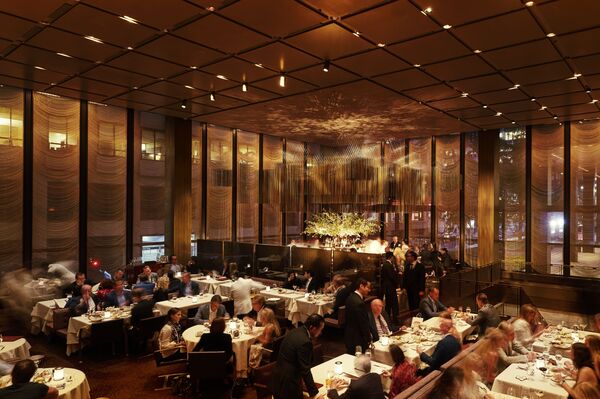
The Four Seasons lives on, now renamed the Grill and run by Major Food Group, of Carbone fame. Lunch guests still ascend the staircase into sunshine exquisitely filtered through its famous beaded chains, designed by weaver Marie Nichols, that shimmer in the convection currents of the 22-foot-high space.
“We set a stage, we are in costume, we are theatrical,” says Mario Carbone, the co-owner. His props are meticulously chosen: the small cut-glass vessel with sugar water that accompanies every order of iced tea, the astonishingly glossy butter that comes with the bread. Fraise du bois (small French wild strawberries) are sold by the gram and described by the maître d’ , falsely if charmingly, as being “more expensive than cocaine.”
The power dance, however, is missing.
It’s not that the Grill isn’t busy, but it’s surprisingly easy to get into; you’re more likely to find yourself next to an interchangeable finance bro than David Zaslav or Ken Griffin. All public restaurants, no matter how expensive, have become less exclusive. The dealmakers are more often found at members’ clubs and other places the general public simply isn’t allowed, such as Coco’s at Colette or Jamie Dimon’s private dining room at the top of 270 Park Avenue . Those are places you take someone when you want to impress them — but they have almost zero utility in terms of being seen in the classic sense.
The extravagant theater that defines Cote 550, then, isn’t reserved for a select elite. It’s a far cry from Le Cirque, another legendary power magnet, which achieved global notoriety in 1993 when Times restaurant critic Ruth Reichl contrasted the miserable experience of not being recognized with the top-tier VIP treatment.
At Cote 550 there isn’t a bad seat in the house. Diners are ushered down a narrow staircase that opens up after a series of turns to reveal a dark neon-lit bar behind which steaks are dry-aged under deep red light. Farther, past the translucent wall between the women’s and men’s washrooms, you enter an immersive pastel-hued tunnel, at the end of which you finally encounter the meat-scented vista of banquettes and glowing plant life.
Then comes the meal itself, where you might marvel at the tableside preparation that justifies the price of the $76 Alaskan king crab japchae, and where you’ll certainly find multiple servers coming to flip the pieces of salted steak grilling in the center of your table. (A custom-designed light fixture vents the smoke.)
With all that potential social media content, who needs gatekeeping and Page Six? Kim, the owner, insists he’s “not snobby about who comes into our restaurant.” Rockwell, on the same page, says he wanted to reinforce the whole point of living in a city in the first place, which is “to rub up against different people.”
The place is hard to get into, to be sure — good luck gaming Resy — and it can be gasp-inducingly expensive. (That Kobe rib-eye at $82 isn’t weirdly almost affordable; it’s $82 per ounce .) But all the same, it’s democratic in a purely capitalist way, accessible to anyone with the kind of liquidity that opens doors. The days of snobbisme are over: A personalized butcher’s block , on permanent display and taken out to be used whenever you dine, is something money can buy, if you come frequently enough and spend a lot.
After all, every power restaurant needs to be able to cultivate its deep-pocketed repeat visitors. Barry Wine ran the Quilted Giraffe at the same address, 550 Madison Ave., in the 1980s and made it the most celebrated and expensive restaurant in town. He remembers that actually paying your check in the restaurant marked you out to the regulars as someone to be pitied a little, what with all that grubby money changing hands and the obligatory fighting over who pays what. Much more elegant to send a monthly bill to the office.
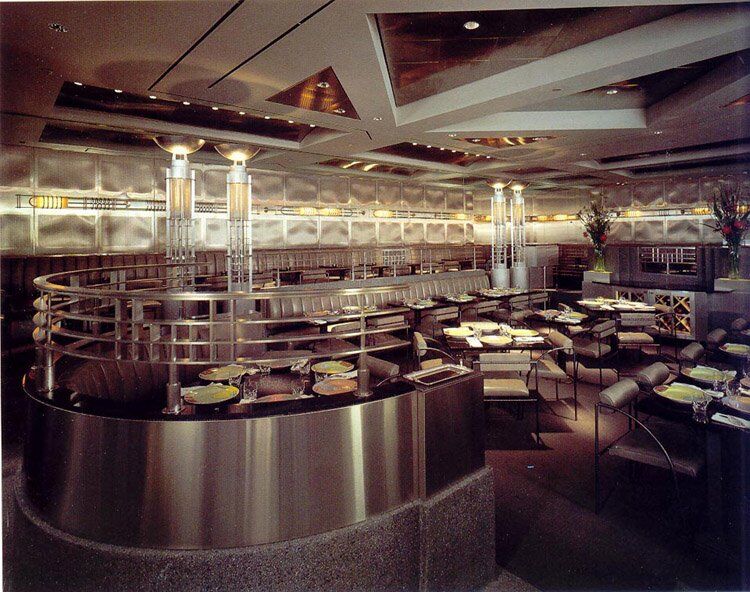
The restaurateur was also early to the members’-club trend: When Sony bought the AT&T building in 1991, the Quilted Giraffe closed down, to be replaced by a Sony Club at the top of the building. There, the likes of Barbra Streisand and Michael Jackson would eat at a five-seat sushi bar helmed by Masaharu Morimoto before he became the executive chef at Nobu. As for his celebrity haunt of the 1980s, it lives on in the Quilted Giraffe Room, Cote 550’s private dining room, adorned with a custom giraffe-bedecked carpet and artworks by Wine himself.
Today the locus of power — the set of people diners want to be seen by — is no longer to be found seated at dinner tables or even reading the Post or WWD . Instead it’s online, and the brass ring has become what restaurant historian Andrew Friedman calls “the trophy photograph on Instagram.”
Being seen is now a do-it-yourself operation, and Cote 550 features strategically placed IYKYK artworks that can telegraph a diner’s location to the cognoscenti scrolling through social media. “They all take photos of Don’t Worry ,” says Rosa Suehyun Kim of Artline, who commissioned that piece, along with two other neon works by British artist Martin Creed. “It’s very photogenic.”
Then comes the rub. Once you’ve posted that selfie — once you’ve “documented that you were there, you were able to get in,” as Friedman puts it — is there even really a reason to go back?
“The relevancy of places starts to decline pretty quickly these days,” Friedman says, bemoaning how restaurants are increasingly “disposable.” The power restaurants of yore changed locations when their lease expired or a better opportunity presented itself; that almost never happens anymore. The velocity of restaurants has surged: El Morocco buzzed for more than 50 years, but today’s hot spots tend to dim after five years or less. Cote 550 is ascendant right now, but you might want to grab it while it’s hot.