
When Chris Barber, who’s been in the computer business for a quarter-century, says he’s never seen anything like the AI boom, he’s not talking about its potential to transform the future. He means what it’s doing to hardware prices right now.
Barber runs “Cheaper Than a Geek,” a Baltimore-based outfit that helps small companies with IT. Memory upgrades are a popular service, but nowadays he’s advising people that it’s barely worth the cost. RAM chips that sold for $100 six months ago are an “insane” $300 now, so customers may be better off just buying a new computer. “Parts themselves are just completely out of control,” Barber says. “This is the worst increase I’ve ever seen.”
Behind it lies the rush to build data centers, which power artificial intelligence and need vast quantities of memory chips. That surge in demand is what’s pushing prices up for industry specialists like Barber who buy RAM chips raw. But the ultimate impact is much broader, since memory is embedded in all kinds of consumer staples, from phones and computers to cars.
The upshot: AI, driver of growth in America’s economy and creator of record wealth in its stock markets, has also become part of the country’s latest inflation problem.
Headline inflation climbed back above 4% last month for the first time since the spring of 2023. While the principal cause is an oil spike, triggered by the US war in Iran, AI is chipping in too.
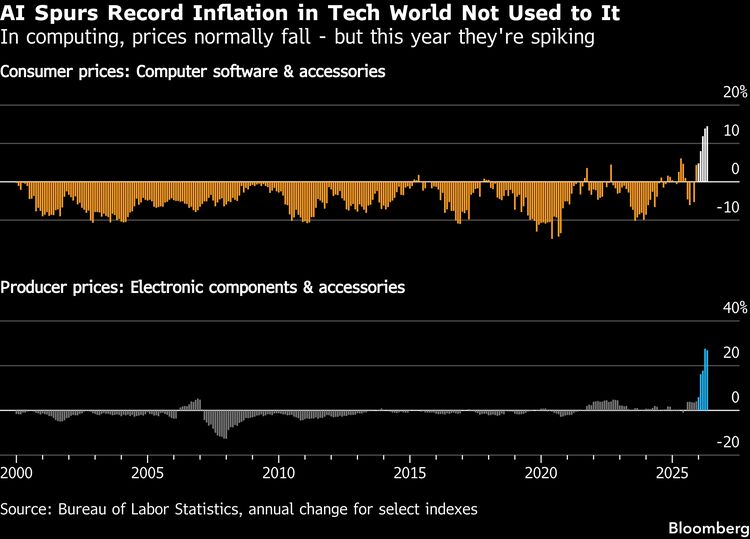
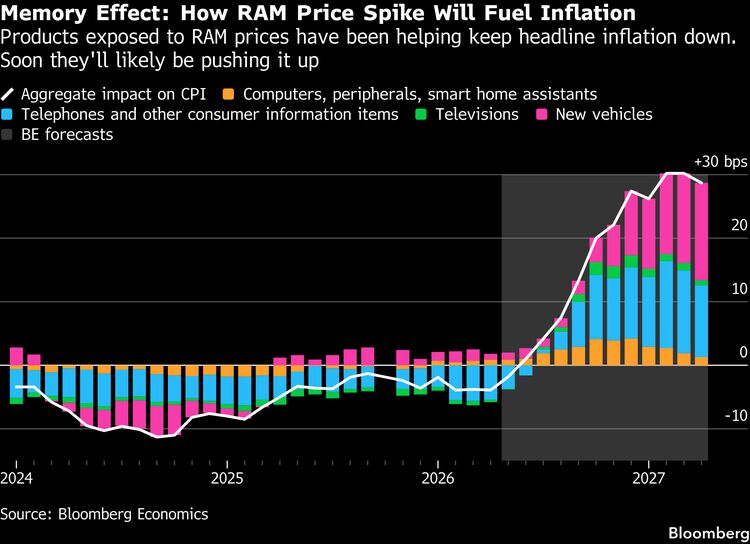
Software and computer accessories, which usually trend cheaper as technology improves, were up a record 14.5% in May from a year earlier while the cost of electronic components for producers soared 27%. The memory squeeze will add 0.4 percentage point to headline inflation before it eases, Bloomberg Economics calculates. There are other knock-on effects too, like higher electricity prices due to demand from data centers.
‘Certainly Inflationary’
All of this adds financial strain to households still scarred by the post-pandemic inflation wave. It creates headaches for President Donald Trump and his Republican party, ahead of midterm elections — and for the Federal Reserve under its new chief Kevin Warsh, who’s argued that AI will eventually make companies and workers more productive, easing price pressures in the economy.
For now it’s having the opposite effect, says Stephanie Roth, chief economist at Wolfe Research. “The AI boom is stoking overall inflation pressure in meaningful ways,” she says. “The disinflationary productivity boom is still a ways out.”
Fed Governor Lisa Cook and St. Louis Fed chief Alberto Musalem are among policymakers who’ve recently highlighted various ways the AI boom is pushing prices up, whether via chips or electricity.
It’s among the factors that will likely prevent Warsh from cutting interest rates as quickly as he’d suggested should be possible, according to Torsten Slok, chief economist at Apollo Global Management Inc.
“Initially the AI boom will certainly be inflationary,” Slok told Bloomberg Television’s Surveillance . The risk is “very clear when you look at semiconductor prices, when you look at energy prices, when you look at labor.”
As they suck in memory chips and electricity, data centers are also creating jobs for a growing chunk of the construction workforce, and they need armies of electricians or HVAC technicians to get up and running. These numbers may not be big enough to shift wage inflation nationwide, but there’s a palpable impact in many industries and regions.

Chip McElroy is head of McElroy Manufacturing Inc. in Tulsa, Oklahoma, which makes thermoplastic pipe fusion equipment. He says business is booming, with the AI buildout driving around half of growth and staffing at a record above 600. But he still has openings for up to 60 more people to work as welders, machinists, assembly technicians and more.
“The economy for the labor we need is definitely booming,” McElroy says. “Starting pay is definitely up from a year ago.”
‘Like You Buy Lobster’
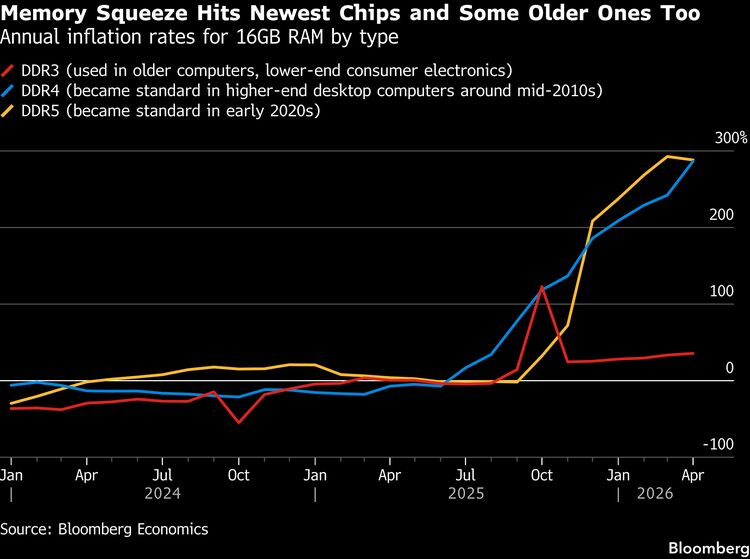
A much bigger AI effect on inflation right now is the memory-chip shock. One big unknown, for industry buyers and central bankers alike, is how long it will last. Bloomberg Economics, which studied thousands of memory kits and found an average year-on-year price increase of 237%, estimates that the impact will peak in February next year.
“We think it will be a meaningful factor keeping core inflation elevated this year,” says Michael Pearce at Oxford Economics. In the longer run, it’s unclear “whether this is another transitory effect or a new supercycle for memory prices,” he says. “The chip cycle has historically been very volatile, and prices could drop back quickly once supply adjusts.
Pearce also points to the difficulty of measuring prices for this kind of fast-evolving computer equipment, an issue flagged by a recent Fed paper . It’s a longstanding debate among inflation wonks, who refer to “hedonic quality adjustments.” What this means in lay terms is that inflation for, say, computer game consoles has to factor in not just what they cost but also how much better they get with each upgrade.
Rapid tech progress means the prices of computer kit, unlike most other things, typically fall. Annual inflation for computer software and accessories averaged -5% in the first quarter of the 21st century — which likely made the shock even worse when it soared in recent months, to above 14% in May.
The trade press has been full of articles capturing the trauma. Late last year, PCWorld described how stores had stopped putting prices for RAM on their shelves because they changed too often, requiring customers to ask at checkout instead. “Get ready to buy PC memory like you buy lobster,” the magazine advised.
At his ‘Cheaper than a Geek’ shop in Baltimore, Barber says he can’t see a turning point anytime soon. “I don’t see any indication that it’s peaked,” he says. “These things are kind of scary.”