Canadian Prime Minister Mark Carney’s government introduced legislation that would ban social media for youth under 16 unless companies such as Meta Platforms Inc. and X Corp. meet a set of safety standards.
The bill unveiled Wednesday would also impact artificial intelligence chatbots, though they wouldn’t face a ban on youth users. Firms must mitigate the risk of the chatbot communicating harmful content and be transparent about their reporting thresholds in crisis situations.
The legislation comes ahead of Carney’s Friday meeting in Paris with French President Emmanuel Macron, who has led a push in Europe to protect children online. Group of Seven leaders are also expected to discuss the issue next week.
“The act will require social media platforms and AI chatbot services to do more to protect children, to make their platforms safe by design,” Culture Minister Marc Miller said at a news conference.
“The measures in this bill represent in my view the basic expectation that parents and Canadians have for keeping their kids safe online. I believe all parties should agree on the importance of these minimum safeguards.”
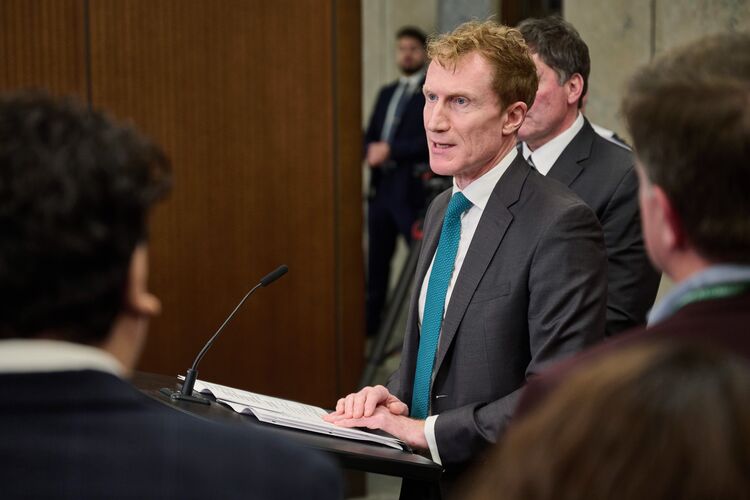
The Canadian government had signaled that it was mulling a ban on social media for children, but it stopped short of complete prohibition on Wednesday. Miller said the government believes social media platforms can be made safe by design.
“What the federal government or the state can or should do and what parents can or should do” was also taken into consideration when the bill was crafted, Miller said.
The legislation enables the creation of a digital regulator, which would impose the new rules on platforms. The regulator will be tasked with setting out the requirements social media firms must follow in order to receive an exemption from the ban on users under 16.
However, it’s expected to take about 18 months after the bill becomes law for the regulator to be set up, meaning the social media platforms will likely face a period where youth users are banned without any option for an exemption.
Companies that don’t comply with the law will face a maximum penalty equivalent to 3% of the firm’s global revenues or C$10 million ($7.2 million) — whichever is greater.
An official said in a background briefing that some smaller social media sites may be captured by the law, but the regulator will determine the minimum size threshold and set out other criteria. Live-streaming services and adult websites focused on user-shared content will also be included.
The law will not affect gaming platforms such as Roblox Corp.
A spokesperson for Meta said the company is assessing the details of the proposed bill.
“Social media bans are counterproductive, but we are encouraged that the government appears to recognize” that online services can provide teens with sufficient safeguards, the spokesperson said in a statement.
“With teens using more than 40 apps weekly, it is important that any regulations apply equally across the many apps teens use. Leaving age verification up to individual platforms raises concerns about privacy, security and effectiveness.”
Meta is advocating for age verification to be conducted at the app store or operating system level instead. Miller told reporters that the government is in talks with platforms about the best way to verify age without compromising privacy.
A mass shooting in Tumbler Ridge, BC in February sparked concern about young people’s use of AI chat bots, after it was discovered that the 18-year-old suspect had discussed gun violence on OpenAI’s ChatGPT months before the attack.
Miller said the government opted not to impose age restrictions on AI chatbots because there is less data on the risk of harms they pose to children.
Canada is also considering developing an optional digital age license to facilitate social-media access for those above the age of 16, a government official said in the briefing.
Any move to restrict youth access to digital platforms may add to existing friction with large US tech firms, which are already resisting Canadian rules on news content and streaming services. Carney’s government recently backed down on a plan to force companies such as Netflix Inc. to make larger financial contributions to Canadian film and television productions.
The US Trade Representative’s office has cited Canada’s digital laws as trade barriers , signaling they may become points of contention in the upcoming review of the US-Mexico-Canada Agreement.
Australia has already legislated a ban on social-media use for children under 16 to address mental-health issues, cyberbullying, and exposure to harmful content. As well, the Canadian province of Manitoba plans a prohibition of its own.