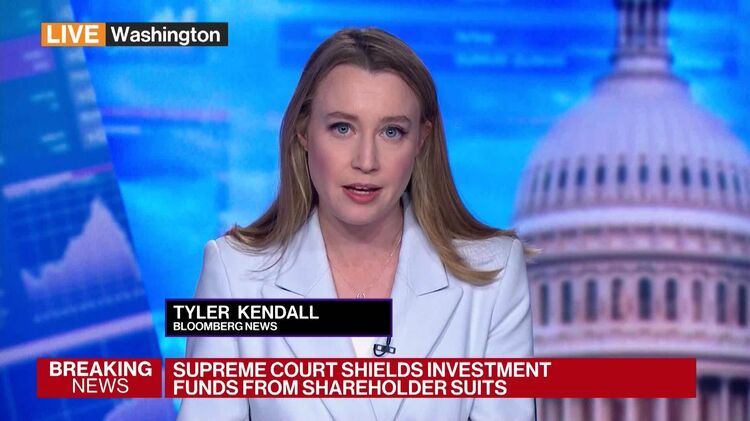
The US Supreme Court shielded funds from some investor lawsuits, ruling that an 86-year-old federal statute doesn’t authorize shareholders to sue over bylaws and management decisions.
Voting 6-3 along ideological lines, the justices on Thursday blocked activist investors from suing 11 closed-end funds, including some affiliated with FS Credit Opportunities Corp. and BlackRock Inc. The investors, led by hedge fund manager Boaz Weinstein’s Saba Capital Master Fund, were seeking more control over the funds.
The high court said the 1940 Investment Company Act doesn’t authorize private lawsuits for most violations, leaving enforcement to the US Securities and Exchange Commission. The ruling reverses a federal appeals court decision that had said the law contained a so-called private right of action letting investors sue to rescind contracts made by a fund.
The fund industry hailed the ruling, saying it will guard against costly lawsuits and regulatory uncertainty. The decision will also shield mutual funds and exchange-traded funds.
“This is a critical ruling for funds and boards that have been subject to litigation threats and attacks simply because they tried to protect the interests of long-term shareholders,” said Skadden Arps lawyers Shay Dvoretzky and Eben Colby, who represented the closed-end funds.
Saba was trying to use the ICA to challenge the funds’ reliance on Maryland’s “control-share” law, which lets controlling investors block others from acquiring more than a 10% voting share. Saba said the Maryland law lets underperforming funds escape accountability, while FS and BlackRock said the state law helps funds take a long-term view, protecting them from arbitragers seeking short-term profits.
Weinstein noted in a statement the court decided only that the investors couldn’t sue and didn’t address whether the closed-end funds violated the ICA’s requirements. He said the ruling puts the onus on the SEC to protect investors from entrenched fund managers.
“These are protections Congress wrote into law more than 80 years ago — they are not optional,” said Weinstein, the founder and chief investment officer of Saba. “The evidence of shareholder harm is overwhelming. The SEC has no excuse not to act.”
The Trump administration and the SEC backed FS and BlackRock, arguing that the 1940 law doesn’t authorize investors to sue. “We are grateful the court agreed with the commission’s position on the scope of private rights of action under the Investment Company Act,” SEC General Counsel Russell McGranahan said in an emailed statement.
Protecting Investors
The ICA is designed to protect investors in a variety of ways, including through registration and disclosure requirements. The provision Saba sought to invoke says that each share of a fund generally shall have “equal voting rights with every other outstanding voting stock.”
Saba contended that Congress authorized private lawsuits under the ICA through a provision that describes when courts should rescind a contract entered into by a fund. FS and BlackRock said that provision provides rules for state courts to follow if cases are filed there but doesn’t itself authorize lawsuits.
Writing for the Supreme Court majority, Justice Amy Coney Barrett wrote that “nothing in the text or structure of the ICA indicates that Congress authorized private parties to enforce virtually every provision in the statute.”
The three liberal justices dissented, saying the court was ignoring Congress’ intent and the words of the 1940 law. “The court’s proper role is to give effect to the will of the people, not supplant it,” Justice Ketanji Brown Jackson wrote.
The Investment Company Institute, which represents the fund industry, hailed the decision.
“Allowing such claims would have risked significant regulatory uncertainty and costly litigation, which would have ultimately harmed fund shareholders,” the group said in an emailed statement.
The Supreme Court ruled in 1979 that the Investment Advisers Act, a separate law enacted alongside the ICA, contained a private right of action letting investors sue to rescind a contract, though not to collect damages.
The court in more recent years has eschewed private rights of action unless Congress expressly authorizes them in a statute.
The case is FS Credit Opportunities Corp. v. Saba Capital Master Fund, 24-345 .