By Gearoid Reidy | Updated on Jun 10, 2026 at 09:00 PM
Do you live in fear of the specter of “Japanese neo-militarism”? Are you girding yourself for another campaign of advance across Asia? Perhaps you fret over the “ gray rhino ” of remilitarization in Tokyo, “charging towards peace and order in the Asia-Pacific”?
I doubt it. The specter of “neo-militarism” is the latest attack line from Beijing, a neologism rolled out over the past few months repackaging longstanding accusations that Tokyo is reviving the spirit of World War II. The phrase has appeared with increasing frequency in briefings and state outlets since Beijing took offense with Prime Minister Sanae Takaichi.
“The malevolent emergence of neo-militarism in Japan is putting regional peace and stability under threat,” Chinese Foreign Ministry spokesperson Lin Jian said last week. “The international community must stay on high alert and take resolute countermeasures.”
Defense Minister Shinjiro Koizumi latched on to the wording at the Shangri-La Dialogue in Singapore last month, when he took a thinly veiled swipe at China for its accusations, despite Beijing holding vast numbers of nuclear weapons and bombers.
The phrasing might be new, but the charge is familiar. It might have carried weight in the decades after the war, when the trauma of Japan’s imperial ambitions were a recent memory. Yet in today’s international community, the narrative Beijing is selling has few buyers. There was no clearer example than Philippines Defense Secretary Gilberto Teodoro, who pushed back at Shangri-La at what he dubbed China’s “improper use of history” and the “unfair vilification of Japan to obscure one’s own misbehavior.”
“Japan certainly is a model citizen of the world,” he added. “I think there is unanimity among almost all of us.” Not every nation would be so effusive. But even those that until quite recently would have been wary about Tokyo and receptive to warnings about remilitarization are nowadays worried less about Japan’s past, and more about China’s present.
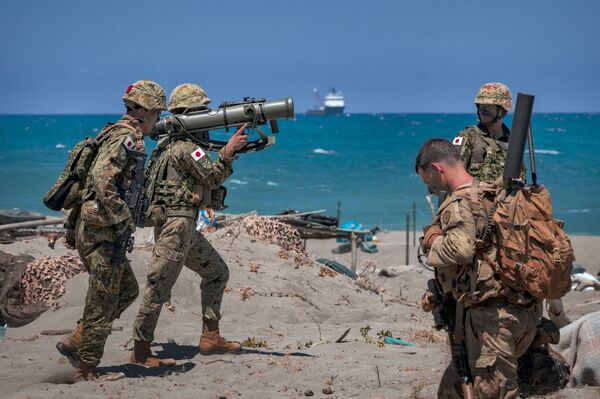
The evidence is all around. Self-Defense Force personnel debuted in US-Philippines military exercises in April, the first time its combat-ready troops have set foot on Philippine soil since the return of Douglas MacArthur. Takaichi signed a defense partnership with Indonesia, which may include the export of destroyers and the sale of its Mogami-class frigates. They’re the vanguard of a defense industry that the region is looking to after a landmark deal to export the warships to Australia, with New Zealand and India also interested.
Japan is the most trusted major power in 10 Southeast Asian nations, with almost two-thirds saying they think the country will “do the right thing” to contribute to global peace and security, according to the latest State of Southeast Asia Survey. That’s the result of decades of initiatives, in the form of development aid, loans and infrastructure projects, and most recently a $10 billion pledge to help countries impacted by the Strait of Hormuz closure secure energy. Steps like this made Tokyo a dependable presence, long before it emerged as a defense exporter.
Relations have even been cordial with South Korea, where grievances against Tokyo’s colonization and war-time abuses remain deeply sensitive. Tokyo and Seoul this week restarted joint naval search-and-rescue drills for the first time in nine years, a sign of the improving relations between Takaichi and President Lee Jae Myung that have surprised those of us who expected the pairing to be a disaster. That said, Lee’s insistence this week that more atonement was needed before expanding military ties further shows that there’s still much work to be done.
Beijing’s definition of regional instability is strangely selective. While castigating Tokyo, President Xi Jinping was this week visiting North Korea, China’s only formal defense ally — and one responsible for proliferating the missile and nuclear technology it also regularly tests.
It is little wonder that Japan is rearming, finally spending more on defense and waking up to the fact that, as Takaichi put it, no one will help a country that doesn’t help itself. While the prime minister has accelerated this transition, she didn’t create it; increased spending began under Fumio Kishida and was continued by Shigeru Ishiba, during whose China-curious time in power Beijing was largely silent .
Historically, Beijing has not been alone in its criticism. During the time of Shinzo Abe in the mid-2010s, it was common to read Western commentaries that characterized his desire to build defense capacity as the work of a dangerous radical, certain to destabilize the region, his vision for a more assertive nation as “extremist.” China didn’t need to work hard to get its message across thanks to such laundering; Asian alarm was treated as a settled fact.
These days, however, more countries see a stronger Japan not as a danger, but a counterweight to China’s actions and growing US untrustworthiness. And Tokyo is also getting better at its own messaging: Koizumi’s speech, delivered in English, is the kind of front-foot diplomacy that the country needs more of, while the Takaichi administration has been clapping back at the claims with smarter, more pointed social media posts .
Beijing will doubtless keep summoning the specter of past militarism. But much of Asia stopped believing in ghost stories a long time ago.
More From Bloomberg Opinion:
Want more Bloomberg Opinion? OPIN <GO> . Or you can subscribe to our daily newsletter .