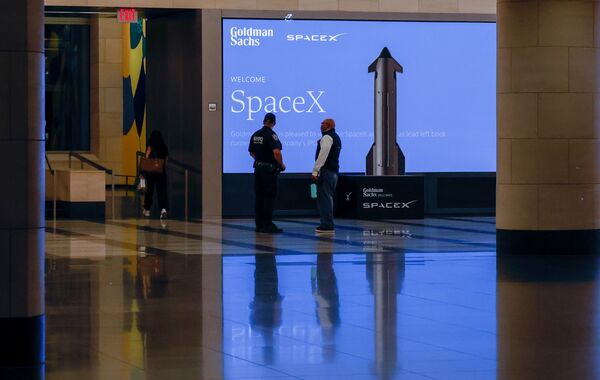
When Space Exploration Technologies Corp. goes public on Friday, its name will be everywhere — just not in the S&P 500 Index. The gatekeepers of the gauge announced last week that they will not make exceptions to their admission criteria for SpaceX. And rightly so.
The S&P US Index Committee’s selection requirements have had a big hand in helping the S&P 500 become the world’s most widely tracked index, with an astonishing $20 trillion invested or benchmarked to it. The committee would be crazy to abandon its approach now, which is essentially what making an exception for SpaceX would mean. OpenAI and Anthropic PBC will surely want a similar accommodation when they go public later this year, as will the other high-flying technology companies that follow. They will all now have to wait at least a year to join the venerated club.
The committee’s insistence highlights one of the great paradoxes in finance: The S&P 500 is widely viewed as the paragon of passive investing, yet it is actively managed. The committee has the last word about who gets in and when, even if companies meet the index’s requirements for inclusion.
That differs from other market trackers, such as the Russell 1000 Index or S&P’s total market index, where inclusion is practically automatic based on market value. The S&P 500’s curation is more akin to old-fashioned stock picking in that regard or to the newer generation of so-called factor indexes that select companies based on fundamental or price characteristics such as value, quality or momentum.
SpaceX will be sidelined by some combination of three requirements: that a minimum percentage of its shares be freely tradeable, that it be publicly traded for at least a year and that it posts a profit during its most recent quarter and full year. The latter two hurdles have contributed more to the S&P 500’s stellar performance than you might imagine.
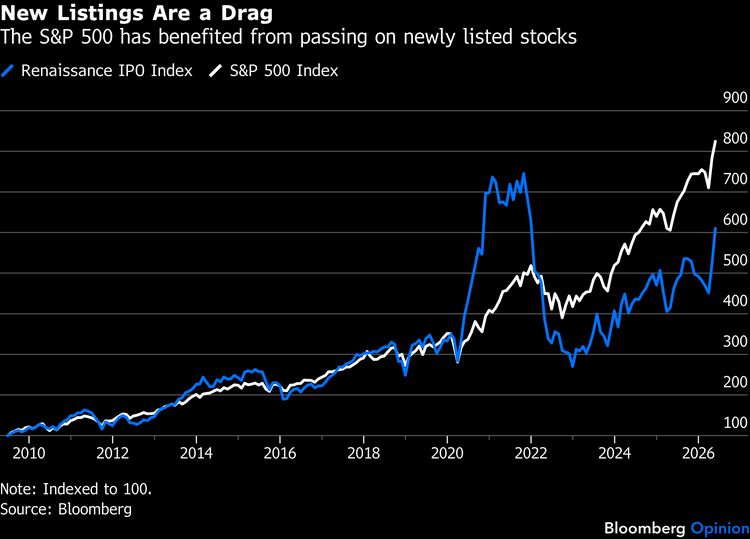
For one, newly listed stocks are a drag. The Renaissance IPO Index tracks the performance of US stocks during their first three years of trading, boasting almost no overlap with the S&P 500. The IPO Index has lagged the S&P 500 by 2 percentage points a year since 2009, the longest period for which results are available, and with nearly double the volatility during that time.
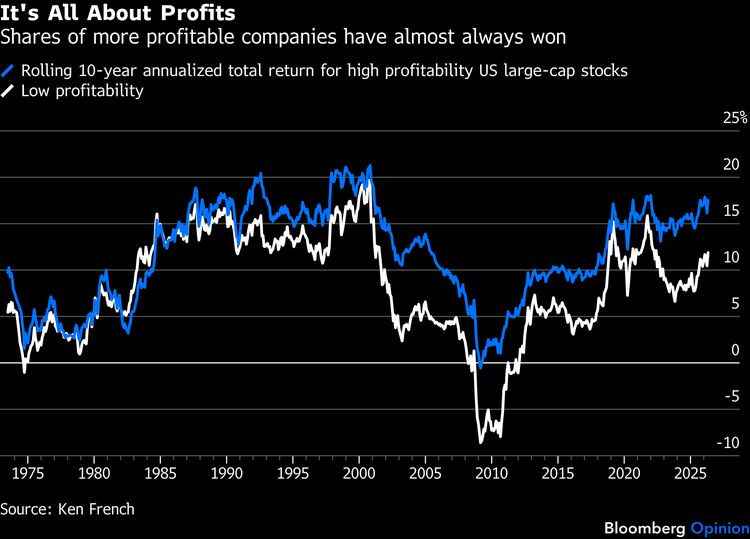
Profitability is even more impactful. Shares of the least profitable 30% of US large-cap companies have underperformed the most profitable 30% by 3.5 percentage points a year since 1963, including dividends, according to data compiled by Tuck School of Business professor Ken French. The low profitability stocks were also about 20% more volatile.
One might suspect then that unprofitable companies such as SpaceX are even worse performers. Some data point in that direction, although it’s muddied by the speculative frenzy during the Covid-19 pandemic.
Goldman Sachs Group Inc. tracks a basket of unprofitable tech companies. The S&P 500 outpaced the tech basket by a cumulative 40% from 2014 to 2019. The basket surged 300% in 2020, however, as traders bid up stocks such as Zoom Communications Inc., Peloton Interactive Inc. and Carvana Co. The group had easily surpassed the S&P 500 by early 2021.
It didn’t last long. Their stock prices soon collapsed, and by 2024, the S&P 500 had regained the edge, doubling the price return delivered by the tech basket over the previous decade.
But the fever appears to be back — the unprofitable tech basket is up 150% since April of last year.
Enter SpaceX to feed investors’ renewed appetite for promising yet unprofitable companies.
If the record of newly public and profitless stocks is any indication, SpaceX’s absence won’t hurt the S&P 500 and may even benefit it. What happens in the near term will depend largely on how much longer this latest love affair with unprofitable tech lasts. If SpaceX becomes fabulously profitable in the long run, as many expect, it will join the S&P 500 to the benefit of the index and investors. Profits are never guaranteed, though, no matter how inevitable they might seem for companies at the forefront of a technological revolution.
What is certain is that the difference in performance between the S&P 500 and other broad market indexes will be more pronounced than ever after SpaceX’s debut. At a $1.8 trillion valuation, SpaceX’s presence in trackers such as the Russell 1000 and Nasdaq 100 Index will be felt. Win or lose on SpaceX, I suspect the S&P 500 will be grateful it didn’t abandon its playbook for a hot IPO.
More From Bloomberg Opinion:
- Matt Levine's Money Stuff: You Can Just Not Buy SpaceX
- SpaceX Needs $5 Quadrillion to Rival Mag 7 Magic: Nir Kaissar
- Apple’s AI Reboot Is Making It Dependent on Google : Parmy Olson
Want more Bloomberg Opinion? OPIN <GO>. Or you can subscribe to our daily newsletter .