For a few hours last weekend, Tether’s USDT stablecoin became more valuable than Ether.
The crossover was brief. The symbolism was harder to ignore.
Ether, the token that powers the Ethereum blockchain, has long been viewed as one of crypto’s most important assets and a proxy for the growth of decentralized finance. Tether’s USDT, by contrast, is designed to maintain a steady value of $1 and functions primarily as a digital dollar for trading and payments.
That a stablecoin could briefly overtake Ether in market value speaks to a broader shift underway across digital assets.
Crypto’s recent downturn has battered many of the tokens that once attracted investors with visions of a blockchain-powered financial future. Ether has fallen sharply from its highs, weighed down by the broader market selloff , growing competition from newer networks and persistent concerns about security vulnerabilities, fragmented liquidity and whether activity on Ethereum ultimately translates into value for the token itself.
Ethereum’s challenge is increasingly described as a value paradox. Activity continues to grow across parts of its ecosystem, yet investors have become less convinced that growth necessarily translates into demand for Ether itself.
At the same time, stablecoins have continued to expand. Governments are advancing legislation aimed at integrating them into the financial system, payment companies are experimenting with digital-dollar settlement and traders increasingly rely on them as the plumbing of the crypto economy.
The contrast captures one of the defining tensions in crypto today. Some of the industry’s most commercially successful products are gaining users and becoming more embedded in finance, even as many of the assets that once represented the sector’s growth story struggle to attract capital.
“What it tells us is that the tangible parts of crypto, the parts that are genuinely being adopted, are continuing to grow, including stablecoins, settlement, payments, and the areas that are more speculative and cyclical are starting to have the question asked of their long term value,” said Zaheer Ebtikar, chief strategy officer at blockchain project Plasma.
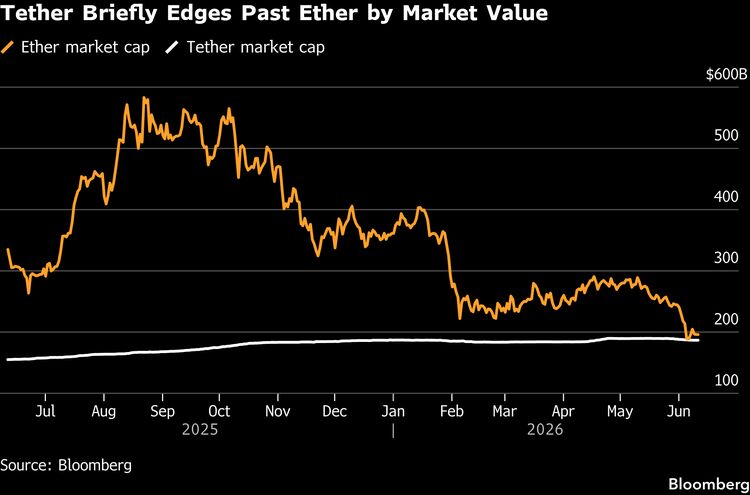
Those doubts appeared to peak this past weekend. Ether’s decline from its August high reached roughly 70% as almost every token got caught up in the accelerating meltdown of market bellwether Bitcoin. That cut the market value of Ether to as low as $182 billion at one point early Saturday. At the same time, there was around $187 billion of Tether in circulation, making the stablecoin briefly the second-largest cryptocurrency after Bitcoin.
Since its launch in 2014, Tether has been an abnormality among the thousands of digital tokens that followed the creation of Bitcoin. While Ether was supposed to be a “better” Bitcoin, Tether was created to solve two major problems in the early cryptocurrency market: high price volatility and difficulties converting holdings between traditional cash and crypto.
Serving those needs, as well as providing liquidity to exchanges, has already made Tether the most-traded cryptocurrency as measured by daily volume. That has come even as Tether continues to mostly operate outside the regulatory guidelines being established for digital assets in the US by the Trump administration.
“It definitely shows that stablecoins are here to stay and will become a more integrated part of our financial system,” said Tian Zeng, CEO and CIO of crypto trading firm Third Eye.
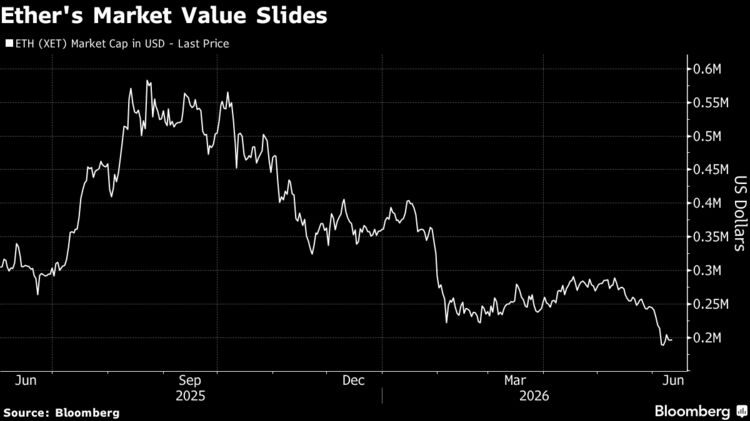
Meanwhile, Ethereum has suffered from a so-called value paradox where network upgrades have continued to weigh on the price of the Ether token. Its loudest supporters are now pitching the network as the plumbing for Wall Street — the very institutions its founders set out to disrupt. Yet the embrace remains partial and slow and comes with increased competition. While the blockchain is still is the most valuable platform for decentralized finance, newcomers like Hyperliquid are quickly outperforming the original “world computer” in many metrics such as fees earned.
Christopher Perkins, CEO of 250 Digital Asset Management, pointed out that the overall environment remains unfavorable for most cryptocurrencies.
“For now, energy is going into infrastructure and for many tokens, token prices are just not reflecting” value, said Perkins. “Retail capital is chasing shiny new AI toys and vulnerabilities uncovered by AI have shaken confidence in places. A less favorable macro environment with looming inflation and prospects of rate hikes hasn’t helped.”