US scientists say the El Niño weather phenomenon that has emerged in the equatorial Pacific is on track to become one of the strongest on record, raising the odds of destructive droughts and floods in the months ahead.
The US Climate Prediction Center said in a Thursday report that the Pacific’s surface has warmed enough to trigger a response in the atmosphere above it. El Niño notices from forecasters in the Philippines and Japan came earlier in the week. As the ocean continues to heat up, the event is expected to grow and exert more force over global weather patterns, peaking toward the end of the year.
“It’s in the ballpark of some of the strongest events we’ve had since 1950,” said CPC meteorologist Matthew Rosencrans. He pointed to a recent string of “wind bursts” and an unusually large accumulation of warm water in the tropics as key factors. “It’s the piling up of all of it together that gets you to this amplitude.”
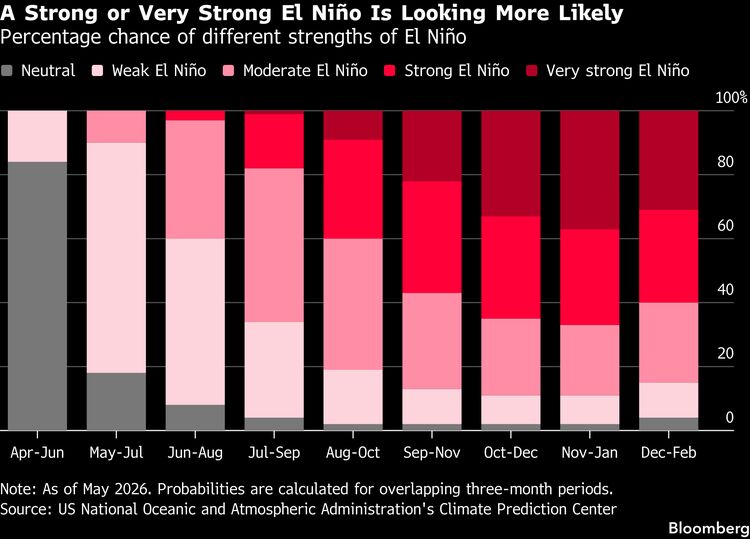
While no two El Niños are identical, stronger events — including outbreaks in the early 1980s and in 2015-16 — tend to produce predictable outcomes. They can pressure agricultural production, energy markets and global shipping routes while increasing the threat of disease outbreaks. Even before the El Niño declarations this week, its effects had been felt across several regions, including a delayed start to India’s monsoon season and a temporary halt to Peru’s anchovy fishing season.
A powerful El Niño in 1997 killed at least 30,000 people and caused roughly $100 billion in damages worldwide. A 2023 study by Dartmouth College estimated the lingering economic effects of major El Niño events can cost the global economy trillions of dollars.
| Read more: |
|---|
|
El Niño Emerges in Pacific, Raising Heat and Crop Risks Explainer: Why the World Is Bracing for a Rare ‘Super’ El Niño · |