Two hours into Bad Bunny’s second of 10 megaconcerts in Madrid , the singer darts offstage for a quick wardrobe change, tasking a Puerto Rican percussion group, Los Pleneros de la Cresta, with keeping the crowd in motion. As the band riffs on “Café con Ron,” a hybrid of plena, tropical synth sounds and bass-rattling drums with more than 300 million streams, the musicians encourage audience members to proudly hoist the flags of their home countries. The show might be taking place in Spain, but a sea of Latin American flags emerges from the masses.
The geographic diversity of the 60,000-plus fans filling the stadium every night of Bad Bunny’s sold-out Madrid residency in May and June reflects a wider trend playing out across the nation. In the past three years, Spain has welcomed more than 3 million immigrants, the bulk of them from Latin America. Their arrival has reignited growth, allowing companies to fill job openings at breakneck speed, and transformed the country into the fastest-expanding major economy in the euro zone. Today, roughly 1 in 5 residents is foreign-born, with recent population growth driven largely by arrivals from Argentina, Colombia, Peru and Venezuela — a kaleidoscope of high-earning Spanish speakers who until recently might have been more likely to land in Miami than Madrid.

Many of these transplants are middle-class professionals fleeing political and economic instability, drawn by Spain’s shared language, accelerated citizenship pathways for Latin Americans and access to the European labor market. At a time when Spain (like much of the developed world) faces a rapidly aging population, immigration has become an economic lifeline. Many open roles, such as those in tourism, elder care and agriculture, don’t require specialized skills, though more recently, the country has aggressively pursued highly educated Latin Americans to fill lucrative, high-demand jobs in tech and healthcare.
Migration has long been a prominent part of Spanish culture and history, and many Spaniards have relatives who emigrated to Latin America, just as many Latin Americans now come to Spain in search of a better future. That history helps explain why integration has often been relatively smooth. “The inclusion of these workers is very easy,” says Patricia Gabaldón, a professor of economics at IE University. “We are super lucky, because we speak the same language, but also because the cultural roots are very similar.”
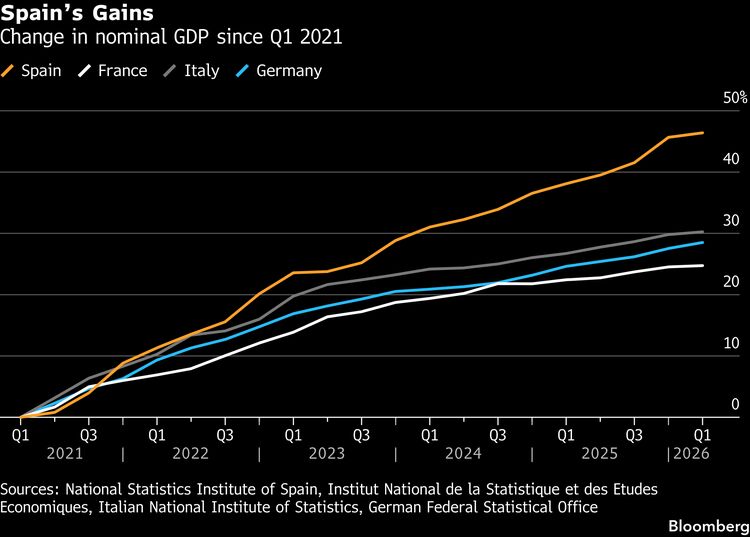
The embrace of immigration — something Prime Minister Pedro Sánchez has identified as both a social and an economic imperative — stands in sharp contrast to the growing nationalism elsewhere, particularly in the US , where many Latin Americans moved before the anti-immigration Trump era. And while other European countries have tightened entry, Spain has embraced the opposite approach. As part of an application process that ends on June 30, Spain will soon naturalize roughly 500,000 residents already in the country. Today immigrants fill roughly 90% of the nation’s newest jobs , according to a paper by Real Instituto Elcano, a think tank in Madrid.
The pro-migrant stance has faced criticism, particularly in parts of the country where housing remains in short supply. Hostile attitudes toward migration have been growing among the far and center-right, where common narratives include claims that migrants steal jobs, receive unfair access to subsidies or commit more crimes. Arab and Muslim migrants, in particular, tend to be perceived more negatively.
Ahead of the Bad Bunny concerts, thousands of locals took to the streets calling for rent protections amid the housing crisis. Across Spain, the cost of living continues to climb, a burden in a country where wages are low and work-life balance is prized. Those sharp price hikes are why 55% of Spaniards report a worse economic outlook compared with before the pandemic, according to a survey by think tank Funcas. Local officials have instituted measures to prevent short-term rentals, but the country still needs about 700,000 additional homes, according to a Banco de España estimate. If the cost of living rises too quickly, it risks curbing the stream of immigrants who’ve helped prop up growth.
Niki Dodd moved to Spain from Argentina in her 20s to find a job in the arts. That was before the latest wave of immigration, and the now-32-year-old creative director and photographer says she can feel the change. With costs rising, she’s having trouble finding the larger apartment she says she’ll need to stay in Madrid indefinitely. At the same time, she relishes the growing diversity in the Spanish capital and the buzz of fellow creatives who’ve helped transform the city.
After attending one of the Bad Bunny shows, Lorena Jusino, a 34-year-old Puerto Rican living in the city, says she regrets that more of her compatriots haven’t made their way to Spain’s capital. But she says interest in her home island is often a topic of conversation, one that inevitably turns to Bad Bunny, a proud Puerto Rican.
Still, when the artist — who
won album of the year
at this year’s Grammy Awards — takes the stage in Madrid, those demographics briefly shift. During his nearly three-hour set, Bad Bunny tells the audience they’re all welcome to be Puerto Rican for the night. His offer draws a deafening response from the multinational crowd. —
With Daniel Basteiro
Read next:
How Trump Has Made the US Doctor Shortage Worse