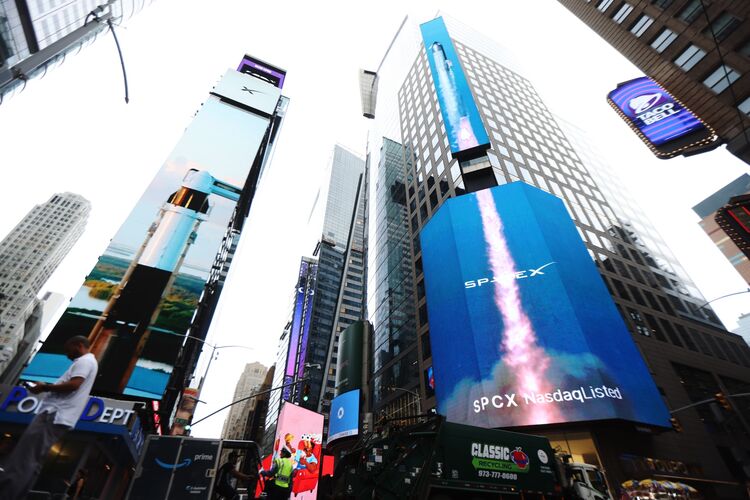
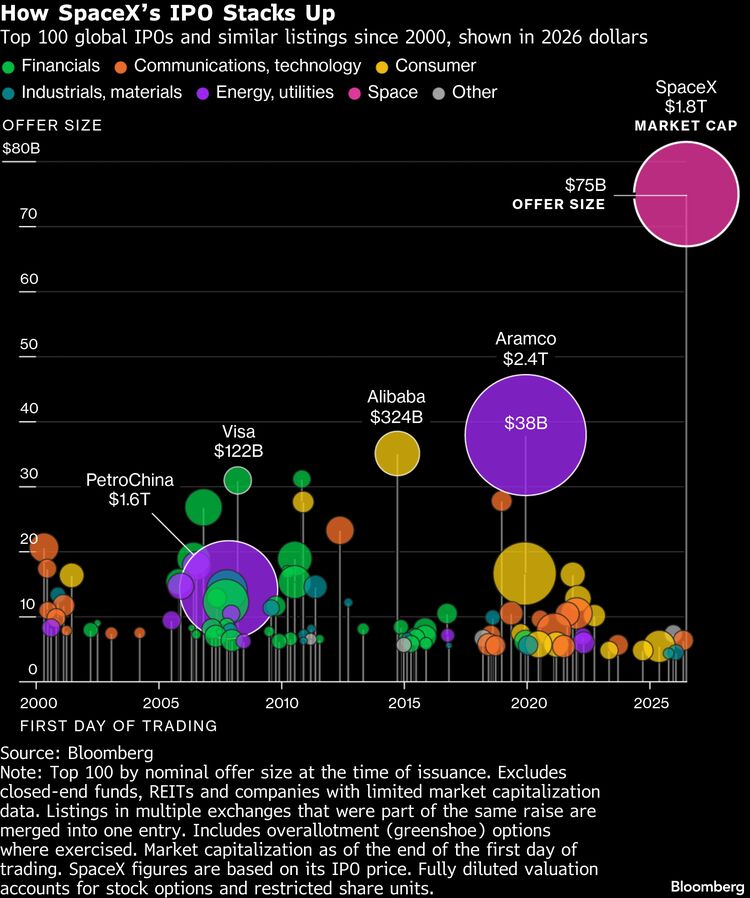
Shares of SpaceX climbed in their first day of trading on Friday following a $75 billion IPO that smashed records and instantly turned the crown jewel of Elon Musk’s business empire into one of the most-valuable public companies in the world.
The stock climbed as high as $176.52, or 31% above its offering price, in afternoon trading in New York. The jump in price turned Musk into the world’s first trillionaire and sent the company’s market capitalization above $2 trillion.
The successful first day of trading allows for a sigh of relief not only for backers of Musk’s company, but for an entire stock market that has been driven higher this year on optimism about the growth potential for artificial intelligence. SpaceX’s embrace of AI earlier this year with the acquisition of Musk’s xAI made the listing somewhat of a referendum on the IPO prospects of competitors Anthropic PBC and OpenAI, both of which plan go public themselves.
“I’m happy to see this go off in a positive way, because I think it bodes well for the market and for these other IPOs that are coming that are going to be quite sizable as well,” said Robert Gruendyke, senior portfolio manager for the growth equity team at Allspring Global Investments. “They clearly priced it right, at least for one day. It should just make you optimistic for the markets for, especially for growth stocks.”
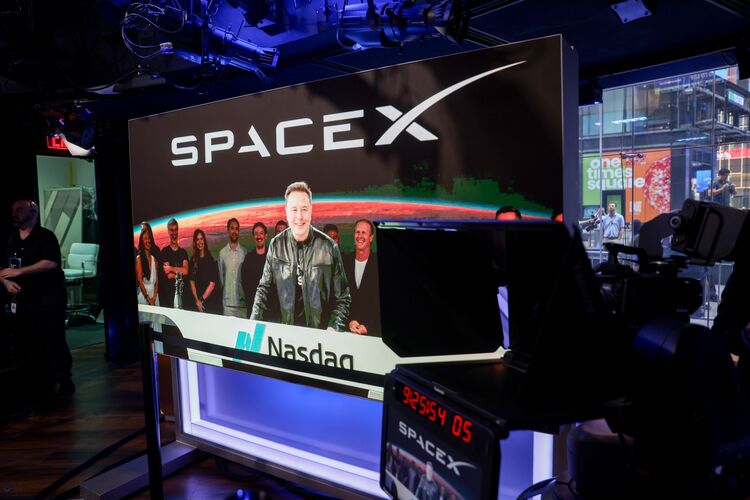
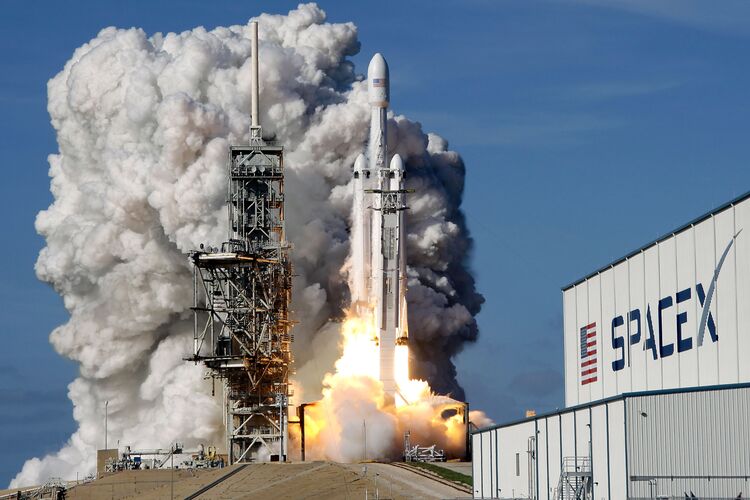
While SpaceX President Gwynne Shotwell, Chief Financial Officer Bret Johnsen and Musk’s mother Maye were among those gathered at Nasdaq MarketSite for the stock’s debut, Musk himself remained behind at the company’s headquarters in Starbase, Texas. And many of his employees had other business to attend to: SpaceX launched 29 of its Starlink satellites into orbit on its Falcon 9 rocket from Cape Canaveral, Florida, about an hour before US stock markets opened.
“It is certainly hard to believe that little company that started in a warehouse in El Segundo is now going public with the largest IPO ever,” Musk said in a livestream on X, the former Twitter that is now part of SpaceX. “And let me tell you if people had told me this was going to happen, I was like, man you must be smoking some really good crack, because I think this company is going to fail.”
The IPO drew more than $350 billion in demand from institutions and retail investors, according to people familiar with the matter. About 70% of the shares sold to institutions were allocated to so-called long-only investors in addition to sovereign wealth funds, the people said. BlackRock Inc. sought to buy about $5 billion in the IPO while Saudi Arabia’s Public Investment Fund and Kuwait Investment Authority placed orders for shares worth $1 billion to $5 billion, Bloomberg News reported.
Among the firms that placed orders, close to one-third of them didn’t receive any stock, some of the people said.
Despite all the enthusiasm for the listing, many investors were skeptical a company that has yet to turn a profit deserves such a hefty valuation.
“On the fundamentals, investors have got ahead of themselves,” said Amanda Lyons, head of research at Energy Group Capital, adding that she believes a sum-of-its-parts valuation would be about $600 billion, roughly one third of its IPO market capitalization. “But ‘expensive’ has never been a catalyst with Elon Musk, and betting against his premium has been a losing trade for a decade.”
Longtime believers in Musk, on the other hand, see value in the type of premium that gets attached to his companies.
“The SpaceX IPO signals the transition point from a software-dominated world to a hardware-dominated world,” said Shaun Maguire, a partner with Sequoia Capital who has led the firm’s investments in Musk’s companies. “This is true across the real economy, venture capital, the public markets, it is something that has been percolating behind the scenes for the last two to three years.”
The unprecedented size of SpaceX’s debut made the market mechanics of the listing complicated, triggering concerns about unexpected technical difficulties like the ones that derailed Facebook’s IPO in 2012.
The debut wasn’t entirely without glitches for the hordes of retail traders among Musk’s fanbase. Customers of Robinhood Markets Inc. faced issues during the first minutes of trading, with the website Downdetector reporting roughly 5,000 outages shortly before noon in New York amid record-breaking traffic.
Read More: Robinhood Clients Face Issues in Early Moments of SpaceX Trading ·
Yet the stock’s debut will likely be remembered for its orderly trading, and a jump in price that was relatively routine for a hot new listing.
“The initial bump is within the range of normality for a technology stock,” said Dec Mullarkey, managing director at SLC Management. “It’s what I would expect as I think the investor base has a range from those who believe Musk has the Midas touch to others that are technical traders. They somewhat keep each other in check.”
Index, Retail Tailwinds
Among the unsatisfied investors whose IPO allocation potentially fell short of their desired amount are retail buyers. That cohort delivered more than $100 billion of demand, the majority of which wasn’t met since the group received about $15 billion in stock. Another tailwind for the stock will be forced buying by index-tracking funds which could generate as much as $6 billion in demand as they snap up shares ahead of the stock’s expected fast-track inclusion in benchmark gauges, according to Bloomberg Intelligence.
Read More: SpaceX IPO Whips Musk Fans Into Frenzy: ‘The More, the Better’
Still, a jump in price on the first day following a large IPO is no guarantee of future share gains. Even some firms that soar after their IPOs fail to maintain the momentum. SpaceX will still need the market’s ongoing validation of its ambition to dominate AI and carry humans to the moon and Mars, as well as the company’s controversial governance regime that promises Musk near-total control.
For US IPOs raising at least $1 billion, the record for the biggest day-one gain belongs to design software maker Figma Inc., which rose 250% in its 2025 debut, data compiled by Bloomberg show. It gave up the increase and is now about 45% below its IPO price.
Companies with negative net income tend to lag by more than 10% over the first 18 months after their listing compared with profitable peers, according to a Trivariate Research report last year. SpaceX had a net loss of $4.28 billion in the first quarter of 2026.
At least some of the price action in post-IPO trading is due to the relatively small number of shares made available. SpaceX’s IPO is an outlier even by normal standards, with roughly 4.2% of its outstanding shares available to trade on day one.
Goldman Sachs Group Inc., Morgan Stanley, Bank of America Corp., Citigroup Inc. and JPMorgan Chase & Co. led the deal with 18 other banks participating. The company is formally known as Space Exploration Technologies Corp.
With Wall Street already lining up to give SpaceX price targets · as high as $190, the debate over Musk’s dream of making humans a multiplanetary species is about to begin.
| Read more on IPOs: |
|---|
| For the latest news on equity capital markets activity in the US, Canada and Latin America, terminal users can follow the channel or visit NI BFWECMUS. To subscribe to ECM Watch, Bloomberg’s daily roundup of news from around the region, click here. |