By Martin Ivens | Updated on Jun 12, 2026 at 05:00 AM
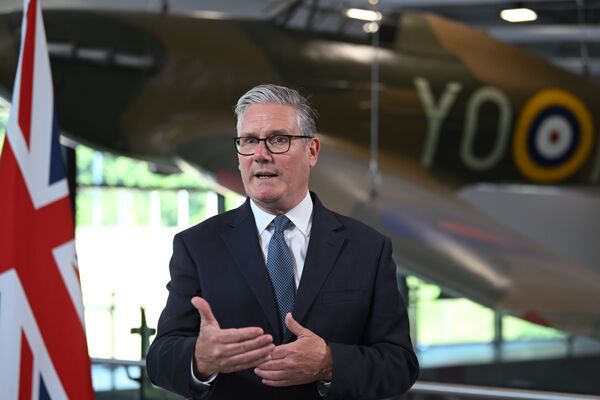
Three months ago Iran launched two intercontinental ballistic missiles toward the UK-controlled island of Diego Garcia in the Indian Ocean. Neither reached its target: A US destroyer shot down one and the other broke up in flight. Yet the strike blew an enormous hole in the credibility of Prime Minister Keir Starmer’s grandiose foreign and security policy.
That insight is now not only shared by his critics. His own Defense Secretary John Healey has issued a blistering resignation letter, essentially saying that Britain’s leader is not capable of dealing with threats to the country and NATO.
Like the rest of Europe, the UK is vulnerable to missiles and drones. But unlike some allies it has almost no independent air defenses. According to defense analyst Francis Tusa, in March the Royal Navy could deploy just one serviceable Type 45 destroyer equipped to shoot down ballistic missiles. That ship would have had to be permanently based in the Thames estuary to defend London, leaving the rest of the country totally exposed.
This unpreparedness for war is replicated across Britain’s shrunken, ill-equipped armed forces. In March, ministers tried to reassure voters that the UK had everything it needed to defend the country. It wasn’t true and Healey knew it. The prime minister ignored the wake-up call and the rot set in for one of the most crucial relationships in government, between leader and defense chief.
Not given to fits of pique, the pragmatic loyalist Healey decided to quit, saying he had “no other option.” On Thursday he delivered a devastating rebuke in his letter, using Starmer’s own acknowledgment that “there could be an attack by Russia on NATO as soon as 2030” as a call to arms. The charge against the PM is that he’s jeopardizing the security of the nation.
This is not so much a flounce as a gesture of despair. Healey has been pleading with the Treasury for almost a year — long before the Iranian war started — to commit resources to the government’s own defense investment plan. Some £28 billion ($37 billion) over four years is required to fulfil it. This week he was offered £13.5 billion — perhaps as little as £10 billion in new money once “Treasury tricks” or backloaded financing is taken into account.
Healey accused Starmer of playing cynical games with the numbers. The UK is meant to be committing 3% of gross domestic product to defense by 2030. Yet this spending “rises to just 2.68% of GDP in 2030, when we will reach 2.6% next year with the investment we are already making,” the exasperated minister wrote. Poland already invests 5% of GDP in its armed forces.
In his two years in No. 10, Starmer has found solace from domestic woes by taking to the international stage. With French President Emmanuel Macron he has led a European “coalition of the willing” to back Ukraine against Russia and helped create a multinational military mission to police the Strait of Hormuz.
The UK now leads NATO’s Arctic Sentry mission to counter Russian submarine threats and has promised to deploy a British force to Ukraine in the event of a ceasefire. But these are just words. Where are the troops, the money and the ships? On the last NATO exercise in the High North, a British commander led the mission from a German frigate because no Royal Navy destroyer was available.
Starmer has been too weak to face down his Chancellor of the Exchequer Rachel Reeves, too weak to order cabinet colleagues to cut welfare budgets to switch funding to defense, too weak to take on his own soft-left lawmakers. Above all the Healey riposte points to his defining flaw: He lacks the moral authority to make the case to voters for a greater commitment to the defense of the realm. So he relies on twisting the figures beyond credibility.
In fairness, the size of his task mustn’t be underestimated. It’s a classic “guns versus butter” dilemma for a left-of-center party. At the end of the Cold War, defense spending was much higher but in those days only 4% of GDP went to the National Health Service. Now that’s risen to 9% and the economy is growing at nothing like its pre-financial crisis rate.
A recently leaked WhatsApp message from another phlegmatic cabinet loyalist, Work and Pensions Secretary Pat McFadden, reveals Labour lawmakers’ priorities: “Every meeting I have is ‘who can we tax in order to pay benefits to others.’” Starmer has been forced to concede billions for welfare to appease his backbenchers, while putting small change in the defense begging bowl.
Next week we will learn whether Andy Burnham, the Manchester mayor, has won a by-election that will let him return to the House of Commons and challenge Starmer for the leadership. The PM has let it be known he’s up for the fight. No talk of his departure is permitted at cabinet. But what is he actually fighting for? A few more weeks of impotence? His dwindling band of defenders say he wants to put on a good show at the NATO summit in Ankara in July and secure a reset deal with the European Union as part of his legacy.
Britain’s allies will try to be polite, but Healey’s resignation makes the summit an impending humiliation. The Trump administration, already engaged in a war of words with the UK government over immigration, will not spare his blushes. As for a reset, the European Commission and member states will fail to see the urgency of concluding a deal with a man on his way out.
A robust defense and security policy was supposed to be Starmer’s legacy. It looks more like a millstone now. The problem with Healey’s resignation is that it has revealed that even the most stolid colleagues don’t believe the Starmer stump speeches. His word is not his bond and that is fatal.