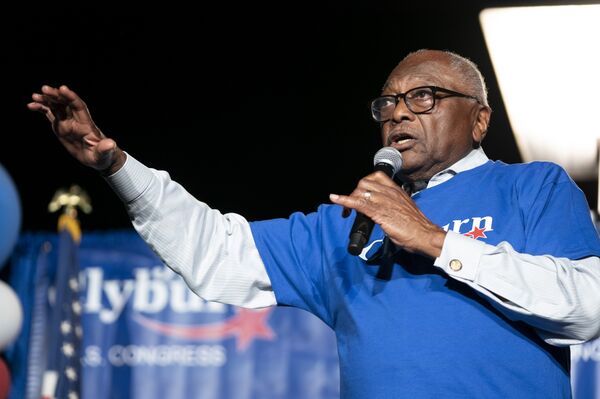
You can’t really think about South Carolina or national politics without thinking about Representative Jim Clyburn. First elected to Congress in 1992, Clyburn twice served as majority whip and had a big hand in rescuing Joe Biden’s flailing 2020 presidential campaign. His annual fish fry is a folksy, can’t-miss test for presidential hopefuls, like Kentucky Governor Andy Beshear and Representative Ro Khanna, who attended this year.
The 85-year-old Democratic powerbroker won his primary Tuesday in South Carolina with 90% of the vote . But his victory came as Republicans, enabled by the Supreme Court justices appointed by their party, have redrawn districts to blunt Black representation throughout the South, where the majority of Black Americans live . The GOP’s anti-democratic gerrymandering ahead of the midterms will accelerate in advance of 2028, further imperiling seats like Clyburn’s — majority-Black Democratic seats in the South.
It may also mean a new, diminished role for the Congressional Black Caucus. Known as the “Conscience of the Congress,” because of its advocacy around ending apartheid in South Africa and addressing poverty in the US, the CBC has also been a guaranteed check on GOP power since its founding in 1971. Members have gone on to the presidency (Barack Obama) and vice presidency (Kamala Harris). The caucus had a record-high 62 members at the start of the 119th Congress, roughly twice as many as when Clyburn was first elected.
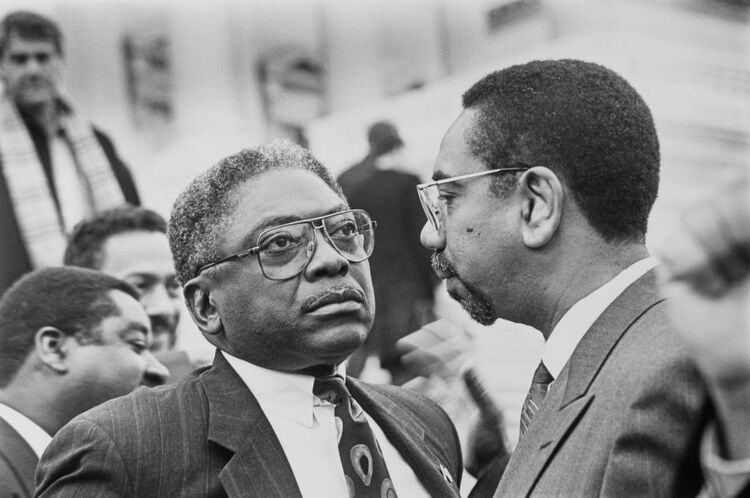
Clyburn, who I spoke with on Tuesday, has been involved in South Carolina politics for decades, fighting for civil rights nationally and in the state, where one in four residents are Black. South Carolina wants to be part of the “New South,” where tourists, retirees, snowbirds and corporations flock, rather than the “Deep South,” where entrenched racial divisions stifle progress and growth.
So when South Carolina Governor Henry McMaster, under pressure from the White House, called a special session to redraw Congressional districts to make them more friendly to Republicans, the effort fizzled. With early voting already underway, 12 Republicans sided with the state’s Democrats to preserve the current map, which includes Clyburn’s district.
For Republicans, it was a move at odds with the rest of the South where GOP leaders have erased districts with a sizable share of Black voters.
Clyburn’s status in the Palmetto State also likely helped stave off the GOP attempt to redraw his district, a reality Clyburn acknowledged. He also admitted that his other colleagues face more difficult odds.
“CBC members, if they run on their records, and lay out, in a very articulate way, America’s promise, they’re gonna do well,” Clyburn said. “But there’s gonna be some losses, some reduction in the numbers. A lot depends upon the state. A lot depends upon the voters in the district. A lot depends upon the candidate themselves.”
In all, as many as six CBC members could lose their seats in 2026 as a result of redistricting, though Representative Yvette Clarke, who chairs the group, has said that 19 are vulnerable. Whatever the final number, the drop in CBC membership will likely be a historic reversal in Black representation. Alabama has targeted one of its heavily Black districts, as has Louisiana. Tennessee’s Republican-led legislature also carved up the state’s lone majority-Black district.
A coalition of civil rights groups, among them the NAACP, has launched a grassroots movement highlighting the rollback in Black representation across the south. An “All Roads Lead to the South” rally was held last month in Selma, Alabama, the site of voting rights marches in the 1960s.
Nevertheless, when the dust settles in November, even if Democrats take the majority, it will likely be slim and the coalition may be less diverse.
After a Supreme Court ruling that narrowed a key part of the Voting Rights Act, Democrats have been hungry to counter GOP gerrymandering efforts with their own new maps — even if it means erasing Black districts. A May Politico poll found that a plurality of Democrats would be fine with fewer minority-majority districts if it meant gaining more seats.
The impact would likely not be felt in full for another cycle or two — and in the meantime, the 120th Congress could see Minority Leader Hakeem Jeffries elevated to the Speaker of the House. And it could be Clyburn’s last term .
Clyburn is confident that Jeffries will gain the gavel yet is also mindful of history.
“If Trump decides to declare an emergency and call out troops to the polling places, that’s the only thing that’s gonna keep Hakeem Jeffries from being Speaker of the House — and it could happen,” Clyburn said. “Anything that has happened before, can happen again. If you fail to learn the lessons of history, you’re bound to repeat them. It just may be that we have not learned any lessons from that history.”
Clyburn remains the consummate teacher, a link to a past that doggedly sought a more just future. The octogenarian lawmaker is a living testament to the strides the country has been forced to make by people who imagined and worked toward a world different from the one they were born into. Congress does have a need for a new generation of leadership, but the struggles and the hopes of the old generation are more relevant than ever.
More From Bloomberg Opinion:
- Jesse Jackson Remade the Democratic Party: Nia-Malika Henderson
- Can Democrats Spot the Real Lesson in the California Governor’s Race ?: Erika D. Smith
- Of Course the South’s Redistricting Push Isn’t Race-Neutral: Mary Ellen Klas
Want more Bloomberg Opinion? OPIN <GO>. Or subscribe to our daily newsletter .