The loans totaling $164 million are intended to spur private investment in conservation.
By Fabiano Maisonnave | Updated on Jun 12, 2026 at 04:50 PM
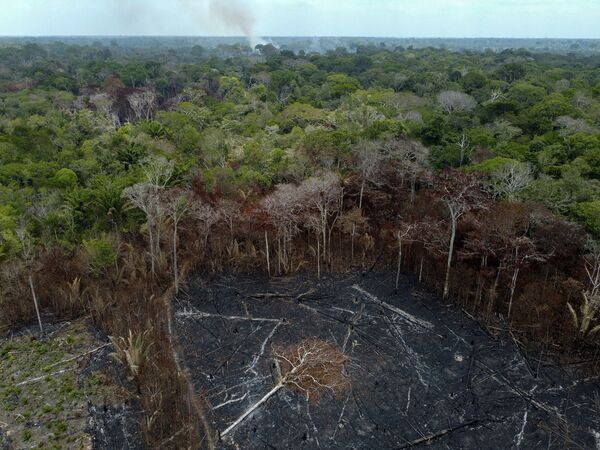
Brazil’s development bank approved 834 million reais ($164 million) in new loans as the country’s government looks to increase private-sector involvement in conserving and restoring Brazil’s major ecosystems, including the Amazon rainforest.
The loans will support five projects that, together, are expected to restore more than 65,600 hectares of land — an area roughly the size of Madrid — add more than 108 million native trees and generate some 27,000 jobs, according to the bank, known as BNDES.
Announced Wednesday at an event in Brasilia, the financing underscores how the government of President Luiz Inácio Lula da Silva is trying to shift forest restoration away from pilot projects and grants to become a bankable industry.
“This fund we are announcing here is credit — not philanthropy, not a donation,” said Tereza Campello, socio-environmental director at BNDES. “These companies are borrowing resources to invest in restoring native forests.”
Read More: Regrowing the Amazon
The development bank’s Climate Fund offers a 1% annual interest rate. The loan conditions are designed to reduce one of the main barriers to private forest restoration: the mismatch between commercial finance and the long timeline of forest growth. The bank says the new loans will mobilize 2.7 billion reais in total investment, combining subsidized public credit with private capital from companies developing restoration, agroforestry, carbon-credit and sustainable forestry projects.
A loan of 116 million reais will go to an agroforestry startup, Courageous Land, for a project in southern Roraima, a part of the Amazon under heavy pressure from cattle ranching and soybean cultivation. Agroforestry is a restoration model that seeks to balance farming and conservation. It mixes food crops, fruit trees and native species on the same land, seeking to generate income while rebuilding forest cover and ecosystem health. The company is in the early stages of producing coffee, açaí and cacao.
“The loan terms are very low interest rate, good grace period, and very long tenors that are compatible with agroforestry,” said Philip Kauders, Courageous Land’s CEO and co-founder. “And what’s interesting about this is that it allows other investors to crowd into these deals and make them bigger.”
Investment bank Banco BTG Pactual SA’s Timberland Investment Group said one of its companies received 200 million reais for a project covering about 49,400 hectares in the Cerrado, Brazil’s savannah. Another 87 million will go to Biomas, a restoration company backed by major banks and corporations, including Banco Santander SA and mining giant Vale SA, for a project aimed at reconnecting fragments of Brazil’s heavily depleted Atlantic Forest.
The financing comes as Brazil tries to meet its pledge to reduce deforestation to zero by 2030 while proving that conserving forests can compete economically with raising cattle and soy on cleared land. Deforestation is the country’s largest source of carbon emissions, accounting for roughly half of the nation’s total.