A growing divergence in interest-rate outlooks is forcing emerging-market investors to reshuffle bets.
Within the past week, Indonesia’s central bank delivered an off-cycle rate hike to reverse a market selloff and support its currency, while policymakers in Hungary and Poland are considering lowering borrowing costs after inflation fell short of estimates. Traders — who are also bracing for rate decisions in the US and Japan — expect Brazil to cut and Chile to keep key rates unchanged in the coming days.
“Divergence is the theme in the market now, given each country’s different inflation dynamics and central bank credibility,” said Ning Sun, senior EM strategist at State Street in Boston. “Core rates are rising in the US, Europe and Japan. But in EM, not everything is moving up with the core rates these days.”
Sun favors currencies and rates with what she calls “good carry” — high yields backed by credible policy frameworks and stable fundamentals — including Brazil, Colombia, Hungary and South Africa. She’s shorting what she deems as “bad carry” currencies, such as the Indian rupee and Indonesian rupiah, while steering clear of lower-yielding names due to uncertainty over the Federal Reserve’s path.
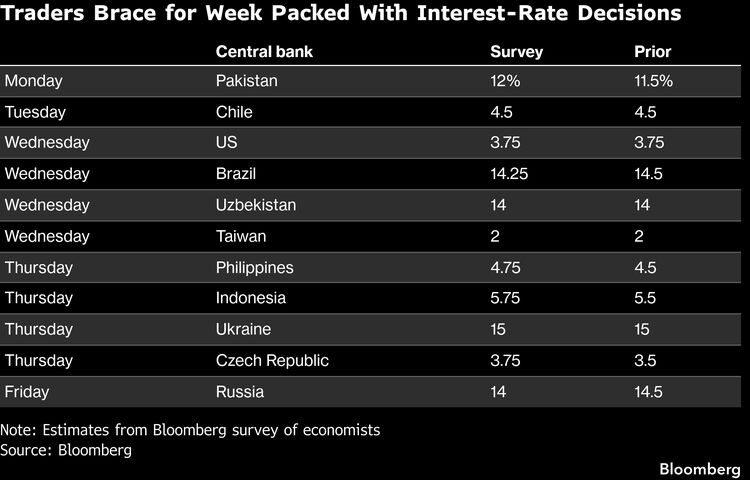
The widening discrepancies in monetary policy paths come amid increased volatility in global markets, roiled by constant changes in the outlook for the Middle East conflict and its impact in energy prices. Romania will likely have to hold rates after inflation hit a three-year high, and in the Czech Republic central bank Governor Ales Michl flagged a June rate hike as a “real possibility” amid price pressures.
Investors are also bracing for a potential hawkish turn by the Fed after strong US labor-market data and sticky inflation, and are now pricing in a rate increase by early next year.
Thierry Larose, a portfolio manager at Vontobel Asset Management, and Alexander Robey, a portfolio manager at Allianz Global Investors, both like local rates in Mexico and Brazil, betting the market has priced in too many additional rate increases. Larose also pointed to the impact of high oil prices on energy importers’ foreign reserves.
“Our preference is for countries that went into the war with significant FX reserves and real-rate buffers, especially those less dependent on crude and refined-product supply from the Middle East,” he said.
Some investors are also seeing value in Thailand’s longer-dated bonds after the yield curve shifted to the steepest in emerging Asia as slower price pressures and a weak economy allow policymakers remain on an extended rate pause.
Read More: What to Expect From EM Rate Decisions Ahead
JPMorgan Chase & Co. strategists Luis Oganes and Nora Szentivanyi last week turned overweight on higher-yielding currencies and markets where central banks are “ready to hike” — acting pro-actively to counter “any repricing higher in US rates.” They kept an underweight on Asian FX.
Citigroup strategists including Luis Costa, meanwhile, reduced exposure to the Turkish lira citing “a difficult path for the central bank to bring inflation under control.” Turkish policymakers held the main interest rate unchanged for a third time on Thursday even as annual inflation accelerates on the back of higher oil prices.
Caution
Even among the favored high-yielding markets, however, investors are becoming more cautious.
Allianz’s Robey is favoring the Chilean peso against the euro to avoid exposure to swings in the greenback. He’s particularly wary on Asia because the region is heavily dependent on energy imports, leaving currencies and inflation more vulnerable to higher oil prices.
“The biggest part from a fundamental perspective is how exposed countries are to what’s happening in the Middle East,” he said.
That caution is especially evident in Brazil, one of this year’s most crowded emerging-market trades. The country’s benchmark interest rate of 14.5% had attracted investors seeking carry. But over the past month, the real slid and swaps rates repriced as rising inflation expectations and higher US Treasury yields forced traders to unwind positions betting on lower rates.
“The recent rise in rates may present an attractive opportunity to bet on Brazil rates. However, we are still monitoring the development of key events, such as the US-Iran conflict and Brazil’s upcoming election, before taking a position,” said Mauricio Ferraz, portfolio manager at Kinitro Capital.
Read More: Brazil Assets Drop as Popular Emerging-Market Trade Fizzles
Brazil’s election is also on the radar for Ward Brown, fixed income portfolio manager on MFS’s dedicated EM debt team. “You can’t put too much weight on polls so far ahead of the election date, but from what we see, it looks to be a close call,” he said. President Luiz Inacio Lula da Silva leads most recent electoral surveys for the October election.
Wells Fargo strategist Alvaro Vivanco is waiting for better levels to resume buying the real, while preferring bullish positions in the South African rand and Peruvian sol against the Israeli shekel and Mexican peso. He has reduced bearish dollar bets and raised the threshold for adding exposure to fundamentally attractive currencies.
“We have turned more discriminating in our EM trade ideas this week,” he said.
What to Watch
- Activity data from Colombia and Peru will likely show that the two economies continued expanding in April.
- China’s activity data may show domestic demand remained a drag on growth last month; Malaysia’s inflation likely accelerated in May due to higher oil prices
- South Africa and Nigeria report inflation numbers