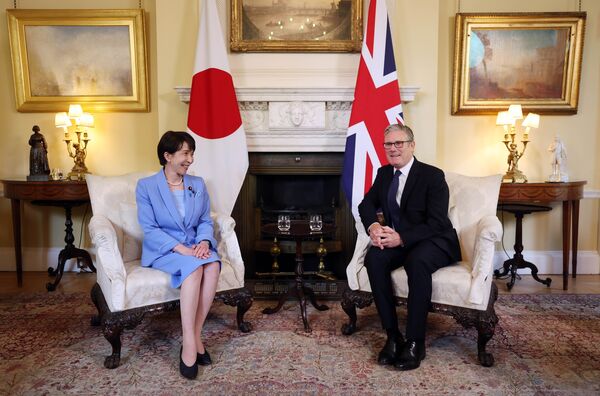
Japanese Prime Minister Sanae Takaichi hailed increasing defense cooperation with the UK during a meeting with her British counterpart Keir Starmer on Sunday, even amid uncertainty about a new fighter jet program.
“The UK is a very important partner to Japan given the deepening of ties across a wide range of fields, including security and defense,” Takaichi said as she met with Starmer in London. “Given the GCAP project, I think we have reached a level that we can call a near-alliance,” she said, adding that she hoped to elevate ties to the next level with Starmer.
“I’m really pleased that today we can reconfirm our deep commitment in relation to GCAP,” Starmer told Takaichi.
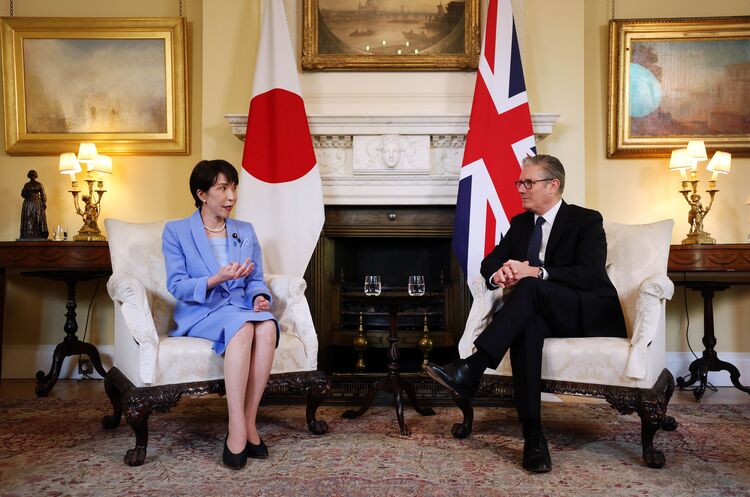
The comments on GCAP, or Global Combat Air Programme, an initiative between the UK, Japan, and Italy to develop a next-generation fighter jet by 2035, come as the project faces roadblocks including delays to Britain’s financial contribution and uncertainty after UK Defence Secretary John Healey — a champion of the project — resigned on Thursday.
Starmer and Takaichi were expected to discuss the launch of the next phase of the project through an international contract set to be signed this month, according to a statement by the British government ahead of the meeting. The statement didn’t say how much money would be invested.
Read more: Starmer to Meet Japan’s Takaichi as Fighter Jet Funding Sputters
The pledge to sign the international contract by the end of June would signal continued commitment, but the length of the contract wasn’t immediately clear. While an initial agreement lasting through June was signed in April to tide the project over, no longer-term contract has surfaced.
Britain had been expected to unveil billions of pounds for the GCAP in late 2025 as part of its 10-year defense investment plan, but it was postponed by several months due to a spending row between the UK defense ministry and Treasury.
In contrast, Italy’s parliament in February backed a $10.7 billion funding plan for the project, Reuters reported. Japan has set aside funds for GCAP from its annual budget. Its spending on the project totaled over ¥500 billion ($3.1 billion) in the five years to March, and the government earmarked a further ¥170 billion for the current fiscal year starting April.
“Japan and the UK are strengthened global strategic partners and also maritime nations. Therefore, we share the understanding that the security of each country’s region is inextricably linked,” Takaichi said at Sunday’s meeting. “Japan and the UK now share a strong determination to contribute together to international peace and stability.”
Starmer said he was pleased that they could reconfirm their cooperation on GCAP, which he called an “important strategic initiative for our two countries.”
The two leaders were also expected to to discuss the strengthening of economic security ties with a spate of initiatives and projects aimed at deepening cooperation in fields spanning AI, energy, and dual-use technology.
Starmer is looking to secure an investment of up to £9 billion ($12 billion) for the UK’s offshore wind sector, which would generate clean power for some 8 million households when completed, according to a statement from the British government.
That pledge would come months after the UK government blocked plans for a Chinese turbine maker to set up a £1.5 billion factory in Scotland after concluding that it posed a risk to national security. Offshore wind developers had asked the government if they could use parts provided by Ming Yang Smart Energy Group Ltd., but the government decided against it based on security concerns.
Read more: UK Blocks Chinese Wind Turbine Maker Over Security Fears
Starmer and Takaichi are also looking to form a new partnership that funnels Japanese investment into British research, with a focus on advanced technology spanning AI, quantum computing, civil nuclear, and defense. A new council will also be set up to support cooperation in developing dual-use technology that have both civilian and military use, such as drones and AI.