By Erika D. Smith | Updated on Jun 14, 2026 at 01:00 PM
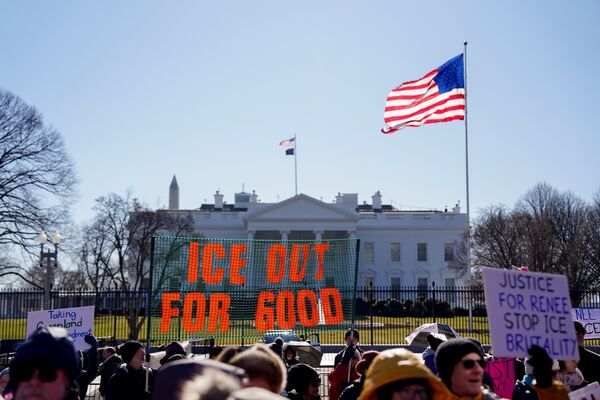
It was a year ago this month that President Donald Trump gave many Americans their first glimpse of his long-promised campaign of mass deportations. He deployed the military and immigration agents to Los Angeles for weeks of violent raids, and polls showed most Americans didn’t like it. They liked it even less when those violent raids moved to Minneapolis earlier this year and immigration agents fatally shot two Americans.
Nevertheless, Trump last week signed a $70 billion bill to fund ICE and Customs and Border Protection through the end of his term, setting up what’s likely to be the next iteration of mass deportations.
For congressional Republicans, who got creative by using the reconciliation process to shove the bill through on a mostly party-line vote, this represents a victory. But it’s likely to be a short-lived one.
Trump’s immigration enforcement campaign remains deeply unpopular with Americans. Less than half — 45%, according to the latest AP-NORC poll — approve of the administration’s handling of the issue. More than half want to abolish ICE. What had already been scant support for hardline policies such as separating undocumented immigrants from their children has declined further . Most Americans even oppose ICE agents patrolling stadiums during the World Cup.
And yet, Democrats’ demands to include reforms in the bill, including provisions prohibiting immigration agents from wearing masks and requiring them to get judicial warrants before entering homes, went nowhere.
At Trump’s behest, congressional Republicans just enabled those agents, under the Department of Homeland Security, to continue operating without the restraint that so much of the voting public has said it wants. This is a political ticking time bomb for Republicans, especially those running for reelection. By allocating funding for the next three years, they’ve given up any leverage that they might have had over Trump.
We’ve already seen the disastrous political and economic consequences of immigration enforcement conducted by an administration that’s notoriously resistant to accountability. LA was merely the first to experience it on its streets.
It was only a backlash in public opinion, fueled by viral videos of immigration agents dragging people from their homes and cars in Minneapolis, that led the administration to pull back on its most aggressive tactics. More recently, the White House has gravitated toward quieter policies — making it harder for undocumented immigrants to travel, for example, and to file taxes and receive medical care. But now that DHS is flush with tens of billions of dollars , some of which will go toward building and running a sprawling new network of ICE detention centers, expect that to change.
Already, turmoil has spilled into public view. As Bloomberg News has reported , DHS regularly leaves local government officials in the dark about its work, even when it’s planning to open a detention center near a school or a neighborhood. That has enraged residents, even in Republican-led states.
At existing ICE detention centers, protesters have been gathering and clashing with law enforcement, particularly at Delaney Hall in Newark, New Jersey . Immigrants held there and at other facilities have launched hunger strikes over what they describe as inhumane conditions , including spoiled food containing maggots and substandard medical care.
Even more troubling, a recent analysis by The Marshall Project and MS NOW found that the number of babies and toddlers held in ICE detention centers has increased dramatically under Trump. Between January of last year and March of this year, an average of 25 were in custody every day — 10 times more than under the Biden administration. Parents report their children have ended up sick and with noticeable regressions in their development.
As the mother of a 1-year-old told MS NOW: “Every single day, I would break down, hysterical, because my child had gone without proper food.”
Rather than address such complaints, DHS has largely dismissed them while also shutting down additional oversight . “The fact is, we’re giving them the calories they want,” Homeland Security Secretary Markwayne Mullin told reporters. “This isn’t Holiday Inn.”
At a signing ceremony in the Oval Office last week, Trump said the billions of new dollars would “give the heroes of ICE and Border Patrol ... the support and resources they need to defend our borders, protect our homeland and to keep America safe.” Trump has often tried to cast this and mass deportations as a “mandate” from voters.
But there’s also reason to believe Trump increasingly doesn’t care what voters want, as some of his recent comments on affordability show. When asked about the economic impact of the war in Iran, he told reporters in May : “I don’t think about Americans’ financial situation.” And just last week, he insisted, “I love the inflation.”
Once Trump is truly a lame duck after November’s midterm elections, there’s a good chance he will care even less about what voters want. Just like there’s a good chance he will care even less what congressional Republicans want or need to get reelected. The political incentives to address voters’ anger over the rapid expansion of ICE detention centers will be all but gone, for example. That’s a recipe for electoral disaster.
For months, polls have shown that Americans, by a 2-to-1 margin, believe the Trump administration has “ gone too far ” with its immigration enforcement campaign. $70 billion to go even further is an expensive self-own.
More From Bloomberg Opinion:
Want more Bloomberg Opinion? OPIN <GO>. Or subscribe to our daily newsletter .