
Corporate America is blowing past Wall Street’s expectations for a stellar earnings season , adding to the rosy backdrop for a stock market trading near a record high.
Powered by Big Tech, S&P 500 Index earnings have risen 31% in the second quarter from a year earlier, the best growth outside of recoveries from major recessions in Bloomberg Intelligence data going back to 1992. The performance is also trouncing projections for a 23% increase, a reading that itself would’ve ranked among the best outside of rebounds from downturns.
Analysts attribute the surprising growth in part to swelling profit margins as more companies deploy artificial intelligence. But they also cite the resilience of the US economy in the face of a bevy of headwinds, including the surge in energy prices sparked by the Iran war.
“It becomes even more of an outlier when you think of the context,” said Marta Norton, chief investment strategist at Empower.
Results from chip giant Nvidia Corp. are still ahead this month. But so far, tech, the largest sector in the US market, has seen profit growth accelerate from an already robust first-quarter pace, according to BI. The upshot is that with more than 90% of S&P 500 members having reported, the benchmark is on track for the strongest first half since the same period of 2021.
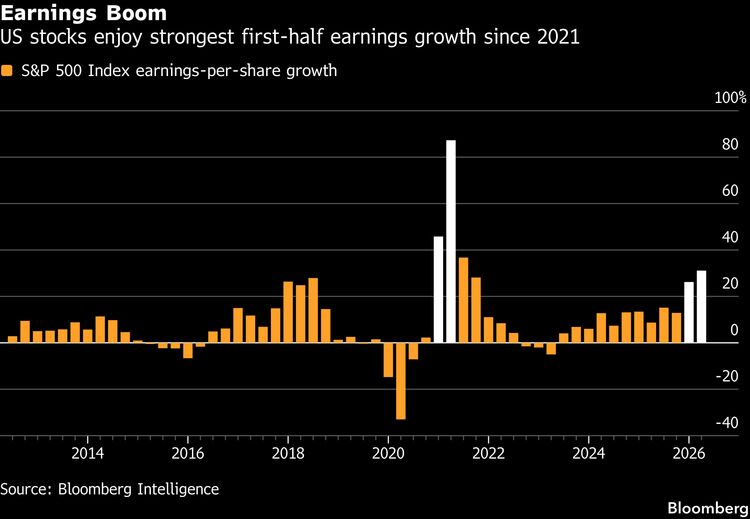
With profits booming, strategists are lifting their S&P 500 forecasts. The average projection has climbed to 7,894 points for year-end, indicating a further gain of roughly 1% for a market that set an all-time high this week. Analysts have also boosted estimates for the index’s full-year profit growth to 27%, from 15% at the start of 2026, BI data show.
“The scope of earnings upgrades is pretty much unprecedented — you don’t get double-digit upgrades outside of recovery periods,” Grace Peters, co-head of global investment strategy at JPMorgan Private Bank, said on Bloomberg TV.
Here are five things we’ve learned this earnings season.
Margin Lift
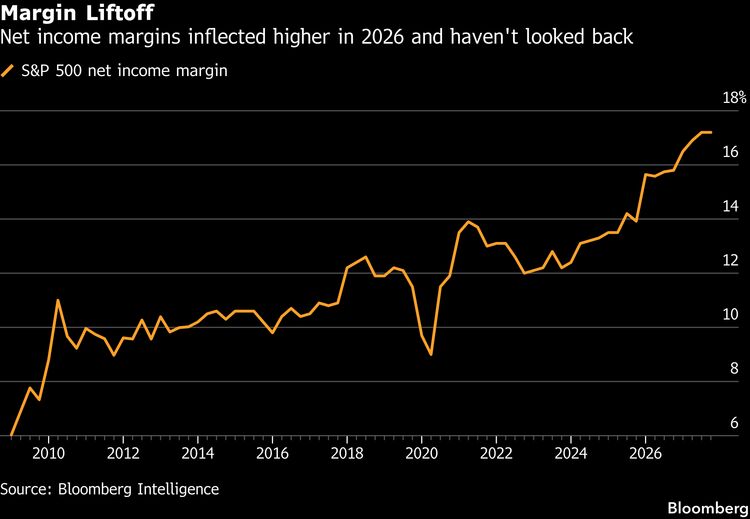
US companies’ profit margins are surging. Net income margins for S&P 500 members, which had previously struggled to exceed 14%, are now approaching 16%, according to BI, and analysts point to both the tech sector and tech-driven productivity gains as the driver.
“AI has been a cost center for the last five years, except for the hyperscalers that have benefited from the stock impact,” said Mark Hackett, chief market strategist at Nationwide Funds Group. “You’ve reached an inflection point this year where it’s now acting as a profit center.”
Tech continues to boast some of the largest margins in the S&P 500, according to BI. But more firms in other industries spelled out exactly how AI was helping increase margins, with 22V Research LLC pinning the boost at 150 basis points.
It’s not just the US. European profit margins surged to a record 12% in the second quarter, according to Deutsche Bank AG, amid broad confidence in economic growth and signs of AI-related cost savings.
European company executives mentioned AI more than four times on average on post-earnings conference calls, an all-time peak and above the average of 0.5 mentions since 2016, data compiled by BI show.
“Measurable cost and efficiency benefits have emerged as a key discussion point, with increasingly meaningful commentary on realized gains,” Barclays Plc strategists including Emmanuel Cau said.
Valuation ‘Reset’
Earnings growth for the S&P 500 is outpacing the advance in the index. The US benchmark is now trading just below 22 times forward earnings, compared with around 26 times at the beginning of the year, when a dominant theme was concern about sky-high valuations.
“We’ve had a nice reset and valuations are attractive,” said Keith Lerner, chief investment officer and chief market strategist at Truist Advisory Services Inc.
Even in the tech sector, which is headed for a seventh straight quarter of earnings growth exceeding 20%, multiples have come down. Lerner doesn’t expect those valuations to return to their previously lofty levels given questions around the outlook for Federal Reserve policy and energy prices.
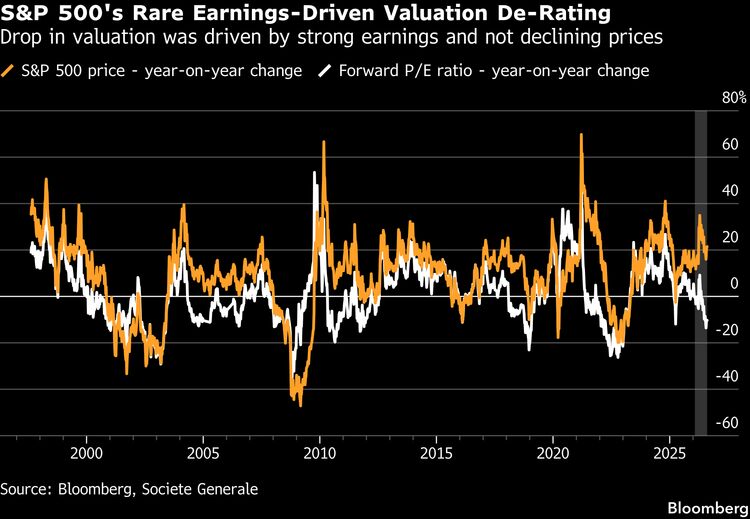
“So far, earnings, not multiple expansion, are doing the heavy lifting,” Scott Rubner, head of equity and derivatives strategy at Citadel Securities, wrote in a note.
Tech Divide
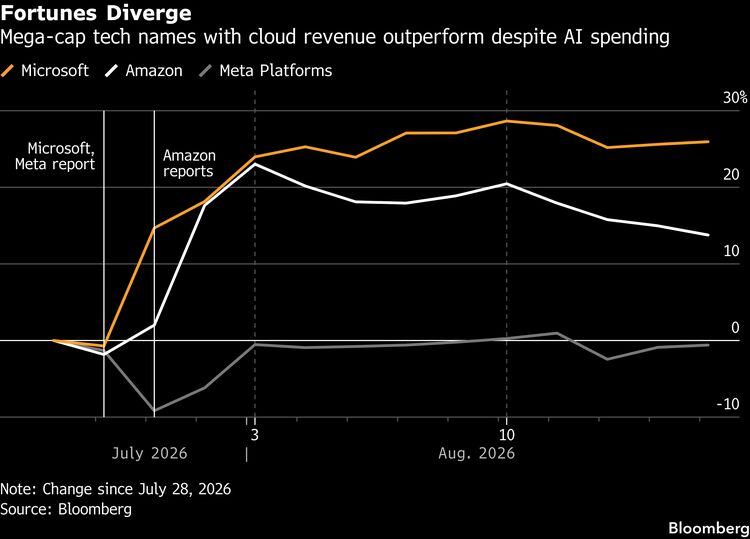
This earnings cycle showed investors will reward companies that demonstrate their spending on AI is generating cash, said Norton at Empower.
“The cloud is probably the clearest signal of all,” she said. She noted the outperformance of firms including Amazon.com Inc. and Microsoft Corp., which have monetized their cloud assets.
On the other hand, Facebook-owner Meta Platforms Inc.’s shares tumbled and have only recently recovered after the company gave a revenue outlook that was seen as disappointing.
International Appeal
European firms also showed resilience in the face of worries about the impact on growth and inflation from the US-Iran war. MSCI Europe Index constituents posted an 18% jump in second-quarter profits, the best showing since 2022, data compiled by BI show.
Economy-linked sectors including energy, materials and industrials were among the biggest contributors to earnings. That momentum has lifted several regional indexes, including the Stoxx Europe 600, Germany’s DAX and France’s CAC 40 to record highs.
“It’s undeniable that the macro story is picking up in Europe,” Benedicte Lowe, equity derivatives strategist at BNP Paribas SA, said on Bloomberg TV. “All of this is happening when positioning is still low to neutral. That paints a positive picture for stocks.”
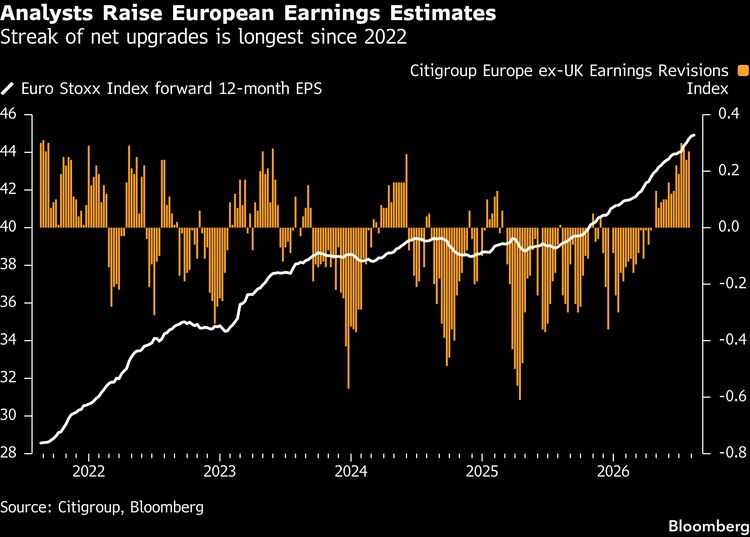
Companies are sounding even more bullish about consumer demand and economic growth in the second half. A Barclays analysis found the share of firms raising guidance was the highest in four years, with management confident about maintaining high profit margins.
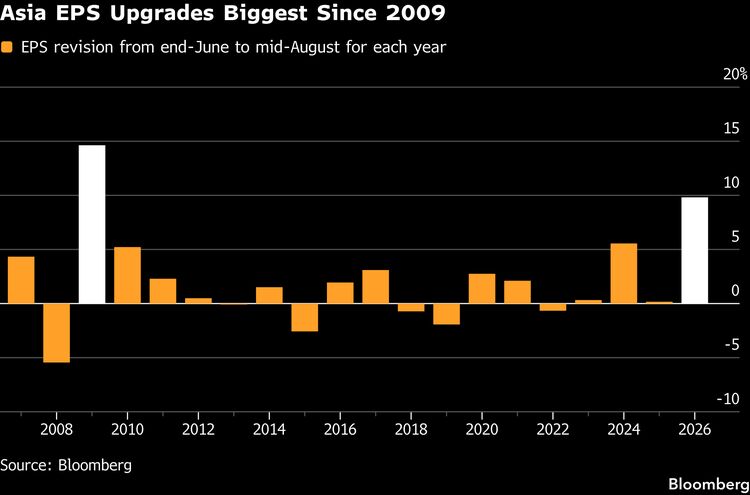
Meanwhile, consensus earnings estimates for the MSCI Asia Pacific Index have risen almost 10% since June, the strongest increase for this period since 2009.
Broad Beats
Wall Street strategists say they’re confident the robust earnings outlook is sustainable because the gains are evident in nearly every sector. Health care was the lone S&P 500 segment to contract in the second quarter.
“You have a positive breadth story this earnings season, which tends to tell us there’s more to come at the same pace,” said Rob Haworth, senior investment strategy director at US Bank Wealth Management.
Among 1,500 US-listed companies that had reported through Aug. 12, some three-quarters had posted earnings-per-share beats and also saw sales exceed expectations, data from Bespoke Investment Group show.
“The story goes beyond mega-caps,” said Ed Clissold, chief US strategist at Ned Davis Research. Beat rates for mid- and small-cap stocks are near record highs outside of the aftermath of the pandemic, he said.
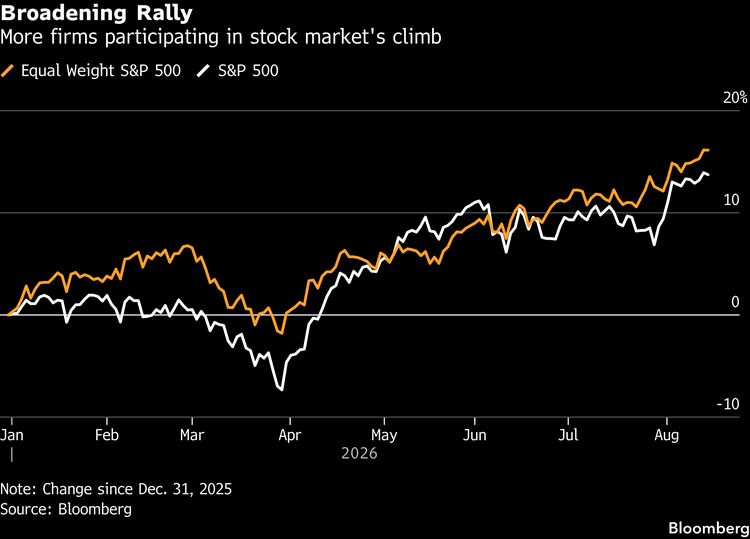
Asia’s rally is also widening out. Asian financials just posted their strongest monthly outperformance versus the MSCI Asia Pacific Index since 1998.
“The AI theme still dominates, particularly in semiconductors,” said Rajeev De Mello, a global macro portfolio manager at Gama Asset Management. “But investors are increasingly looking beyond the obvious chip names — to non-chip AI beneficiaries, financials and other laggards where valuations are less demanding.”