Even before Nvidia Corp.’s splashy $500 billion financing partnership this week, investors were starting to fret over the roughly $70 billion in phantom liabilities that don’t appear on major AI companies’ balance sheets, but could materialize at the worst possible time.
With its latest move, Nvidia is poised to provide potentially tens of billions of dollars of what’s called “residual value” support for debt deals tied to the artificial intelligence build out — effectively letting firms rely on its strong credit rating in a bid to contain customer costs.
With demand for computing power soaring, this backstop has become something akin to a free lunch for massive companies like Nvidia and Broadcom Inc., since they can bolster sales to clients and AI firms without taking debt onto their own books. Meta Platforms Inc., which first used this structure for its own data centers, referred to its residual value guarantees plainly in filings: “RVG payments are not probable, and therefore no liability has been recorded to date.”
“Not probable,” though, is increasingly not enough for some.
These backstops are expected to expand with the looming explosion of AI chip debt. That’s led investors to look at the handful of past deals for clues about how Nvidia could structure its agreements.
Under the way Meta put together its deals, the backstop could only come into play if Meta itself chooses to walk away from its data centers early. But Broadcom applied the concept to chip financing and is backstopping Anthropic PBC, tying its own exposure to a customer’s moves.
The arrangements typically involve a multi-step chain: a special-purpose vehicle borrows money to buy the chips, backed by the cashflow from a contract with a company that will use the technology. If the firm stops paying, then the assets are leased out again or sold to pay back the remaining debt. If there’s still a shortfall, then the backstopper makes up the difference.
Read More: Nvidia’s $500 Billion Plan Envelops Wall Street in Its AI Frenzy
In theory, that sequence is a remote risk. Proponents argue that demand for chips will outstrip supply for years. The debt is structured to be paid down in full over time, meaning the possible cost of any residual value support also drops as the years pass. Arguably, the tech risk lands where it belongs: on the balance sheets of companies with enough cash to absorb a blow if something goes wrong.
| Deal | Backstop | Asset |
|---|---|---|
| Beignet (Meta) | $28 billion | Data center |
| Sopaipilla (Meta) | $13 billion | Data center |
| Big Sky (Broadcom for Anthropic) | $29 billion | Chips |
Yet rating agencies aren’t ruling out those backstops being used, and investors are urging caution over risks accumulating off balance sheet. Wall Street was already skeptical that the blistering pace of AI infrastructure spending will yield sufficient returns. In an industry downturn, these backstops could force chipmakers to honor billions in pledges precisely when their own earnings are under pressure.
“It’s like you’re really gaming the system here; you’re trying to get preferential treatment from rating agencies so that you get the best rating possible,” said Mariya Entina, a portfolio manager at DoubleLine. “We’re coming into this era of financial engineering. And that’s one of my concerns: When you have financial engineering, you’re obscuring the financial reality.”
Representatives for Nvidia and Broadcom didn’t respond to requests for comment. A representative for Meta did not have a comment.
‘Boom-Bust’
The question consuming investors now is how to gauge the probability that these off-balance-sheet contingencies will turn into on-balance-sheet problems.
Read More: AI Investment Race Could Turn Debt-Fueled Boom to Bust, BIS Says
With the residual value support, Nvidia is effectively “writing a put,” analysts at CreditSights wrote in a report.
“This is pro-cyclical and exacerbates boom-bust potential,” the CreditSights analysts wrote. “The guarantee is nearly costless in the boom phase, but becomes most relevant in a severe, abrupt downturn, if / when customers are defaulting and market value for hardware is falling.”
Read More: Nvidia Taps Wall Street for $500 Billion Funding Commitment
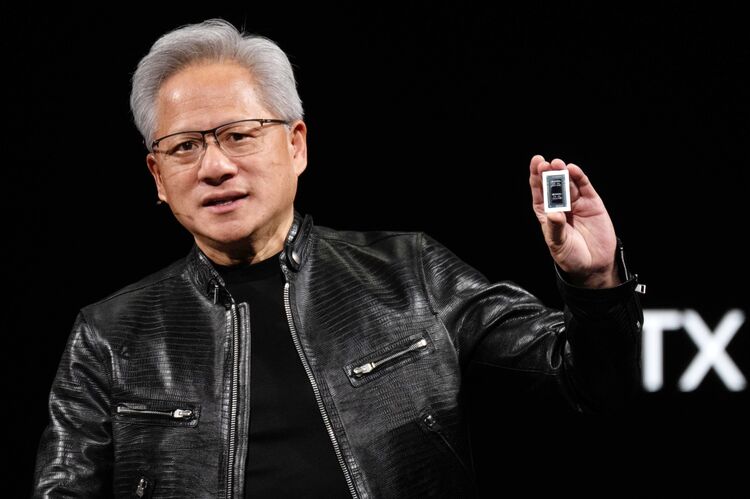
Nvidia Chief Executive Officer Jensen Huang wrote in a post on X that his firm may provide a residual-value support mechanism for up to 25% of an opportunity, assessed on a case-by-case basis.
“Our role is to help unlock a very large pool of independent capital while maintaining disciplined risk exposure,” he wrote.
Nvidia offered few other details about the partnership, besides saying it was meant to allay “ circular financing ” concerns — where AI firms fund one another to buy each other’s products — by bringing in outside capital.

Meta created a template for the AI buildout when it used the residual value backstop structure as part of a roughly $27 billion debt package to finance the construction of its Hyperion data center in rural Louisiana, in a deal called Beignet. This essentially protects lenders if Meta chooses to exit its 20-year lease early. The company followed a similar format in a roughly $13 billion debt deal for its Sopaipilla data center project in Texas.
Broadcom made waves by applying a similar structure to chip financing with project Big Sky, where it backstopped most of a $35 billion debt deal where investors including Apollo Global Management Inc. and Blackstone Inc. financed the purchase of custom AI chips to lease to Anthropic. This enabled the senior debt tranches to win investment-grade ratings at lower borrowing costs.
Read More: Apollo Wraps Up $35 Billion Chip Deal for Anthropic
Unlike those decades-spanning data-center deals, chip financings operate on shorter timelines. They typically amortize in roughly five years to match the rapid depreciation of the technology. This shorter horizon burns down the backstop value quickly, giving lenders the confidence of a visible horizon rather than a multi-decade bet.
“This isn’t your garden-variety investment grade credit underwrite,” said Brian Gelfand, co-head of global credit at TCW, speaking of the arrangements broadly. “It’s far more complex than that. The tail risks are elevated given the off-balance sheet nature.”
Contingent Obligations
The Big Sky deal was the first part of a partnership called AI XPV that Broadcom struck in June — a platform that could amass $370 billion of senior debt by mid-2029, according to Bank of America strategists.
“The primary risk lies in multiple such transactions occurring over a short period,” analysts at Moody’s Ratings wrote in a note. “We would view a substantial increase in Broadcom’s contingent obligations, even if leverage associated with its outstanding debt remains low, as limiting Broadcom’s financial flexibility and could create an overhang on the company’s credit profile.”
While the medium-term outlook for AI infrastructure remains strong, they wrote, the risk of the backstop being triggered still exists amid limited long-term visibility.
S&P Global Ratings said it considers the residual value support offered by Broadcom a “contingent debt-like obligation” that it will add to its adjusted debt calculation.
Under US accounting rules, companies typically record contingent liabilities on their balance sheets when losses are likely and can be reasonably estimated. In some other cases, they may instead disclose potential losses in financial statement footnotes.
Some see a doomsday scenario as an overblown fear. For the residual value support to be triggered, “you would have to have growth rates of token usage fall of a cliff, which we’re just not seeing,” said John Lloyd, global head of multi-sector and corporate credit at Janus Henderson Investors. “They’re not trying to hide the contingent liability. They’re trying to get it financed.”
| What to Watch |
|---|
|
Week In Review
-
In the latest sign of Silicon Valley stalwarts competing for capital as well as business, Nvidia Corp. said that six US investment giants, including BlackRock Inc. and Goldman Sachs Group Inc., are providing
$500 billion of financing
for AI infrastructure for the chipmaker’s clients. The money managers will independently choose to provide based on their assessments of individual projects.
- Nvidia CEO Jensen Huang said that the company would also guarantee as much as 25% of some projects, using a residual value support mechanism
- The funding coalition also included Apollo Global Management Inc., Blackstone Inc., Brookfield Asset Management and KKR & Co.
- The deal is meant to allay concerns of circular financing, where AI suppliers help finance their customers’ purchases, potentially leaving them with losses if clients end up losing money. Credit default swaps on Nvidia broadly narrowed after the announcement, but remain high relative to the company’s credit ratings.
- Jane Street issued $14.6 billion of bonds, part of a broader overhaul of its debt load that will also allow it to fund technology infrastructure and expand its trading strategies.
- The default rate across 1,300 US private debt borrowers tracked by Fitch Ratings rose to a fresh record in July, a report showed.
- The big tech companies disrupting industries with AI are a risk for investors, but so are the companies getting disrupted. AI tools, investors fear, could replace many existing software products. Developers owned by private equity firms are facing piles of debt and market headwinds, a potential disaster scenario being dubbed as the “SaaSpocalypse.” Many private equity firms are now gravitating toward more traditional buyouts of businesses that are asset-heavy and old-economy.
- The US Securities and Exchange Commission rejected credit rating firm Egan-Jones Ratings Co.’s application to re-enter the market for grading asset-backed securities and government debt. The SEC added that it has to reject petitions if a firm doesn’t have adequate resources to consistently produce credit ratings with integrity and to comply with specified statutory standards.
-
Companies rushed to the investment-grade debt market ahead of key US inflation reports this week. On Monday, 19 firms tapped the market,
the most in seven months
. They raised a combined $27.6 billion of notes.
- In the high-yield markets, Lambda Inc., an AI cloud-computing provider backed by Nvidia Corp., wrapped up a $926 million leveraged-loan deal as that market becomes a new front in the borrowing binge to finance the AI buildout.
- Meanwhile, Zenith Arc, an Oklahoma data center project that is leasing its capacity to Jane Street, is selling $2.25 billion of green bonds , adding to the flurry of builders tapping the market for environmentally focused debt.
-
Myriad investor protections were added to Gainwell Technologies’ $4.34 billion bond-and-loan sale as it works to complete what would be the US software sector’s biggest refinancing this year.
- PureStar, a commercial laundry firm backed by Cornell Capital, pulled a leveraged loan offering after struggling to draw sufficient investor demand at the proposed terms.
- The US SEC is making it easier for data-center owners to raise money in the asset-backed securities market after a staff opinion said that securitizations backed by such assets don’t require the same disclosures and investor protections as debt tied to car loans and home mortgages.
- Billionaire Mark Walter’s firm is in talks with investors to raise money to help pay down loans on the books of its insurers that had drawn scrutiny from the Justice Department. TWG Group is looking to address concerns about the outsize loans that Walter’s insurers have made to other parts of his investment empire. Walter’s announcement this week that he was selling the Los Angeles Lakers basketball team to Josh Kushner and Bob Iger for $12.5 billion is accelerating TWG’s effort. Walter has proposed as collateral his equity stake in Guggenheim Partners, which runs a $320 billion asset-management arm.
- Equity arbitrageurs are growing more confident that Paramount Skydance Corp.’s $110 billion acquisition of Warner Bros. Discovery Inc. will move forward despite an ongoing legal battle with US states, with the arb spread between the Warner Bros.’ share price and the offer price reaching its narrowest level since early March. The debt financing in the transaction could be around $50 billion , including high-grade notes, junk bonds, and loans.
On the Move
- Royal Bank of Canada ’s RBC Capital Markets has hired Lauren Melrose , previously at UBS , as a leveraged finance strategist. Melrose reports to Jason Mandel, head of performing leveraged finance desk strategy.