Grassroots calls for a second incursion into Ceuta from Morocco fell flat over the weekend, with security tight and authorities turning back the relative handful who tried to make the move.
Spain’s tiny North African enclave made global headlines in late July when some 70,000 people, mostly young men, crossed the border by swimming around the breakwater that separated Ceuta from Morocco.
The mass incursion — into a city whose population is about 85,000 — sparked a migration crisis across the European Union and the Schengen zone. At least 88 died in the attempt. The vast majority of the would-be migrants have since returned to Morocco, according to Spain’s government.
Calls spread across social media in the past week for a new attempt to reach the enclave. Bogus posts circulated on Facebook and WhatsApp promoting the claim that Spain would open its border on Aug. 15, a national holiday. But this time, authorities were ready, with a heavy military presence near the border and along major highways further south.
“This Aug. 15 call for an invasion is a hoax. Nothing will happen,” a Moroccan interior ministry official who identified himself as Salheddine, said on Saturday at the entrance to the border post with Ceuta. “The army is combing all the forests and hills surrounding Fnideq. Everything is under control.”
Read more: EU Tries to Tamp Down Divisions After Ceuta Migration Surge
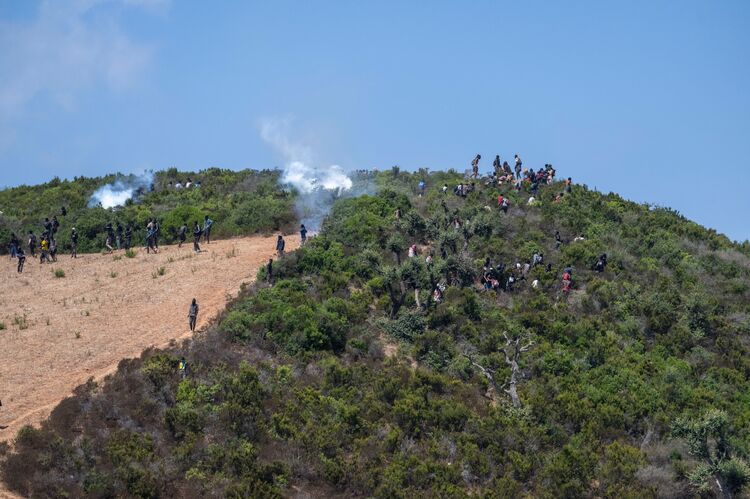
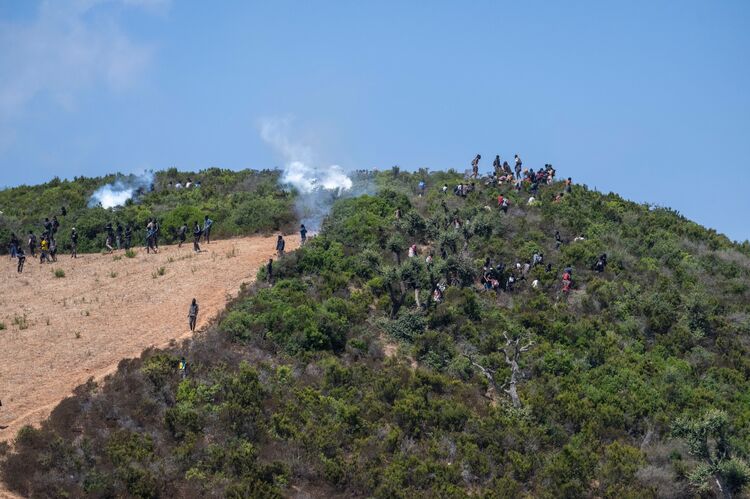
Still, hundreds of sub-Saharan African migrants gathered in Fnideq, a sun-splashed Moroccan Mediterranean town popular with local holidaymakers, watched by a military helicopter hovering over a nearby hillside. They looked to force their way past security forces and reach Ceuta — this time, by foot.
Minutes later, tear gas canisters were fired and Moroccan security forces — part of a massive deployment assembled since the July incident — charged the migrants. Those unable to escape were marshaled into buses and vans parked nearby. State media reported that 111 were arrested.
It was unclear where those detained were bound for. Undocumented migrants from sub-Saharan Africa have at times been sent to remote parts of Morocco, while others have been expelled from the country.
Read more: Italy Insists Spain Border Checks About Security, Not Politics
The EU has reached out to social media giants regarding Ceuta, according to Henna Virkkunen, executive VP for tech sovereignty, security and democracy of the European Commission.
“Earlier this week we met again with Meta and TikTok to advance our cooperation on the Ceuta situation,” Virkkunen said Saturday on X. “Both platforms have ramped up enforcement against human smuggling and disinformation.”
Both Facebook parent Meta Platforms Inc. and ByteDance Ltd.’s TikTok have “activated crisis protocols” to vet posts about Ceuta, Virkkunen said last week.
While none of the migrants who entered Ceuta in July are believed to have traveled on to the European mainland, Italy has temporarily imposed border checks with Spain — a move it said was driven by national security concerns, not politics.
Italian Interior Minister Matteo Piantedosi said Italy’s border checks were to be targeted at third-country nationals and designed to cause as little disruption as possible.
Read more: Sanchez Isolated After Spain Sparks Fear of Migration Crisis