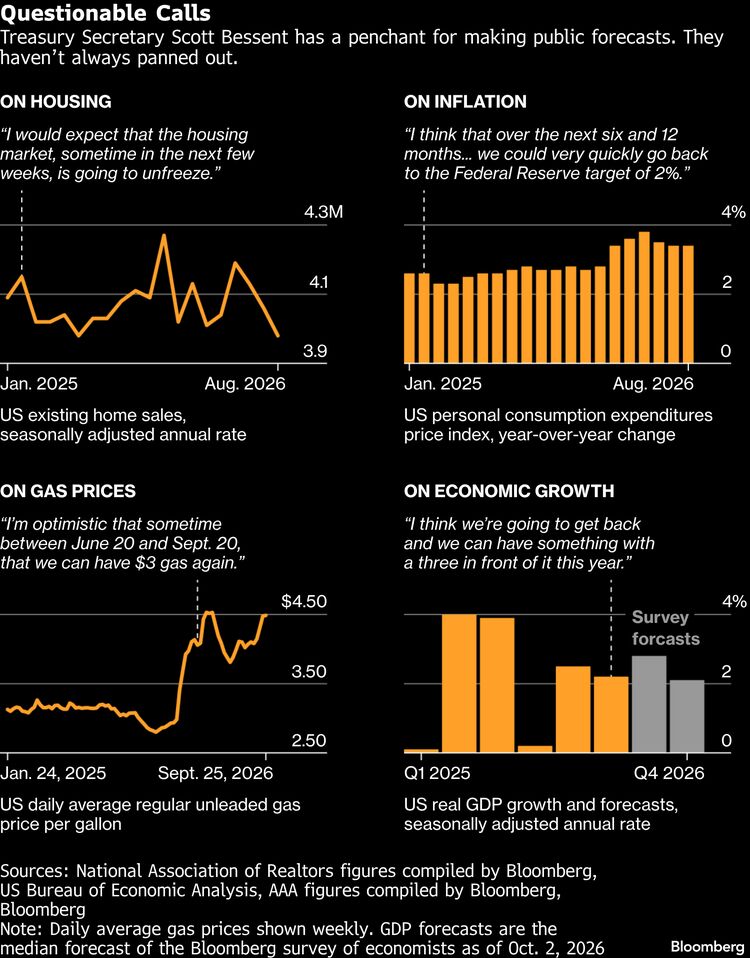
In his 20 months on the job, Treasury Secretary Scott Bessent has made a habit of putting his economic predictions on the record. The housing market, he said in February 2025, will “unfreeze” within weeks , and inflation could return “quickly” to the Federal Reserve’s 2% target. In April, he offered a forecast that spoke directly to the pocketbook concerns of many Americans: “I’m optimistic that sometime between June 20 and Sept. 20 that we can have $3 gas again .” He’s made similarly rosy projections for economic growth, budget deficits and more.
Most of those forecasts have been off the mark. The housing market is still glacial, reflecting rising borrowing costs: Sales of existing homes in August dropped to the slowest pace in more than a year, while residential construction fell to its lowest level since the pandemic. The US and Israel’s war in Iran has sent average gasoline prices over $4.50 a gallon, adding to the affordability crisis that President Donald Trump vowed to address during his campaign for a second stint in the Oval Office. Data published on Sept. 30 shows inflation still well above the Fed’s goal, despite having slowed.
Every Treasury secretary has to be a cheerleader for the president’s policies, but Bessent is unusually explicit in his optimistic prognostications — something his predecessors studiously avoided, partly to avoid boxing themselves in. “It has hurt his credibility, there’s no question about it,” says Douglas Holtz-Eakin, president of the American Action Forum, a right-leaning think tank in Washington. “That’s not good for the Treasury.” Officials at the Treasury declined to comment for this story.
Holtz-Eakin’s comments are indicative of a recent shift in how Bessent is being perceived in circles where he once enjoyed a high degree of credibility. In 2025 his efforts to contain the market fallout from Trump’s “Liberation Day” tariffs elevated his standing among investors, American lawmakers and government officials abroad. After the president unveiled import duties of as high as 50% in April of last year, triggering the biggest two-day selloff in US stocks since the pandemic, Bessent persuaded Trump to pull back . Within a week, markets had recovered.
Wall Street had already been predisposed to see Bessent, who spent decades working at hedge funds, as one of its own. For investors, the rollback of tariff rates was proof that the former financier was able to rise above the fray of the West Wing and exert a steadying influence on his famously unpredictable boss.
He had “established himself squarely as a market- and business-friendly Treasury secretary,” says Matthew Aks, an ex-Treasury official under President Joe Biden who is now a senior strategist at Evercore ISI, the research arm of an investment banking firm. “But the recent interventions and ambiguity around his goals now create challenges for that initial impression,” Aks says, alluding to Bessent’s efforts over the past few months to steady the Japanese yen and cap yields on US Treasuries.
While Treasury secretaries have many levers to guide the economy, there are limits to their power. The price of gasoline is determined by global forces of supply and demand, and geopolitics often intrudes. Likewise, the day-to-day decisions of households and businesses are usually a bigger driver of the performance of the US economy than government bond buybacks or tweaks to financial regulation.
Still, the job comes with influence. The secretary advises the president on economic policy, conducts international economic diplomacy and manages federal finances, including the $32 trillion market for Treasuries that drives the cost of everything from US mortgages to corporate and government borrowing around the world.
A secretary who has earned the confidence of investors at home and abroad — as well as of his peers in foreign capitals — can help restore calm during market panics, sometimes with just a few well-chosen words. The 2008 global financial crisis, the onset in 2020 of a global pandemic, the collapse of Silicon Valley Bank and other regional lenders in 2023 — in each instance the sitting Treasury chief lent personal gravitas to rally the force of the US government to stabilize the nation’s economic and financial health.
“The world watches. People are looking to the US for guidance,” says Tim Adams, who has worked for four Treasury secretaries, most recently Hank Paulson during the George W. Bush presidency. The role is not to be “just a technician. You’re not there just because of your market intelligence, but because you offer a sense of confidence and trust.”
Bessent, who like several of his predecessors has spent most of his career in finance, knows that credibility is an even more important asset in his new line of work than it was in his old one. But markets are showing they will let fundamentals and facts — not the Treasury chief’s comments — drive their decisions. When he intervened in currency markets in July to try to put a floor under a plummeting yen, the effects dissipated in a bit more than a week. A few weeks later, Bessent’s attempts to tame Treasury yields also fell short: Despite jawboning and a significant expansion in buybacks of longer-dated bonds, yields on 30-year Treasuries have continued to climb higher, hitting 5.63% on Sept. 30, their highest level since 2002 .
At a hearing in Congress on Sept. 15, Bessent called the bond market intervention successful . But traders remain jittery, waiting on a decisive conclusion to the war in Iran and also progress at home in containing the US public debt, which officially breached $40 trillion in August — about double what it was when Trump was first sworn into office, in January 2017. Speaking to reporters the day after the release of that startling figure, the Treasury chief said the US could manage to grow its way out of its debt problems , a notion that several economists called far-fetched.
To tamp down the criticism, Bessent said he and other members of the administration were working on a plan to tame the debt and narrow the annual budget gap, which is equal to nearly 6% of gross domestic product. Yet at a midterm national convention Republicans staged in Dallas a few weeks later, Trump promised $5,000 for every adult American if Republicans hold on to Congress in the midterm elections, a giveaway that would cost more than $1 trillion.
The pledge of $5,000 checks revealed that Bessent was treating the US Treasury market as “a play thing,” Martin Whetton, head of financial markets strategy for Westpac Banking Corp., wrote in a note to clients on Sept. 10. It’s “something no sane investor would dream of.”
Some of Bessent’s interventionist efforts have paid off. In October of last year, the Treasury announced it had provided the government of Argentina with a $20 billion currency swap facility in a bid to stabilize the peso. The move helped President Javier Milei, a political ally of Trump, fend off a challenge from opposition parties in elections held that month. The operation earned the Treasury “ tens of millions of dollars ,” Bessent said later.
Some of the secretary’s projections have panned out too. His prediction last year that a boom in data center construction and other AI spending would boost economic expansion over the coming one to two years has proved accurate. However, his call at midyear that GDP growth was poised to accelerate to at least 3% during the remainder of 2026 does not jibe with the forecasts of the 60 economists and analysts Bloomberg surveys each month.
Importantly, Bessent maintains a high level of trust with Trump, who’s tasked him with managing the all-important US-China economic relationship. More recently, the president has pushed back against criticism that his Treasury secretary’s attempts to cap bond yields were misguided, calling Bessent a “ very capable man .”
Bessent’s proclamations continue. In early September he said that oil prices will nose-dive to as low as $40 a barrel once the Iran conflict is over. The comments came as fresh military strikes between the US and Iran drove benchmark Brent crude to $95 a barrel. Then, during a Sept. 28 interview on Fox News, he predicted that Iran’s economy was some two weeks away from collapse .
Bessent’s real test lies ahead. Democrats are widely expected to win control of the House in November’s midterms, and odds are increasing that the party secures a Senate majority as well. If that comes to pass, the Treasury secretary will need to work with Democrats to pass economic measures. The most important trial could come next year, when the nation’s debt ceiling will become a hot topic on Capitol Hill once more. With investors already on edge over the size of the fiscal deficit, Bessent will have to marshal every ounce of credibility to broker a political compromise that also reassures bondholders around the world that the US is committed to getting its financial house in order.