Treasury Secretary Scott Bessent’s assurance that US economic growth combined with spending restraint can rein in the federal deficit met with skepticism by market strategists who highlighted the scale of current borrowing.
The Treasury chief, in remarks late Monday, said the administration is doing two things after having inherited “a big stack of debt.” He said the administration is “constraining spending and growing the economy.” He also pointed to a resumption of higher tariff revenue after a one-time slew of $180 billion worth of refund payments.

“What is important is the debt-to-GDP, and we will start bending that curve and bringing it down,” Bessent said at a Pennsylvania Chamber event. “It could happen very quickly.” Consistent gross domestic product gains in excess of 3%, a target already set to be accomplished for last quarter, will help secure the goal, he indicated.
While the comments marked a reiteration of Bessent’s talking points — he’s been speaking of growth and spending restraint bending down the debt curve since at least June last year — the latest remarks came with Treasuries yields near multi-decade highs. His views are also under scrutiny ahead of the Treasury’s quarterly refunding statement scheduled for Nov. 4, when the department is set to lay out debt-issuance plans.
“Bessent attempted to jawbone the long-end of the yield curve after 10-year Treasury yields surged,” Brown Brothers strategists led by Harriman Elias Haddad wrote in a note titled “Bend It Like Bessent.”
Outsize Deficits
Benchmark 10-year yields hit their highest level since 2002 on Monday, at almost 5.35%. A retreat in oil prices Tuesday helped offer support, and they were lower at around 5.26% as of 11:30 a.m. in New York.
Economists anticipate a roughly 6% fiscal deficit to GDP ratio for this year, an historically high figure for a time of low unemployment and solid economic growth. While GDP gains clocked almost 3% in 2023 and did touch that rate for 2024, those years also saw deficits surpassing 6%.
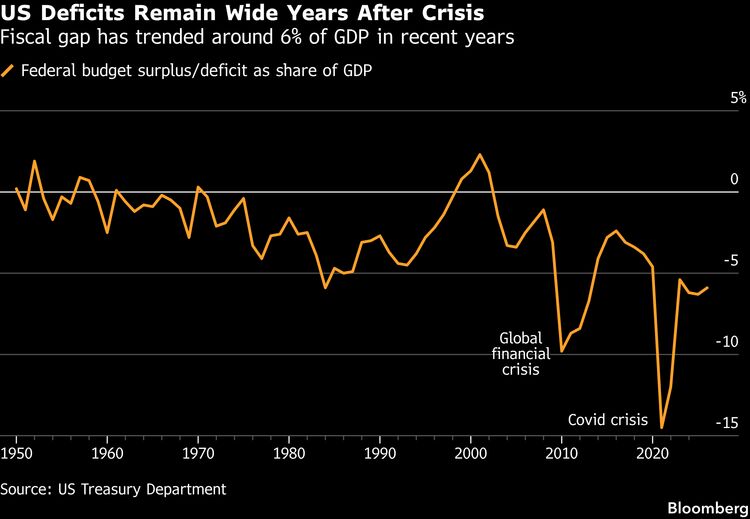
“Economic growth, unless it is incredibly rapid, is not a replacement for real fiscal discipline,” said Marc Goldwein, senior policy director at the nonpartisan Committee for a Responsible Federal Budget.
As laid out by many forecasters, the debt curve is heading to unseen territory . The Congressional Budget Office in February warned the debt-to-GDP ratio will exceed the 1946 record of 106% in 2030.
‘Implausible’ Scenario
As for deficits, to get them down to 3% of GDP — Bessent’s target — it would take 4.5% growth, Goldwein said. “We’re not going to grow our way out, not because it’s mathematically impossible, but it is implausible.”
The surge in Treasury yields this year has only added to pressures on government borrowing. Investors are demanding yields of more than 5% for debt maturing in five to 30 years. Bills, which mature in up to 12 months, are above 4%.
All those levels are above the 3.48% average on marketable Treasuries as of the end of August — which means debt-servicing costs will keep climbing as older, lower-yielding debt has to be refinanced at higher rates. Net interest already totaled $1 trillion for the first 11 months of the 2026 fiscal year.
The rise in longer-dated yields partly reflects “concerns over fiscal profligacy,” said Rodrigo Catril, a strategist at National Australia Bank. “Growing the economy at a faster rate and on a sustained basis is helpful, but it doesn’t fix the problem.”
‘Not a Plan’
Congress is in charge of fiscal policy, Catril and other market participants highlighted — which limits the influence of Bessent’s pledges on spending restraint. “Reducing the budget deficit requires bipartisan agreement and of course that is in short demand at the moment.”
The Treasury chief suggested last month that Republicans might aim to accelerate a fiscal-consolidation plan through Congress after the Nov. 3 midterm elections. He’s also said he’s been working on a package together with the White House budget director, Russ Vought.
But Bessent has yet to lay out a program.
“A stated ambition is not a plan,” said Gareth Berry, a strategist at Macquarie Group.
A day after the elections, the Treasury will lay out its latest plan for debt issuance. It will be the first such statement since officials unexpectedly revamped the buyback program for long-maturity Treasuries, a move Bessent dubbed a “ Treasury twist .”
Investors and strategists say the Treasury could signal less reliance on long-dated bonds going forward, given their higher cost. The department did make a subtle shift to its guidance at its last refunding statement, saying officials were evaluating potential future “changes” in coupon and floating-rate note sales rather than potential “increases” — opening the door to potential cuts in supply.