Chilean forestry company Empresas CMPC SA has an unenviable choice to make — push ahead with a massive project in Brazil and risk its investment grade rating, or shelve it and get left behind by rivals.
Proceeding with the $4.6 billion Natureza pulp mill would mean taking on a spending commitment that’s almost twice the company’s entire market value, when debt is already elevated and wood pulp prices are under pressure.
But shelving the project would also come at a heavy cost, leaving it trailing in the wake of local rival Celulosa Arauco y Constitucion SA, which is in the latter stages of building an even bigger mill in Brazil. That investment is part of a wave of new capacity accelerating the pulp industry’s shift toward Brazil’s vast, low-cost eucalyptus plantations. If CMPC sits out that expansion, it risks losing ground in an industry increasingly dominated by the biggest and cheapest producers.
“CMPC almost has to do it because it’s a race to become one of the giants in pulp and it can’t be left behind,” said Josefina Valdivia, head of fixed-income research at Credicorp Capital. “If they don’t do it, somebody else will.”
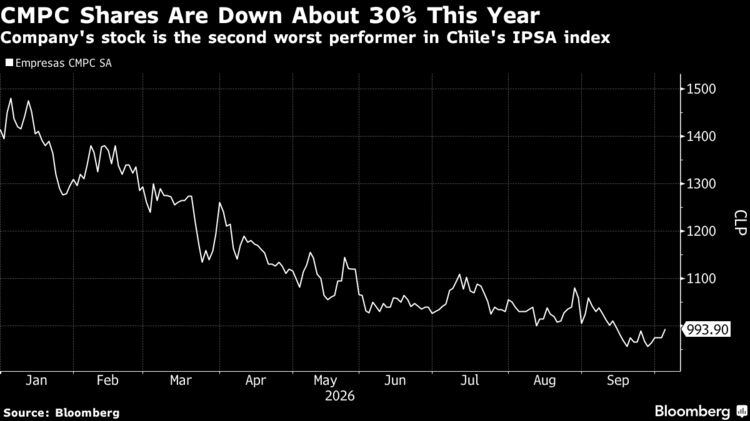
Shares in the company controlled by the billionaire Matte family have lost 30% this year, the second-worst performance on Chile’s benchmark stock index. Spreads over US Treasuries on CMPC notes due in 2034 reached a record high in late September, while yields have surged more than 160 basis points this year.
Further Delays
CMPC first mentioned plans to expand in Brazil in April 2021. Three years later, it unveiled Natureza as a project that would add 2.5 million metric tons of annual eucalyptus pulp capacity. The company provided further details on the project and its financing at an investor day in December 2025.
“Natureza has significant competitive advantages given the characteristics of the region, including access to highly productive forests and competitive costs,” the company said in response to questions last week. “These factors position the project among the most competitive globally and give it the resilience to withstand different price cycles and generate value over the long term.”
Yet in March, CMPC told analysts in its earnings call that it was pushing the final decision toward year-end. The company now says it is awaiting permits, and that the project’s progress will depend on those approvals, market conditions and financial considerations.
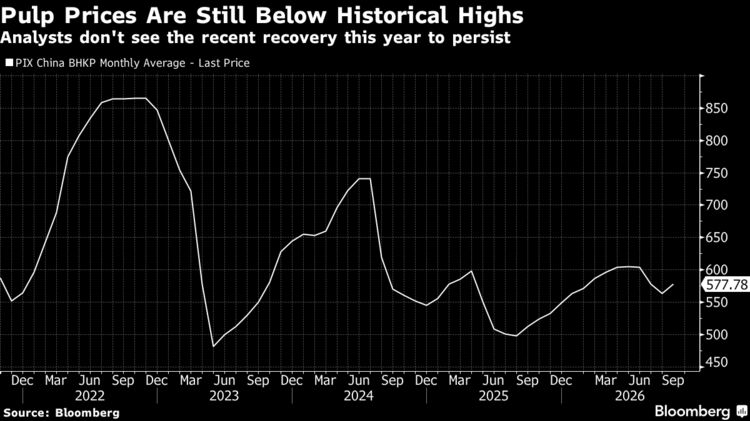
Amid the delays, the backdrop threatens to become more challenging. Pulp prices have been under sustained pressure as China boosts output and new capacity comes on line in South America, according to Horacio Herrera, an equity analyst at MBI Inversiones. At the same time, higher financing, energy and construction costs have made Natureza less attractive.
Herrera estimates Natureza needs a long-term pulp price of around $575 a ton to generate an acceptable return, just below where it is now.
“It’s an acceptable return considering the cost of capital, but it’s not something to pop the champagne over,” Herrera said. Below roughly $575, “it’s better not to do the project.”
Financing Plans
Bradesco last month downgraded CMPC shares to underperform, citing a years-long decline in net income and elevated leverage, as well as the increasing risks over the Brazil project. Banco Itau maintained its underperform recommendation in September.
CMPC plans to sell $1 billion to $1.5 billion of non-core assets and two weeks ago agreed to offload its Chilean corrugated-packaging business for $420 million. Together with about $300 million of hybrid bonds issued in June, the deal marks the first substantial progress on a financing plan investors had been waiting to see.
Still, MBI estimates CMPC could need another $600 million to $700 million of new equity if it raises only half of its targeted proceeds from asset disposals. That possibility has become a major overhang for shareholders.
And “even with a capital increase and asset sales, there’s uncertainty about whether they’ll manage to avoid” losing their investment grade, Valdivia said.
CMPC’s dollar debt is currently rated BBB- at Standard & Poor’s, one notch above junk and with a negative outlook. It has the same rating at Fitch, but with a stable outlook. Net debt stood at 5.1 times Ebidta at the end of last year, up from 3.6 times the year earlier, according to data compiled by Bloomberg.
Maintaining its investment-grade rating is a key consideration in all of CMPC’s investment decisions, the company said.
Falling Behind
For CMPC investors, the stakes are underscored by the progress of a similar project by a major rival. Arauco approved construction of its Sucuriú mill in 2024, the same year that CMPC announced details of its Natureza plans.
Work at Sucuriú is more than 70% complete, with operations expected to begin by the end of 2027. The mill will produce as much as 3.5 million tons of pulp annually, making Arauco the world’s No. 2 pulp producer.

Other Brazil-based producers are expanding too. The industry is betting that higher-cost pulp production in the Northern Hemisphere will decline over time, concentrating more supply in Brazil and, to a lesser extent, Chile.
“They want to secure their piece of what the industry is going to look like 10 years from now,” Valdivia said. “It’s not as if they can say, ‘Let’s wait another three years,’ because somebody else will come and do it.”