Russia shipped the most crude in two months while another jump in prices propelled the value of those cargoes to the highest since before the full-scale invasion of Ukraine in 2022. But subsidies to refiners and a diesel exports ban are chipping away at Moscow’s war chest.
In the four weeks through Oct. 4, overseas crude flows rose to 3.76 million barrels a day, tanker-movements data compiled by Bloomberg showed. That was the most since early August, and helped to meet the needs of refiners in key customers India and China, with supplies from the Persian Gulf still constrained by the hostilities between the US and Iran.
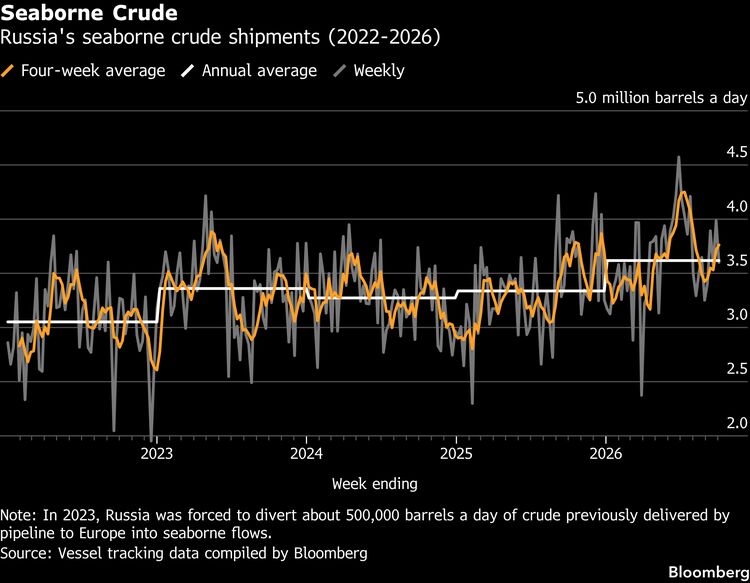
At the same time as crude flows are rising, four-week average prices to Oct. 4 for Russia’s key Urals crude loaded in the Baltic Sea hit a wartime high. Other grades were not quite so strong, pricing slightly below levels last seen in May. Still, the high prices and jump in flows combined to lift the value of crude shipments to a fresh high on a four-week average basis.
But while that surge helps boost revenues for the government, it’s not all good news for the Kremlin.
The jump in crude flows has been driven by repeated Ukrainian drone strikes that put several of Russia’s refineries out of action, at least for a while. Even though the intensity of the attacks fell to a three-month low in September, the pace of strikes was still faster than the speed of repairs, preventing a meaningful pickup in oil processing. Refinery runs likely remained below 4 million barrels a day last month, forcing Moscow to divert crude that can’t be processed domestically into the export stream.
However, a shortage of key fuels has led the Kremlin to extend through October a ban on most overseas sales of diesel, which averaged about 1 million barrels a day before Kyiv’s intensified attacks. It also led the government to pay oil companies the biggest subsidy in more than four years last month to supply road fuels to the domestic market.
The loss of diesel export revenues and the multi-year high in subsidies to refiners both drain the war chest.
Crude Shipments
In the week to Oct. 4, some 36 tankers loaded 25.21 million barrels of Russian crude, vessel-tracking data and port-agent reports show. The volume compared with 27.9 million barrels on 37 ships the previous week.
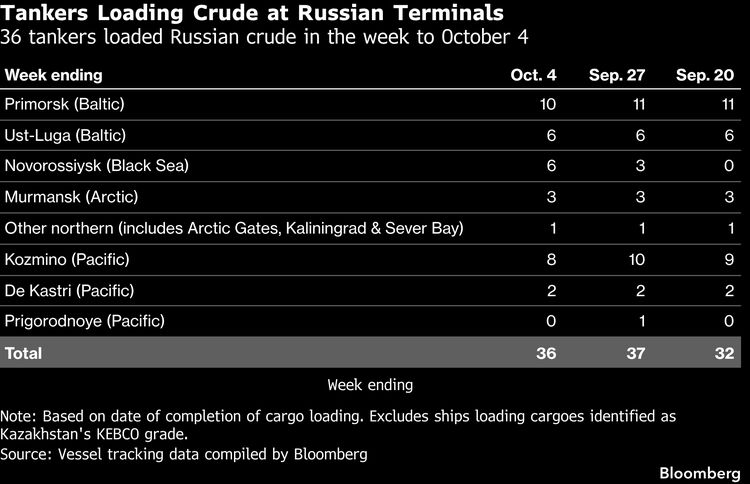
Shipments from Novorossiysk recovered, with the number of ships completing loading operations during the most recent week returning to levels not seen since July.
Weekly shipments can be volatile, affected by weather, maintenance work, sanctions, military activity and the timing of departures.
There was one shipment of Kazakhstan’s Kebco grade from Novorossiysk during the week. Moscow diverted all shipments of Kazakh crude last month through the Black Sea port, freeing up more capacity for its own barrels at Ust-Luga on the Baltic, which is seen as safer.
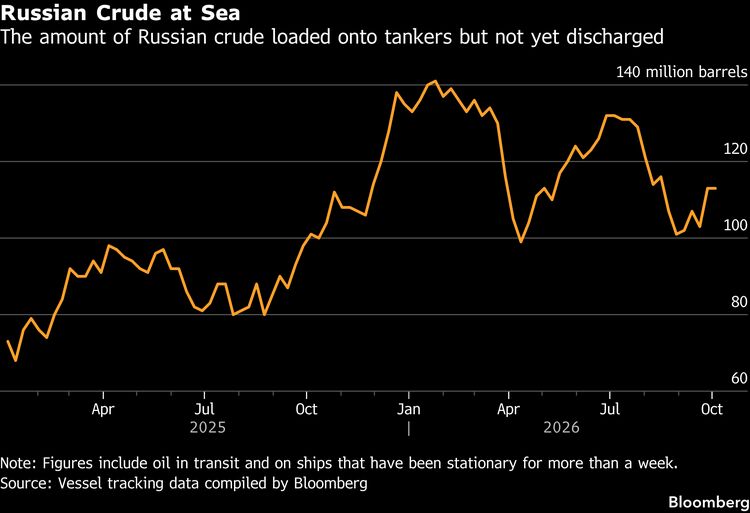
The amount of Russian crude on the water remained steady last week. Ships hauling Arctic crude to China are typically transferring their cargoes onto other vessels. These transfers usually take place east of Singapore from ships taking the Red Sea route and off Nakhodka or Zarubino for those taking the Northern Sea Route. Most Sokol cargoes are also transferred, usually in Kozmino Bay. These transfers can introduce delays, boosting the amount of oil at sea.
Export Value
On a four-week average basis, the gross value of Moscow’s exports rose to $2.58 billion a week in the 28 days to Oct. 4, up by $200 million from the figure for the period to Sept. 27. That took the value of Moscow’s crude shipments using this measure to the highest since before Moscow’s full-scale invasion of Ukraine in February 2022. The increase was driven by a combination of higher four-week average prices for Russia’s key crudes and the increase in flows.
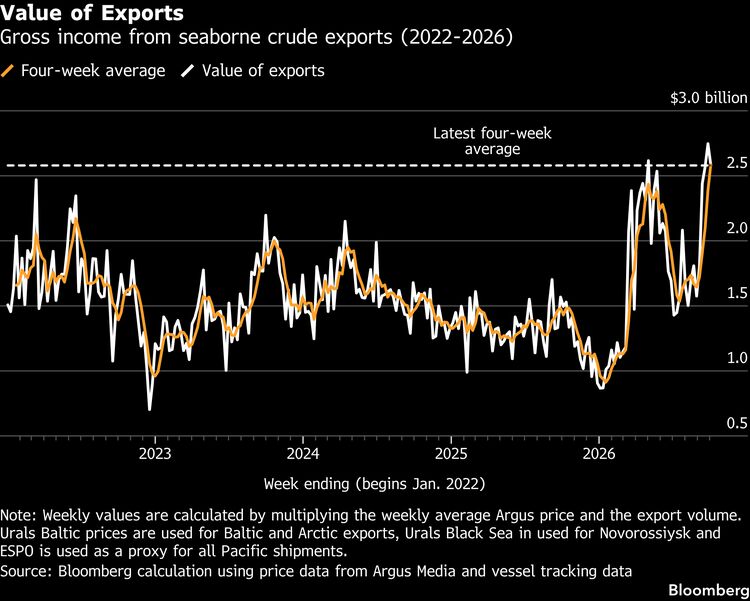
On a weekly basis, the value of exports fell by about $160 million to $2.58 billion, with higher Urals prices more than offset by a drop in shipments.
Flows by Destination
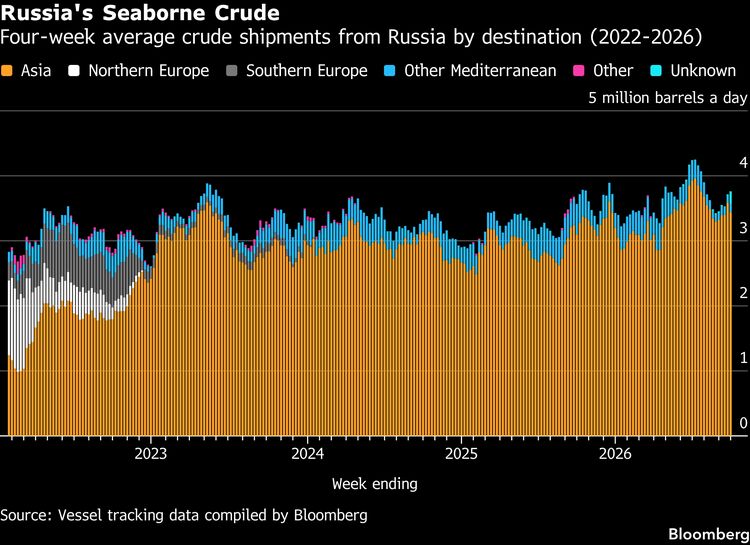
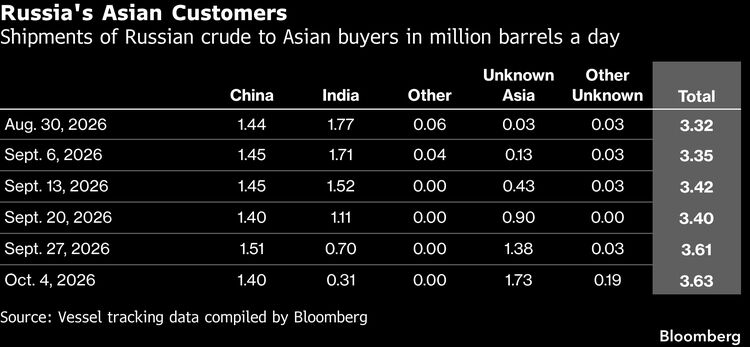
China and India remain the biggest buyers of Russian crude by a considerable margin. But it’s not always possible to assign a final destination to individual cargoes until well into their voyage, leaving many of the more recent shipments on tankers showing interim destinations, such as Suez, Port Sudan, or Singapore. These are recorded as “Unknown Asia” until a credible final destination is available. Ships still showing their destinations as their Russian loading ports, or places such as Gibraltar, are recorded as “Other Unknown.”
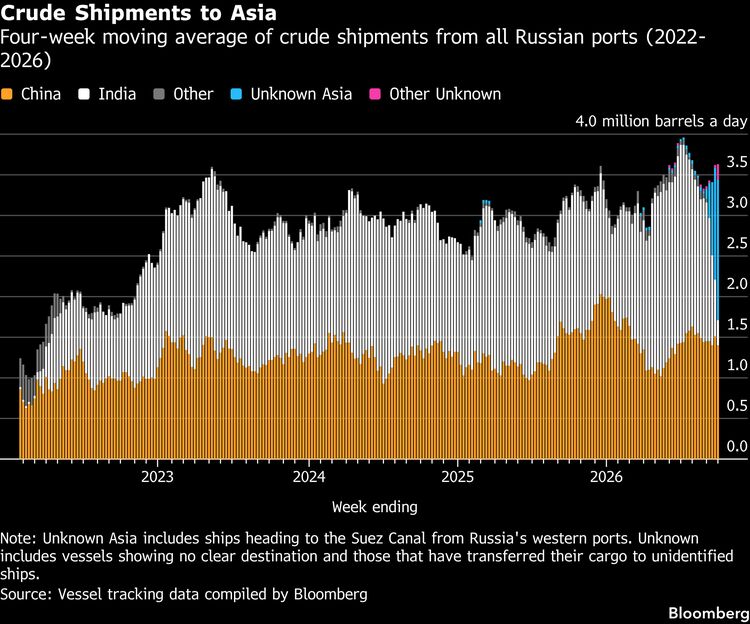
Observed shipments to Russia’s Asian customers, including those showing no final destination, rose to 3.63 million barrels a day in the 28 days to Oct. 4, up from a revised 3.61 million in the period to Sept. 27.
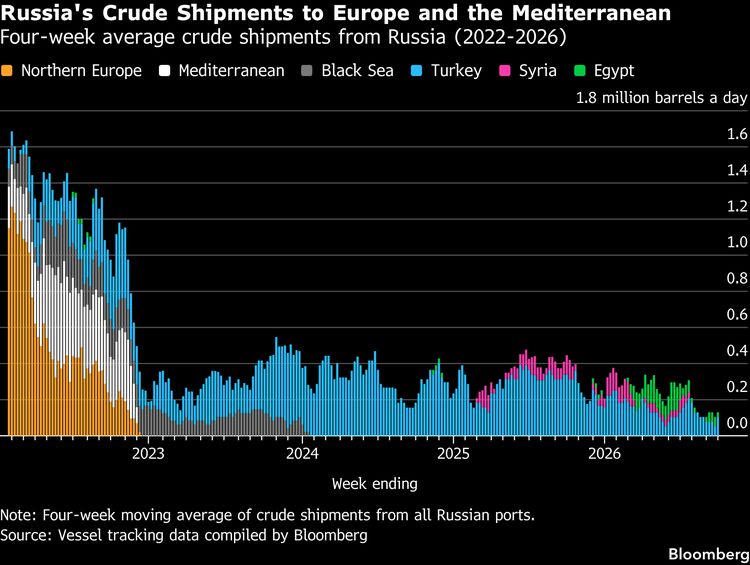
Shipments to Moscow’s remaining customers in the Mediterranean region remain near the lowest since the Ukraine invasion, falling to about 130,000 barrels a day in the four weeks to Oct. 4.
Flows to Turkey, Russia’s biggest buyer west of Suez, rose to about 100,000 barrels a day, while shipments to Egypt, Russia’s newest east Mediterranean customer, fell to about 30,000 barrels a day.
Flows to Syria have fallen to zero since August after the Mediterranean nation agreed to “drastically” reduce Russian oil imports in negotiations with the US on lifting remaining sanctions.
NOTES
This story forms part of a weekly series tracking shipments of crude from Russian export terminals and the gross value of those flows. The next update will be on Tuesday, Oct. 13.
All figures exclude cargoes identified as Kazakhstan’s KEBCO grade. Those are shipments made by KazTransoil JSC that transit Russia for export through Novorossiysk and Ust-Luga and are not subject to European Union sanctions or a price cap. The Kazakh barrels are blended with crude of Russian origin to create a uniform export stream. Since Russia’s invasion of Ukraine, Kazakhstan has rebranded its cargoes to distinguish them from those shipped by Russian companies.
Bloomberg classifies ship-to-ship transfers as clandestine if automated position signals appear to be switched off or falsified — a tactic known as spoofing — to hide the two vessels involved coming together to make the cargo switch.
Vessel-tracking data are cross-checked against port-agent reports as well as flows and ship movements reported by other information providers including Kpler and Vortexa Ltd. and satellite imagery covering Russian ports.
If you are reading this story on the Bloomberg terminal, click for a link to a PDF file of four-week average flows from Russia to key destinations.