Scandal-tainted Nidec Corp., which grew from a startup into the world’s largest manufacturer of precision motors, has fallen to the bottom rank of the yen debt market by one measure, leaving its new president with a challenge to restore investor confidence.
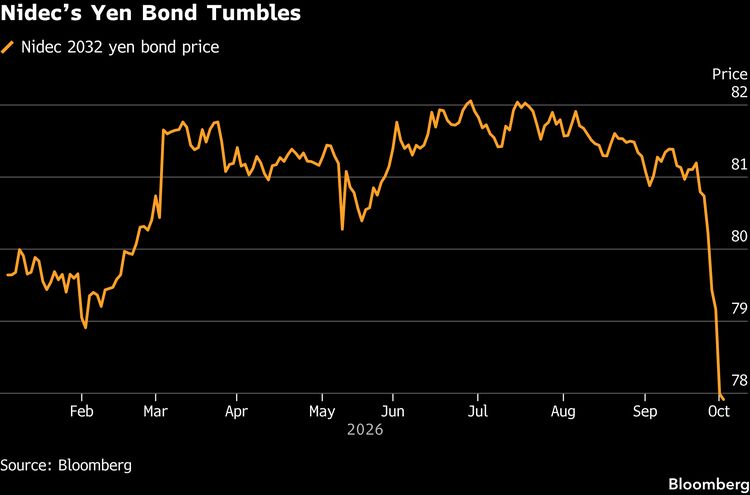
Nidec’s yen bond due in mid-2032 slumped to 77.7 yen, the lowest among more than 3,000 local corporate notes maturing by then, according to data compiled by Bloomberg. The drop came after the Kyoto-based company reported last week a net loss of ¥564.6 billion ($3.6 billion) due to writedowns in the year ended March 31, while Nidec’s auditor PwC Japan refused to sign off on its financial statements, in the latest dramatic turn in an accounting scandal.
“We will appropriately secure the necessary funds for bond repayments at maturity, including by utilizing cash flow generated from our business operations,” said a spokesperson for Nidec in response to questions from Bloomberg News. The company declined to comment on the bond’s market price, saying it is determined by factors including supply and demand, as well as investor sentiment.
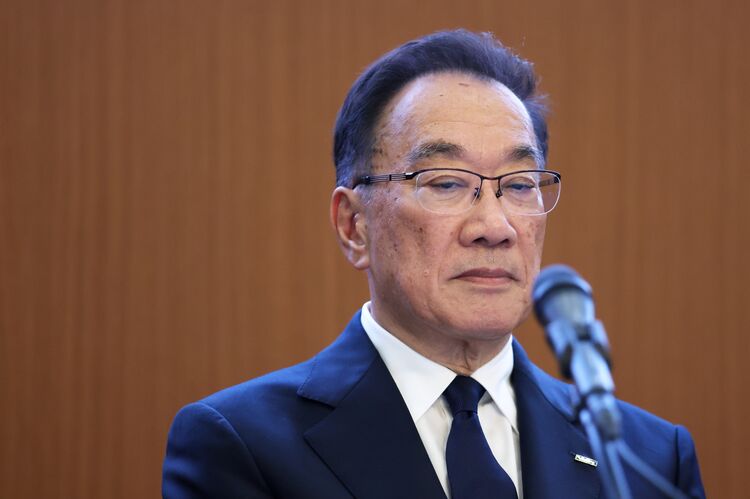
The long-awaited disclosure — which came with a restatement of five years of past earnings — reignited concerns about Nidec. Now under the leadership of Michio Kaida, the manufacturer is trying to stave off a delisting and has been under pressure from investors including hedge fund Aspex Management to resolve its financial reporting issues.
Nidec is under the spotlight at a time when global investors are growing concerned about the impact of rising bond yields on corporate earnings, and the potential for cracks in credit markets to emerge after years of easy access to debt.
“You never know how a scandal is going to develop,” said Taketoshi Tsuchiya, chief executive officer of Fujiwara Capital Co. While Nidec isn’t facing any immediate risk of failure given the strength of its core business, it’s probably become harder for some investors to justify holding onto its debt, he said.
Improper accounting practices at individual firms can often send a shiver through credit markets. That happened last year when First Brands in the US filed for bankruptcy, with allegations of a large-scale fraud soon emerging, fueling investor worries about lax debt underwriting standards.
The impact from the latest developments in Nidec’s accounting scandal, which first surfaced last year, has so far been muted in the secondary market for yen debt. That is partly because of support from Japan’s biggest banks, and the company’s relatively small amount of outstanding bonds at ¥90 billion.
Nidec currently has unused credit lines expiring next month from MUFG Bank Ltd. and Sumitomo Mitsui Banking Corp. that amount to a combined ¥600 billion. The company is discussing a renewal of the agreements, a Nidec spokesperson said.
Its notes due by the end of 2027 still have investment value given their wider spreads and the company’s available liquidity, according to Hideki Matsumoto, a senior credit analyst at SMBC Nikko Securities Inc.
“There is no need to be excessively pessimistic from a bond-investment perspective,” Matsumoto wrote in a report last week.
Read More: Nidec Founder Drove His Company a Bit Too Hard
The bigger problem for Nidec may be putting in place reliable internal controls after years of seeking to comply with the relentless demands of its hard-charging founder Shigenobu Nagamori, who resigned from the board last December. He started the company from a prefabricated shed in 1973.
Nidec plans to submit a report on its internal management system to the Tokyo Stock Exchange by Oct. 28, marking one year since its stock was put on special alert by the bourse. If it fails to satisfy the TSE that its internal controls have sufficiently improved, the exchange can extend the designation.
Kaida, who became president last week, said in a news briefing on Oct. 1 that Nidec is working with PwC to obtain its audit opinion by the end of the month.
The debacle has put an increased focus on the importance of governance issues for both investors and issuers, said Toshiyuki Suzuki, a senior credit analyst at Mizuho Securities Co.
“It will probably be difficult for Nidec to return to the corporate bond market for some time,” he added.
The misconduct puts Nidec among the ranks of Japanese companies that have fallen from grace due to management upheavals and weak corporate governance. They include Olympus Corp. and Toshiba Corp., the former tech titan that is now privately owned by a consortium led by government-backed Japan Industrial Partners.
More favorably for bond investors, Nidec boosted holdings of cash and equivalents by more than threefold to ¥852.2 billion as of March 31 from a year earlier, as it increased borrowings, its filings showed last week.
Cash flows from operations stood at ¥234.2 billion at the end of March, down 14% year-on-year, but still elevated by historical standards. Nidec is forecasting a 3.4% increase in sales to ¥2.8 trillion in the 12 months ending March, and operating income of ¥200 billion.
Still, the numbers come against a background of reporting irregularities. PwC said in its review, released by Nidec last month, that some executives involved in or aware of the accounting misconduct remained in positions with responsibility for financial reporting, and so it couldn’t obtain sufficient appropriate evidence. Nidec has said it is taking personnel measures to address PwC’s concerns.
Japan Credit Rating Agency Ltd. and Rating and Investment Information Inc. both downgraded Nidec to A+ last week and signaled further negative rating actions are possible. Their current scores are still 11 grades above what Moody’s Ratings had assigned to the company before it withdrew the evaluation in June at Nidec’s request.
“Revelations of improper accounting practices and quality fraud have also continued to raise concerns over internal control deficiencies and undermine the reliability of financial reporting,” JCR said.