Ford Motor Co. shares have fallen sharply as enthusiasm around its earlier rally fades and a tougher economic backdrop weighs on the auto industry. Analyst price targets, however, remain elevated on hopes that earnings will continue to improve.
The stock has fallen about 30% from its May peak, when investors had pushed the shares higher on beliefs that Ford would benefit from the buildout of artificial-intelligence infrastructure. Since then, analysts have raised their average price target 16%, pushing the gap between Ford’s share price and Wall Street’s target to its widest in three years, according to data compiled by Bloomberg.
That means either the market has become too pessimistic or Wall Street is still too optimistic. Such a disconnect isn’t unusual, said Eric Diton, president and managing director of The Wealth Alliance. But he said the market’s message on Ford is worth heeding.
“I believe the market before the analysts,” Diton said. “I see no reason to rush into the stock — I would rather pay more and see better fundamentals.”
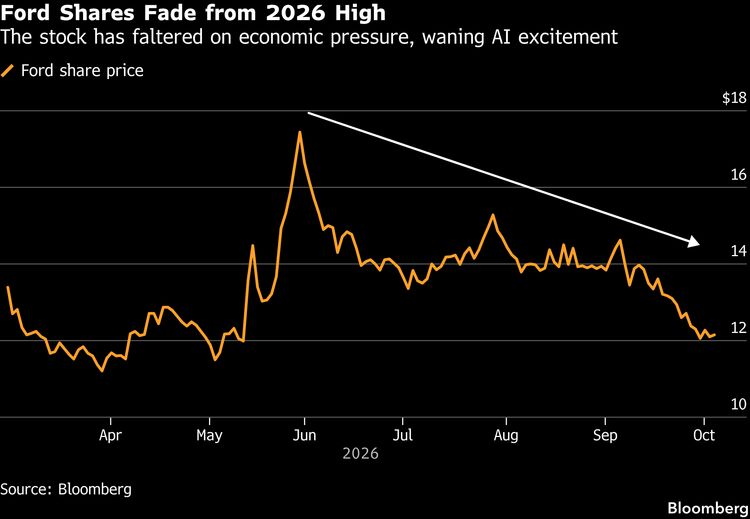
It’s been a volatile year for Ford. The shares surged 44% in May as investors bet the automaker would benefit from the buildout of artificial intelligence infrastructure. But the rally faded as a lack of customer and capacity updates made those gains difficult to sustain.
Ford shares have now closed lower in 14 of the 20 sessions since Labor Day, losing 17% over the past four weeks as enthusiasm for the company’s battery-storage business cooled. Broader pressure on auto stocks from higher oil prices, interest rates and vehicle-affordability concerns has added to the weakness. October brought another disappointment when Ford reported a year-over-year decline in third-quarter vehicle deliveries.
A Ford representative didn’t immediately respond to a request for comment.
| Read More |
|---|
|
Ford Narrowly Avoids Falling Behind Hyundai as US Sales Drop Ford’s 45% Rally Wiped Out as Hopes for AI Windfall Fizzle Ford CEO Says Third-Quarter Sales Hit by F-150 Supplier Issue |
Wall Street, though, has yet to turn negative. None of the 23 analysts tracked by Bloomberg recommends selling the stock. Ford’s last sell-equivalent rating disappeared last month when Wells Fargo dropped coverage of 17 auto stocks amid an analyst departure.
General Motors Co. also has no bearish ratings, but its shares have held up better. GM hit a record in July after strong earnings and has fallen 11% from that high, while Ford shares have dropped nearly twice as much over the same period.
The last time the gap between Ford’s share price and analysts’ targets was this wide was in October 2023, after a six-week US autoworkers strike forced the company to withdraw its profit guidance .
Bloomberg Intelligence’s Eric Varghese said that “research is taking a longer-term view of Ford’s earnings recovery, while the market is assigning less value to that recovery because of execution uncertainty.”
The company’s third-quarter results later this month will provide the next test. A supplier problem disrupted production of its popular F-Series trucks last month, though Chief Executive Officer Jim Farley said manufacturing is “on track” for the final three months of the year.
But “containable does not mean ‘make-up-able,’” UBS analyst Joseph Spak said in a note Friday. The production shortfall is “a setback and a negative heading into 3Q earnings,” Citi’s Michael Ward wrote in a Friday note. Spak holds a bullish recommendation on Ford; Ward upgraded the stock to buy and set his price target to a Street high of $20 in July.
Ford is expected to report third-quarter adjusted earnings of 42 cents a share, according to Bloomberg consensus estimates. Meeting that forecast would still represent a 7.8% decline from a year earlier.
Although he expects the upcoming earnings season to show resilience across the auto sector, BNP Paribas analyst James Picariello said Ford would need a “heroic” increase in F-Series production to meet its full-year target after the supplier disruption.
“This September downtime dynamic does remove the prospect for Ford to raise its full-year guide,” he added.