Africa was already in the midst of an investment boom before the US and Israel went to war with Iran this year. Now, as the conflict exposes the costs of overreliance on the Middle East for oil, fertilizer and even global trade routes, African industries look even more attractive, and money is flowing in from multiple continents.
In energy, for instance, Canada’s Zimar Group in August signed a deal with Niger to build a $1.9 billion oil refinery and a petrochemical complex; the next month, France’s TotalEnergies SE and its partners said they plan to invest $10 billion in Angola’s oil sector over the next five years. In infrastructure, China alone committed $33.5 billion to the region in the first half of 2026 under its Belt and Road Initiative, the most ever for a six-month period, according to a report from Australia’s University of Queensland and China’s Green Finance & Development Center, with Ethiopia and Egypt the continent’s biggest beneficiaries.
Homegrown investors are capitalizing too. Africa’s richest person, Aliko Dangote, committed to replicate in Lamu, a coastal town in southeastern Kenya, the success of his 700,000-barrel-a-day oil refinery in Nigeria after appeals from East African leaders whose nations were among the hardest hit by the energy supply shock caused by the Iran war. The businessman has offered East African nations a 30% equity stake in the estimated $16 billion refinery, on which construction began in September. Tanzanian billionaire Mohammed Dewji has said he intends to invest $100 million in the project.
The continent is also drawing the attention of US companies as the Trump administration has made access to critical minerals — a resource Africa has in abundance — a priority in its ever-heightened competition with China. The minerals are essential in the manufacturing of cutting-edge 21st century technologies including weapons, electric vehicles and the semiconductors powering the artificial intelligence gold rush. California’s KoBold Metals Co. in April unveiled what it called the world’s biggest lithium exploration campaign in the Democratic Republic of Congo. US government-backed Orion Critical Mineral Consortium has signed a preliminary deal to acquire a stake in Glencore Plc’s Congolese copper mines and has emerged as the favored candidate to invest in a large nickel project in Tanzania. Funds are also being channeled into infrastructure crucial to transport Africa’s resources.
“The Africa growth opportunity is now large enough to matter to global investors,” says JPMorgan Chase & Co.’s senior country officer for sub-Saharan Africa, Kevin Latter. “The substantial capital required to support this growth comes precisely at the time that global capital is searching for new sources of growth.”
For this second edition of An Investor’s Guide to Africa (see the 2025 version here ), Bloomberg Businessweek tracked deals across the continent and examined incentives to highlight key areas where investors are increasingly deploying their capital. Critical minerals and data centers remain top investment opportunities, while new sectors, including fertilizer and transport infrastructure, emerge on this year’s list.
In collaboration with Bloomberg Economics, we also updated our investment risk-o-meter, which grades Africa’s most investable markets in five areas likely to influence financial returns. A larger number, denoted in orange, signifies lower relative risk. The scorecard offers a guide to where investors may demand a higher premium for taking on risk.
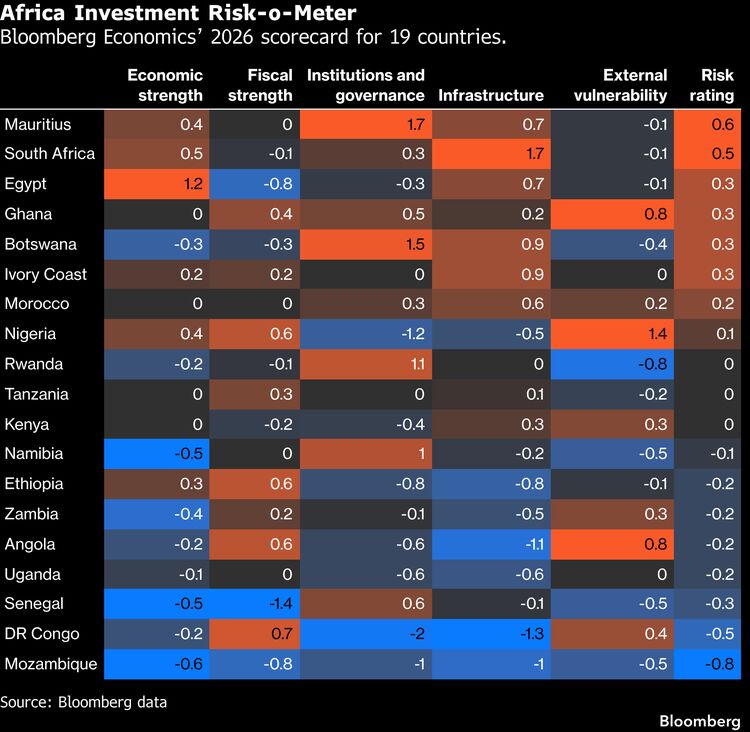
With two years of data now in hand, the risk-o-meter reveals which markets are showing greater promise than they did a year ago. Nigeria was the biggest climber, rising four places, as its economic and fiscal strength improved and its external vulnerability eased. Botswana took a tumble, dropping two places, as the growth outlook deteriorated. South Africa, which led the rankings last year, slipped one slot, reflecting a moderately weaker growth outlook; Mauritius now holds the top spot for relative investability. “Risks vary substantially across countries and regions,” Latter says.
This guide is by no means comprehensive, but it offers a window into the money making inroads in what International Monetary Fund estimates show will be the world’s fastest-growing region over the next five years. — With William Clowes
Methodology
Bloomberg Economics developed a scorecard for 19 African countries, assigning risk ratings based on five key factors: economic strength, fiscal strength, institutions and governance, infrastructure and external vulnerability.
It focuses on Africa’s most investable countries, which together make up about a third of the continent. Two-thirds of those rated are among Africa’s largest economies, and the rest stand out for features that attract investors — including rich commodity reserves, established financial hubs and thriving business tourism centers.
Each country’s performance on these factors — such as growth, debt, political risk and foreign reserves — was converted into a Z-score, enabling fair comparisons across countries and indicators by standardizing all results into a common scale. The Z-scores were then weighted to produce an overall risk ranking. This approach reduces bias by emphasizing relative differences, it highlights outliers, and it makes it possible to combine multiple standardized measures into a single, comprehensive risk score.