NASA is close to announcing a bulk purchase of rocket launches to fuel its $30 billion drive to build a permanent base on the moon for humans to live and work.
It’s a new strategy that comes as the space industry is grappling with a shortage of rockets amid booming demand. But the agency is hoping to get ahead of this bottleneck now, by buying a variety of rockets to provide options for getting cargo to the lunar surface.
“We are evaluating things like NASA doing bulk buys of launchers that could service all the moon base needs,” Carlos García-Galán , NASA’s moon base program manager, said in an interview with Bloomberg.
“In the near future, we’ll probably announce the first set of these bulk buys,” he said.
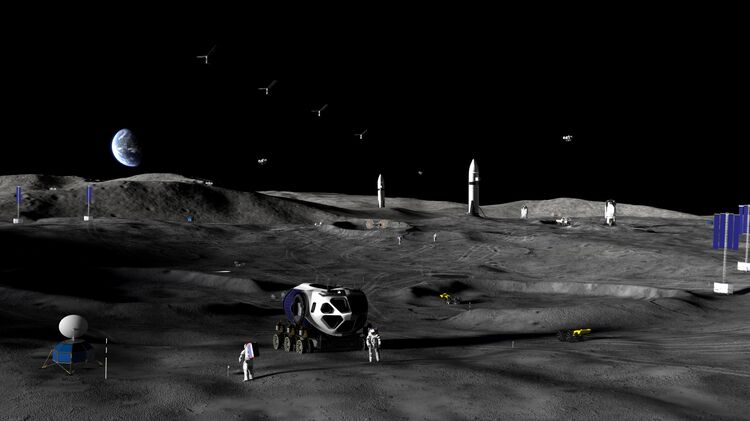
The first phase of the moon base is already underway, with NASA planning to send landers and rovers to scout locations and resources on the moon through 2028. But it needs larger rockets in 2029 to launch as much as 60 metric tons (132,000 pounds) of equipment to the lunar surface to build power systems, habitats and other infrastructure required for a permanent human presence.
This second, more ambitious phase is where the agency faces a snag.
NASA is staring down the impending slowdown of SpaceX’s Falcon 9 rocket, the most prolific rocket in the US — and the world. SpaceX has started to turn away satellite operators seeking dedicated rides to orbit aboard its staple Falcon 9 rocket beyond 2028, Bloomberg has reported. The potential absence of the rocket and its larger variant, the Falcon Heavy, from the market could spell trouble for NASA’s moon base plans.
“We know the issue that’s coming, early. We know it now,” García-Galán said. “SpaceX has been transparent with their plans, so it gives us the option to look for alternatives, and we have.”
SpaceX has not provided a clear timeline publicly on when the Falcon program will end.
Through these bulk purchases, NASA may opt to buy four or five different rockets at a time and match each vehicle to a commercial lander the agency needs to get to the moon’s surface, according to García-Galán. And if there’s extra room on those rockets, the agency could put out a call to others, including government agencies, interested in hitching a ride to the moon.
García-Galán did not specify which rockets would be included, nor did he clarify if the Falcon 9 or Falcon Heavy might be included in these purchases.
There are only a few comparable alternatives to the Falcon 9 currently on the market. The biggest US competitors include Blue Origin LLC’s New Glenn and United Launch Alliance LLC’s Vulcan. However, New Glenn has been grounded since May, after a launchpad explosion , and Vulcan hasn’t flown since February due to issues with its strap-on boosters.
“There’s no one right now that is in a place to be a suitable replacement for Falcon 9, just full stop,” said Caleb Henry , director of research at analytics firm Quilty Space.
There are also concerns over availability. Both New Glenn and Vulcan are on the hook to launch dozens of missions for Amazon.com Inc.’s Leo satellite service . And the two rockets are contracted to launch national security satellites for the US military.
Other Falcon 9 alternatives are supposed to become operational in the months and years ahead, including Rocket Lab Corp.’s Neutron, Relativity Space Inc.’s Terran R, Firefly Aerospace Inc.’s Eclipse and Stoke Space’s Nova. But new rockets are notoriously slow to ramp up, making it unclear if they’ll be flying at a significant pace by 2029.
“The general rule of thumb for new launch vehicles is that they typically struggle to launch more than on average three times a year for their first five years,” Henry said.
Another potential option is SpaceX’s next-generation Starship. However, the rocket still faces a list of technical challenges that must be overcome before it can reach the moon’s vicinity. SpaceX is also working on a variant of Starship to land people on the lunar surface, but it’s unclear how available the rocket will be for purely cargo flights to the moon and how quickly the company can ramp up launches.
Despite the clear challenges, NASA hopes that by buying rockets in bulk now, the agency can meet its ambitious goals. García-Galán said NASA is still trying to be hands off with its commercial partners who are developing landers and rovers, but this new strategy may help if those companies find themselves in a bind needing a rocket.
“It is basically maximizing our flexibility and ability to look for different options to succeed,” García-Galán said.