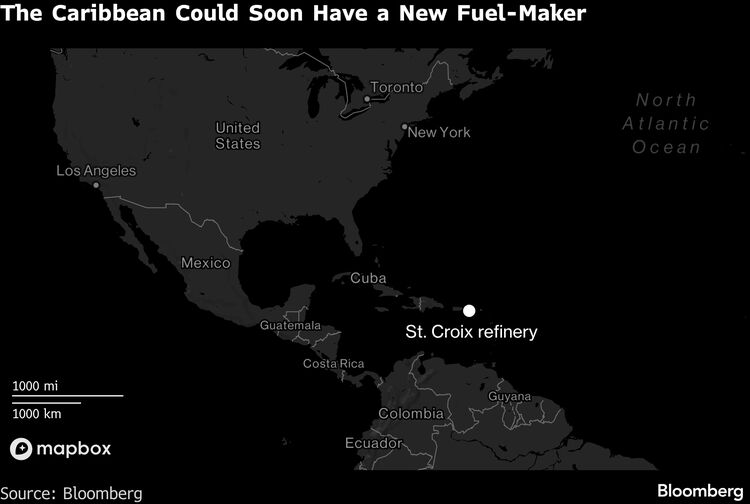
An idled refinery in the US Virgin Islands — once the world’s largest fuel-making plant — aims to reopen next year thanks to interest from the US government, investors and a commercial partner committed to buying its output.
The troubled St. Croix refinery is in the final stages of what owner Port Hamilton Refining and Transportation expects to lead to a 12-month restart to restore output at a facility that was shuttered in 2021, according to the company’s director, David Johnson.
“We are making every effort to safely resume refinery operations as quickly as possible and are targeting 2027, subject to completion of financing, regulatory, engineering and other restart requirements,” he said in an interview. “We have strong interest from both the US government funding programs and private-sector investors and lenders, and we are currently evaluating several funding alternatives.”
The company plans to resume operations in phases and for total production capacity to exceed 200,000 barrels a day. An undisclosed partner agreed to provide the operation with crude and buy its refined product.
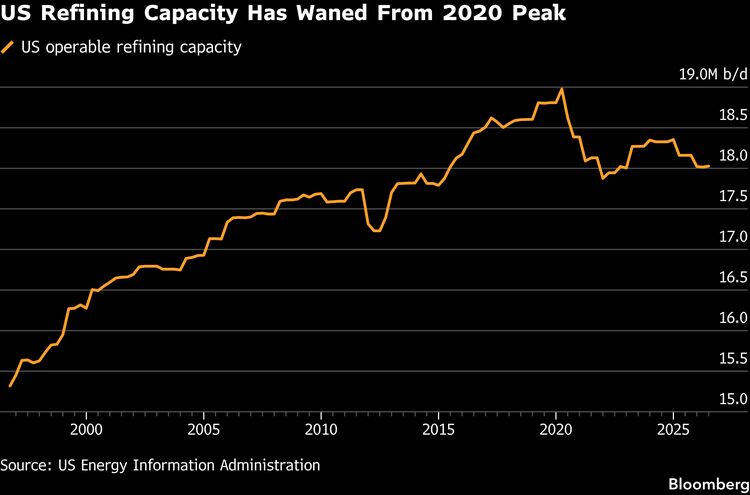
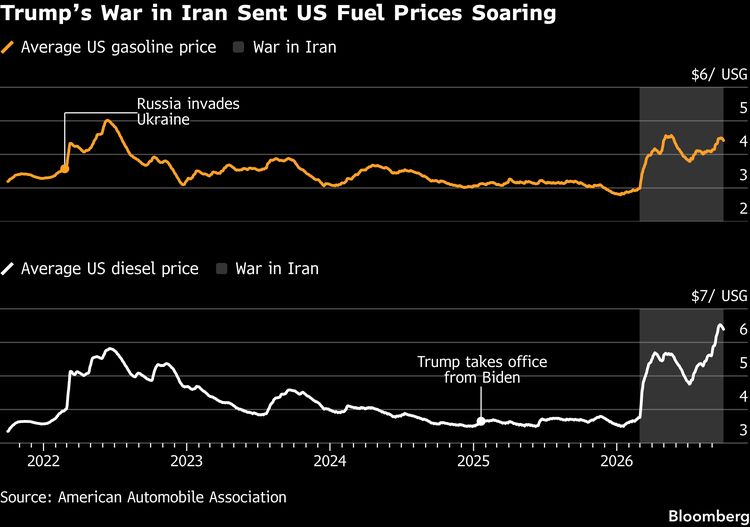
Plans to restart the facility come as refineries post record margins amid a global fuel crunch fueled by the Iran and Ukraine wars that have battered refining capacity in the Middle East and Russia. The market is flashing signs of a significant supply shortage with tight conditions expected to persist into 2027, making the prospect of bringing the St. Croix plant back online a potential source of relief.
The push also comes months after President Donald Trump invoked the Defense Production Act to provide federal funds for a wide range of energy projects as his administration faces pressure to curb rising oil, gasoline and electricity costs. Under the April directives, the agency is authorized to use energy purchases, financial support and other tools to overcome delays, financing shortfalls, regulatory hold-ups and market barriers.
Read More: Trump Invoked Wartime Powers to Fund New Energy Projects
Just 500 miles off South America’s coast, the St. Croix plant is well positioned to handle flows of Venezuelan and Guyanese crude flowing to the market. Trump announced in August that the US secured majority control of 65 billion barrels of oil reserves in Venezuela in a deal with the country’s interim government.
The Trump administration would like to see refineries across the country reopen, especially the St. Croix plant since it’s in a strategic location and was built particularly to refine Venezuelan crude, according to a White House official.
The St. Croix refinery, built in 1966 by Hess Oil and then run as a joint venture with Venezuela’s state-run PDVSA, is well-positioned in the global race to expand refining capacity, Johnson said.
The facility refined about 360,000 barrels a day when it was closed in 2012. The operation restarted in February 2021 after the owners at the time, private equity firms EIG Global Energy Partners and ArcLight Capital Partners, invested more than $3.2 billion to bring the plant back online, according to Johnson.
Soon after, the refinery repeatedly released dangerous levels of hydrogen sulfide and sulfur dioxide into the nearby community. There was also a major fire. The incidents caused significant health threats and prompted local school and business closures. The Environmental Protection Agency closed the plant in May 2021 .
Port Hamilton bought the installations at auction that same year and took pains to preserve the infrastructure. It kept crucial systems powered up and monitored the refinery from a staffed control room, even though the plant wasn’t processing any oil.
“We deliberately chose not to mothball the refinery,” Johnson said. “Instead, we have maintained it in a safe-idle condition because our intention has always been to restart it.”
The refinery has passed most federal and local permitting hurdles, but will need to work through a few regulatory issues once a start-date has been determined.
In an emailed statement, EPA spokesperson Brigit Hirsch said the Trump administration “remains willing to work with appropriate parties to address outstanding requirements and identify a safe and lawful path forward.”
White House spokeswoman Taylor Rogers said “the Trump administration will continue supporting the reopening of shuttered refineries and the construction of new ones to lower prices and strengthen our national security.”
Restarting a plant requires hundreds of millions of dollars and tricky permitting, but there’s serious money to be made. The top three US refiners, which collectively process 8 million barrels of oil each day, made a combined $13 billion in profit in the second quarter.
As important as it is to quickly restart the refinery, Johnson said they cannot cut corners on safety or risk another accident that triggers a shutdown.
“My family lives on St. Croix. Both of our children were born here and go to school here,” he said. “We breathe the same air and drink the same water as everyone else on this island. Making sure this refinery operates safely and responsibly is personal to me.”
| Read More: |
|---|
| Trump Invokes Wartime Powers to Fund New Energy Projects |
| Trump-Touted Texas Refinery Sees Fuel Sales Starting in 2029 |
| War Exposes the Cost of the West’s Retreat From Oil Refining |