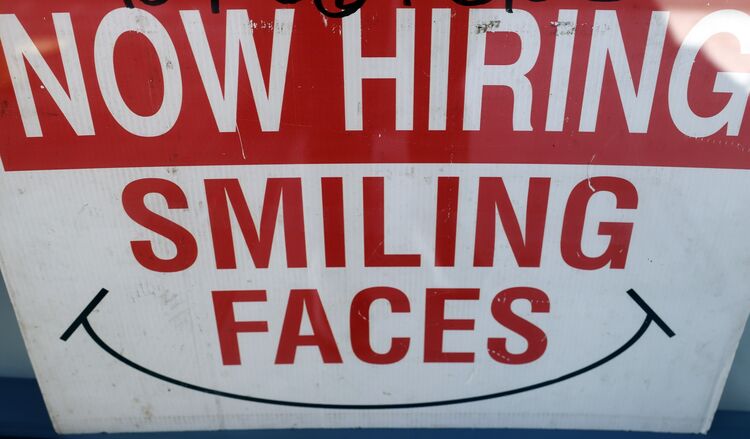
A US government report Friday showed that the unemployment rate ticked higher to 4.2% in September from 4.1% in August. That’s still pretty low by historical standards. But the stability seems illusory, given we seem to be stuck in a labor market that rather than adding high-paying jobs, is dominated by lower-earning positions. No wonder purchasing power is slipping and workers are dissatisfied.
The prevailing read on the labor market is that it’s just ho-hum. As the argument goes, hiring may be sluggish overall but at least layoffs are muted and joblessness is relatively low. So why did a Conference Board’s monthly survey of consumer confidence released Tuesday show that sentiment fell in September to the lowest since 2014? More than a fifth of those surveyed tell Conference Board pollsters that jobs are “hard to get,” the most in about a decade not including the peak of the pandemic in 2020 and early 2021.
What’s going on? I’ll give you one theory: The jobs that are available are failing to meeting workers’ expectations. Below-average-paying industries account for 50,000 of the 46,000 total private sector jobs added in September. In other words, above-average-paying industries shed about 4,000 jobs. And this has been the state of affairs for years now, little-by-little altering the composition of American payrolls for the worse.
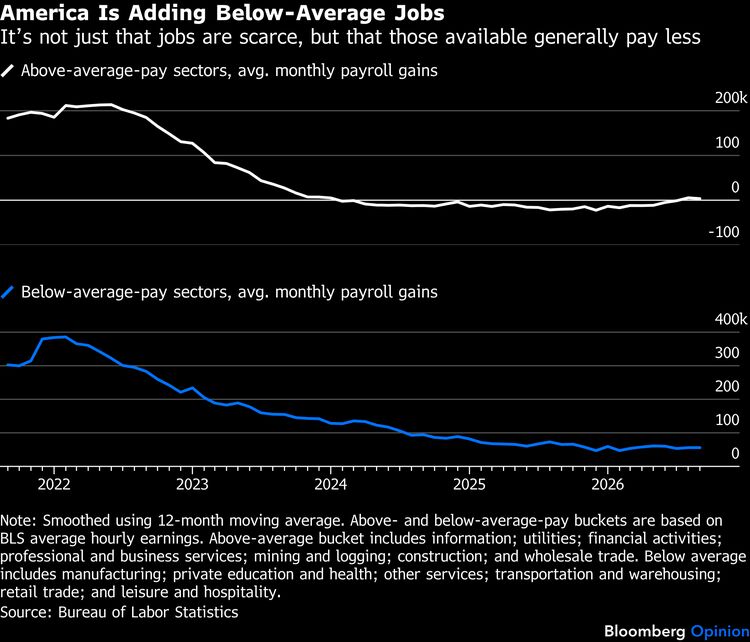
Initially, some of this was catch up. White-collar jobs were better suited to work-from-home arrangements, and they gained ground during the Covid-19 years, so some reversion to the mean was to be expected. Yet the continued stagnation in higher-earning industries points to a series of policy errors that have left businesses in a state of heightened uncertainty.
An ill-advised and haphazardly instituted White House tariff policy prompted caution in hiring. Then, the US-Israel war with Iran spurred an energy shock that’s rippled through fuel-dependent travel and shipping industries, among others. And the policies pushed longer-term borrowing costs higher, making consumer and business financing more expensive. As a result, the cyclical economy is flagging, despite gross domestic product that expanded at a 2.2% annualized pace in the second quarter. Here’s how one respondent put it to the Federal Reserve Bank of Dallas in its monthly manufacturing survey released Sept. 28:
Upcoming elections and uncertainty over continuing tariff and trade negotiations, Middle East disruptions and increasing costs create a volatile environment for business. It becomes a high-stakes gamble.
The two items underpinning the economy are artificial intelligence and health care. The former is contributing through the surge in construction of data centers, while health care has expanded to meet the demands of an aging population. Among the two, health care has clearly been the dominant one in the labor market, with the raw numbers driven by home health and personal care aids, and nurses to a smaller degree. To be clear, the health sector pays only slightly-below average overall. But recent hiring skews toward the lower-paying tiers, and the risk is that even that hiring may fade, especially with the first major Medicaid cuts stipulated in the One Big Beautiful Bill Act going into effect next year.
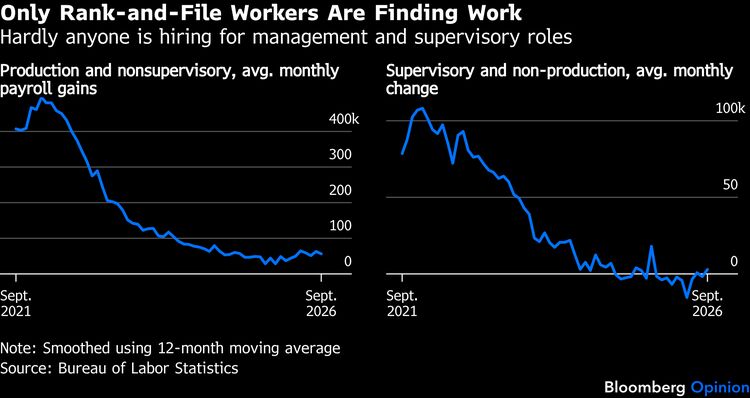
The dominance of lower-paying jobs is visible in other statistics, too. For instance, supervisory and non-production payrolls are essentially flat over the past couple years, and only rank-and-file production roles have been staffing up.
The upside is that layoffs aren’t increasing, and average weekly hours seem to be rebounding somewhat after a long decline from about 2021 through 2025. The labor market hasn’t demonstrably changed for the worse, but it’s failed to get better. Americans have been waiting for an inflection point for higher-paying jobs to come back, hiring to thaw, and worker bargaining power to return. And it hasn’t happened, the result being an ever-so-subtle erosion of the overall job quality among the 136 million private nonfarm jobs in America. (The Trump administration’s elimination of about 317,000 federal government jobs hasn’t helped matters, either.)
The shifting mix is one part of the reason why average hourly earnings growth is slowing, up just 3% year-over-year in an environment in which inflation was estimated to be running around 3.6% for the same period.
It’s no wonder that so many Americans are despondent. They want good jobs that help them keep up with the rising cost of cost living. Those are in short supply, and there’s little evidence that a turn is in the cards.
More From Bloomberg Opinion:
- Why Stocks Make Americans Rich But Not Happy : Allison Schrager
- Your 3% Mortgage Rate Is Crippling Housing Market : Justin Fox
- The US Is Badly Losing Its Trade War With China: Scott Lincicome
Want more Bloomberg Opinion? OPIN <GO>. Or subscribe to our daily newsletter .