
You know it’s a European debt crisis when it has an acronym. This time it’s not a group of countries in serious trouble, the famous PIIGS of Portugal, Ireland, Italy, Greece and Spain. Instead it’s France alone being singled out with FROGS, which stands for French Oversized Government and Social Security (blame Parisian research firm Rexecode for that one).
So will this be a short and excruciating shock for Emmanuel Macron’s government, similar to what the Brits suffered in the incapable hands of Liz Truss, or more the pain of a slow squeeze? For now, it looks like the latter.
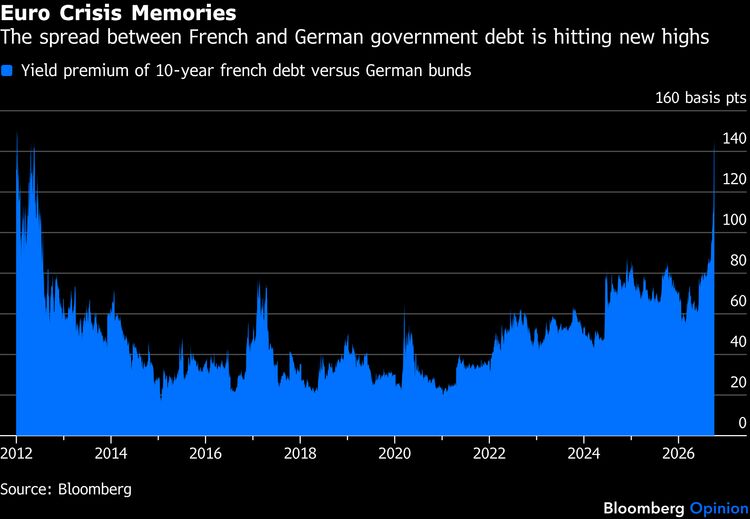
The risk premium on French sovereign bonds is at its highest in more than a decade, reflecting market fears both local and global. The country’s political class has lost its grip on the public finances, with a budget deficit of more than 5% and debt at almost 120% of gross domestic product. And the international backdrop doesn’t help. In America and elsewhere, investors are more and more unwilling to give overstretched governments the benefit of the doubt. And unlike the US, nominal GDP growth in France is shriveling, and taxes and spending are ahead of most of the rest of the rich world.
None of this is especially new, but worries about the rise of the far-right and far-left in the polls, alongside Macron’s inability to get his economic reforms to stick, leave France front-and-center in the government bond rout. Next year’s presidential election, when Marine Le Pen could well emerge as the winner, was meant to be the catalyst for a markets meltdown. But the economic costs to Europe of Donald Trump’s grand folly in the Strait of Hormuz, and wild spending on the AI boom, has made debt investors skittish about risk of all types. This has taken Paris by surprise.
Being a euro zone member is a helpful buffer. But previous talk of mutualized debt, where thriftier northern Europeans such as the Germans would backstop their neighbors, is off the menu. Spain’s Prime Minister Pedro Sanchez, meantime, has called a snap election, which just adds to the uncertainty in a continent facing several big national votes in the next year or so. The Spanish could end up with a coalition government formed by conservatives and the far-right.
Hence France’s freedom of maneuver to fix its structural issues on its own timetable is gone. It’s reduced to street fighting with the bond market, where capital is mobile and in some cases ready to exit a French economy that’s running to stand still.
Getting debt under control would require finding the equivalent of 5 percentage points of GDP through less spending and more taxing, which nobody in France is ready for. Meanwhile, French schools are burning, the most extreme reflection yet of what happens when you spend decades keeping pensioners in clover and don’t invest in the future. Intergenerational unfairness is becoming a defining issue across Europe.
And yet nobody in French politics is willing to roll out the honesty doctrine that’s badly needed. The far-left wants to cancel the country’s debt and tax the rich to lessen the pain on ordinary citizens, but that is fantasy land. On the other extreme, Le Pen has offered a constitutional golden rule to keep spending in check, but it’s a fig leaf to cover all of her own giveaways. The political center is inaudible right now.
To be clear, France is not Greece circa 2010. It has a large diversified economy, well-capitalized banks, first-rate universities and promising startups in artificial intelligence and defense. But when a country is caught in the market’s sights, it is very hard to shake it off. Britain’s Gilts have never really recovered from the Truss debacle, when she tried to fire off a cavalcade of unfunded tax cuts.
Some kind of message of action from Paris may bring temporary relief. The government could make a renewed push to secure a more credible budget. French financial institutions could support the nation’s debt. The European Central Bank could make helpful noises about intervening.
The latter is where things get politically awkward. While many investors still assume that the ECB’s bond-market cavalry will ride in should the situation become gnarly — as it did in the last decade’s sovereign-debt crisis — Europe’s fragmented populist landscape creates problems. Propping up French bond prices might help the country’s centrists fight back against the far-left and far-right. But any perception of bailing out a profligate member state might also create a populist backlash in Germany and elsewhere.
At the same time, if more frugal European partners force Paris to submit to tough remedies for fixing the economy, who will be the presidential candidate to deliver the bitter medicine? ECB head Christine Lagarde, ironically enough, might have the benefit of being above the political fray. She has, however, said running would “not be a good idea” — a fair response given the popularity of technocrats these days.
Whether or not she feels she could lead her country through crisis, she might at least encourage the ECB to be less vocal about the need for interest rate hikes and shrinking its balance sheet. That is only helping the populists.
For now, we are not on the cusp of a PIIGS redux. France is “too big to bail,” as one economist wrote recently, reflecting its inherent strengths as a top-tier economy. The UK’s borrowing costs are pretty scary looking, too, without the government being held entirely to blame (yet).
This does not mean that a FROGS crisis as it currently stands — a drawn-out chipping away at the debt edifice that struggles to attract any voter support — will be a “good” one. It will be bad for the economy and for the generation of children watching their schools ablaze. Room for error is disappearing. This is the moment for real leadership, not acronyms.