By Rosa Prince | Updated on Oct 06, 2026 at 08:00 AM
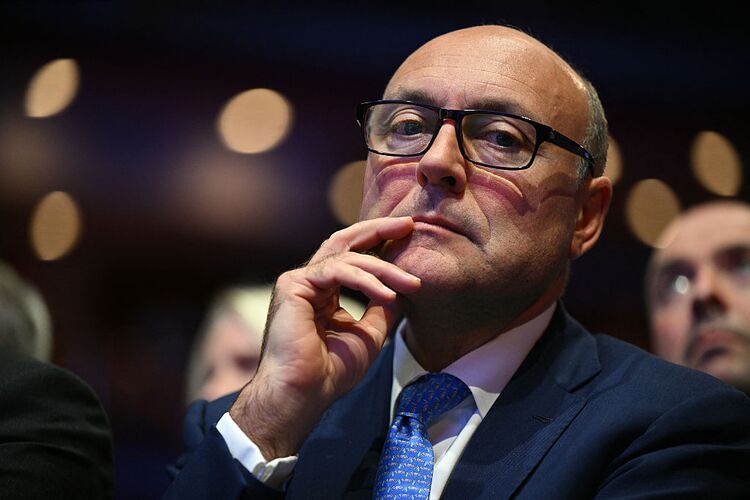
If Andrew Griffith wanted to write a guide on how not to run an economy, he has lots of examples from his fairly short stint in British politics. His first Westminster job in 2019 was for then Prime Minister Boris Johnson, the man who secured the financially ruinous Brexit and who reportedly once uttered, “ F**k business .” Three years later Griffith served at the Treasury during the mercifully short premiership of Liz Truss, who destroyed the country’s credibility with the bond markets.
Yet perhaps it’s fairer to think of these experiences as politically “formative” rather than disqualifying. Kemi Badenoch, leader of the Conservative opposition certainly thinks so, turning to the 55-year-old as her shadow chancellor of the exchequer to sharpen her economic attacks on new Labour PM Andy Burnham.
And why not? Griffith had a substantial business career before politics, helping build Sky into a globally successful media company and accruing a personal fortune along the way. This is a marked difference from a Labour frontbench made up of political lifers who largely reckon the state knows best on how to kickstart growth.
At this week’s Tory conference, Griffith let loose a volley of policies aimed at framing the next election as a battle between two visions for Britain: a low-tax, small state under Badenoch’s Tories versus Burnham’s redistributive, social safety net. A dip in the polls for Nigel Farage’s anti-migrant Reform UK has rekindled hopes of the return of a more mainstream left-right politics in Britain. The Conservatives believe a traditional pro-enterprise platform may make them the dominant force on the right again.
Griffith used his Monday address to the Tory faithful to pledge a “simpler and fairer” tax regime, including an “ambition” to end the 60% marginal tax rate on those earning between £100,000 ($132,000) and £ 125,000. “This will be my personal North Star,” he said. He also announced “a bonfire of regulation,” including scrapping environmental quangos and boosting housebuilders by loosening planning rules. Other avowedly pro-growth plans included fast-tracking a third runway at Heathrow Airport, a project Burnham has been reticent on, eliminating net-zero emissions targets and cutting civil servants.
According to party insiders, Griffith’s task is to present a serious economic plan that frames the Tories as the “only sensible game in town.” Restoring trust is no small thing given the Truss and Johnson debacles, but the most recent Conservative government of Rishi Sunak and Chancellor Jeremy Hunt shows they can still do adult politics at a push.
And at a moment when the global rout in bond prices and soaring energy costs are bearing down on the British economy, there’s room for an argument with Burnham’s 1970s-style statism. What Griffith needs now is to raise his profile to make the Tories less of a one-woman show, with Badenoch’s personal ratings higher than her party’s, and public recognition of her top team low.
Griffith has work to do on this front. “I’m very shy online,” he has said. And despite the Sky years, he looks unrelaxed on TV, like others who’ve jumped from corporate corridors to the knockabout theater of high politics.
Badenoch promoted him after being impressed by his punchy attacks on Labour as shadow business secretary. He’s known to party colleagues as hardworking and sharp, and not particularly affable. One person who’s known him for a decade wonders whether he’s just shy in the real world, as he is on the internet. He’s not jolly but he’s quite likeable, that colleague says.
Balding and nattily dressed, Griffith bears an almost comic resemblance to the man he now shadows, Chancellor John Healey. And for all his wealth, he’s no old-school patrician Tory. He grew up in London’s suburbia. His father, who died of Covid during the pandemic, worked in IT, his mother was a homemaker. As he proudly told the conference, his first job was making hot cross buns in the local Tesco. After attending a state school (known as public school in the US), he was the first in his family to go to university.
On graduating he was torn between law, politics and business. Deciding legal training was too expensive, he ended up in accountancy at Coopers & Lybrand Deloitte . Not unreasonably, he liked business more than auditing. He joined Rothschild Bank, working as a financial analyst on BT, Pearson, ITN and other UK Plc stalwarts. He hopped over to Sky when it was still effectively a startup and by 2008 he was its chief financial officer, becoming operating chief in 2016.
When Sky was sold to Comcast in 2018, Griffith made about £17 million from selling his his shares. As a non-executive director of take-out delivery firm Just Eat, he won plaudits for keeping things together when its chairman and chief executive officer both stepped down suddenly.
Johnson’s allies first approached him when they wanted to broaden the wannabe prime minister’s corporate contacts. After Theresa May quit as PM in 2019, Griffith lent Johnson his Westminster townhouse as a base for his winning leadership bid. He joined him in No. 10 as chief business adviser.
Five months later, as Johnson called an election to break the impasse over Brexit, Griffith was elected member of Parliament for the bucolic West Sussex constituency of Arundel and South Downs, where he lives with his wife Barbara, a volunteer charity worker, and two children.
When Johnson fell because of a series of scandals, Griffith backed Truss to replace him. His reward was a junior role in the Treasury, where the new prime minister and her Chancellor Kwasi Kwarteng cooked up their infamous “minibudget,” a raft of unfunded tax cuts that panicked the markets. Griffith’s defense of their project has come back to haunt him. These days he concedes it was a disaster, though his involvement may rebound on him as he accuses Labour of not making their numbers add up.
Few within his party, however, hold him responsible for the Truss calamity. He remained at the Treasury during the Sunak years, working alongside Hunt. After the Tories were trounced in the 2024 election, Griffith was an early Badenoch backer. Like her, Griffith’s friends say he’s a classic Thatcherite, a firm believer in sound money. It was a disappointing surprise, therefore, that they’re opposing Burnham’s bold move on reforming state pensions, reluctant to cede ground to pensioner-embracing Farage.
As the appeal of the hard-left Greens and the hard-right Reform fades, and immigration falls, the Tories hope that a renewed focus on economic husbandry will be to their benefit. There’s a sense they’re not out of the game, an ally of Griffith tells me.
They can expect plenty more insults about Truss as the battle with Burnham intensifies. But Badenoch’s front bench has a fair attack line of its own: Griffith’s corporate decades possibly give him more business experience than the entire Labour cabinet. An associate says the public probably won’t remember he was part of Truss’s team. The question is: Will they remember anything else about him?